

How to Start a Window Cleaning Business
Window cleaning is one of the lowest-barrier service businesses you can start. The equipment is affordable, the demand is present in almost every neighborhood, and clients who experience genuinely clean windows often want them maintained on a regular schedule. The before and after sells itself.
29+ people found this guide helpful

Why Window Cleaning Works as a Business
Almost every building has windows. Many building owners would prefer not to clean them themselves, and a good portion of those haven't found someone reliable to hand it to.
What makes window cleaning particularly good as a recurring business is how quickly glass gets dirty again. Interior glass accumulates dust, fingerprints, condensation marks, and pet prints. Exterior glass gets hit by weather, pollen, bird marks, and pollution. A client who experiences genuinely clean glass once tends to want it maintained. That turns a first job into a quarterly subscription without much work on your part.
The commercial side is worth understanding from the start. Shopfronts, offices, restaurants, and retail spaces need their glass cleaned regularly, and many are willing to pay for a reliable operator on a fixed schedule. A mix of residential and commercial clients gives you recurring income that holds up even when one segment slows down.
The startup cost is low compared to most outdoor service businesses. No trailer, no large-scale equipment. A quality squeegee kit, a water-fed pole system for multi-story work, and a reliable vehicle is most of what you need to get started.
Is This the Right Business for You?
Window cleaning is physical outdoor work. You'll be on your feet, working through a range of weather conditions, sometimes on a ladder or extended pole. If that's manageable, it's worth pursuing.
Attention to detail matters. Streaks, missed corners, and smeared frames are the things clients notice. The operators who build strong reputations in this category are the ones who take the finish seriously, not just the speed.
The business side is relatively straightforward once you have a system. A route of regular clients on a defined schedule is a predictable working week. You know where you're going, what you're doing, and roughly what you're earning before you leave the house.
If working outdoors, delivering a visible result, and building a client base that comes back on a schedule appeals to you, this is worth taking seriously.
Surfaces, Glass Types, and Techniques
Window cleaning looks simple. Some of the technique is. But glass comes in a wide variety of types, and not all of them respond the same way to the same approach. Understanding this before you start work on a paying client's property matters.
Standard annealed glass. The most common residential glass. Handles squeegee technique and water-fed pole cleaning well.
Tempered and safety glass. More scratch-resistant than annealed glass. Common in shower enclosures, sliding doors, and commercial storefronts.
Tinted and Low-E coated glass. Found on newer homes and commercial buildings for energy efficiency. Requires care with chemicals. Some cleaning solutions interact with coatings and cause damage. Always check before applying anything beyond pure water and a mild neutral detergent.
Screen cleaning. Screens trap dust, pollen, and insects and reduce light even when the glass itself is clean. Removing, washing, and reinstalling screens is a distinct service that adds meaningful value and revenue per visit.
Tracks and frames. Glass door tracks pack with dirt, debris, and dead insects over time. Frames accumulate mold and mildew in their seals. These are often overlooked by homeowners and represent a genuine upsell opportunity for a thorough operator.
Squeegee technique. The foundation of a streak-free result. Angle, pressure, and the fan or straight pull technique each have their application. Worth practicing until consistent results come naturally before working on paying clients.
Water-fed pole systems. Pure water fed through a pole with a brush head. Good for multi-story exterior work from the ground without a ladder. When the water is sufficiently purified and technique is correct, it typically dries with minimal spotting on most glass types. Worth investing in early if multi-story residential work is part of your plan.
There are active Facebook groups and YouTube channels run by professional window cleaners who share technique openly. Spend time there before your first job on a property type you haven't worked on before.
Safety: Working at Height
Window cleaning at height is where the job becomes genuinely dangerous if approached carelessly. Falls from ladders are among the most common causes of serious injury in the trades. Being methodical about this from day one is not optional.
Ladders. Use a fiberglass or aluminum extension ladder rated for commercial use. Inspect before every use. Set the base at the correct 4-to-1 angle. Never lean sideways off a ladder. Never use a damaged ladder. These rules are basic and frequently ignored. Don't be the person who finds out why they matter the hard way.
Water-fed pole systems. For two-story and some three-story work, a water-fed pole from the ground is safer than a ladder and produces good results on most exterior glass. Worth the investment for any operator planning to take on multi-story residential work regularly.
Never take on specialist high-rise or rope-access work without proper certification. Multi-story commercial buildings require certified rope-access technicians or elevated work platform equipment. This is a specialist service category that requires specific training and equipment. Stay within your competency until you've built toward it properly.
Wet surfaces and slips. Water on walkways, driveways, and decking creates slip hazards for you and for the client's household. Non-slip footwear is non-negotiable. Communicate to clients when you're working near areas people walk through.
Research and Plan Before You Start
A one-page plan before you spend anything is worth the time.
Where will you operate? Define your starting area. A tight radius keeps travel time low and your effective rate higher. Established residential neighborhoods with a mix of single and two-story homes are the natural starting point. Denser commercial areas are worth noting for shopfront and office work once you have the residential base established.
Who are you targeting? Residential homeowners, property managers, shopfront owners, restaurants, offices? Each has different needs, different pricing expectations, and different ways of finding you. Start with one. Residential is the most accessible entry point for most new operators.
What does the local market look like? Search for window cleaning businesses in your area. Look at how they present, what they charge, and what services they lead with. If established operators exist, that confirms demand. Understand where there's room for you and what you'd offer differently, whether that's better reliability, broader screen and frame services, or commercial coverage they don't have.
Is the area sustainable? Neighborhoods with higher-value homes, larger windows, and owner-occupancy tend to be the strongest residential market. Commercial strips and office parks are worth mapping for the longer term.
Startup Costs: What to Expect
Window cleaning has one of the lower startup costs of any outdoor service business. Here's a realistic breakdown:
- Business registration (LLC or DBA filing) — $50 to $200 depending on your state
- EIN from the IRS — Free
- General liability insurance — $500 to $1,000 per year
- Professional squeegee set (multiple sizes) — $100 to $250
- T-bar applicators and sleeves — $75 to $150
- Bucket, scrubber, and cleaning solution — $50 to $100
- Extension pole (for interior and low exterior) — $75 to $200
- Water-fed pole system with pure water tank — $400 to $1,500 depending on reach and setup
- Ladder (fiberglass extension, commercial grade) — $200 to $500
- Microfiber cloths and detailing supplies — $50 to $100
- Non-slip boots and safety gear — $75 to $150
- Vehicle signage — $200 to $500
- Branded clothing — $75 to $150
- Door hangers and flyers — $100 to $200
- Domain name (.com) — $15 to $20 per year
- Platform or payment system — $18 to $39 per month
- Logo and basic branding — $0 if you use AI tools, $150 to $400 if you use a designer
A realistic all-in starting figure is $1,500 to $3,500, not including your vehicle. One of the more accessible starting points in service businesses. Start with the basics and invest in a better water-fed pole system once the income supports it.
Your Brand
Window cleaning is a visible business. Your vehicle on the street, your ladder against a house, your shirt on a doorstep. Every job in a neighborhood is a passive advertisement to every neighbor who walks or drives past. A professional brand signals that this is a real business worth trusting with access to someone's home.
Before you settle on a name, run the standard checks:
State business name register. Your state's Secretary of State website. If it's taken, move on.
Federal trade marks. A quick check at USPTO.gov before you invest in signage and uniforms.
Domain availability. A .com. Check it before you commit to the name.
Social handles. Instagram and Facebook at the same time. When the name, domain, and handles all align, register everything and move on.
On logos:
Create a professional logo for [Business Name], a window cleaning business. Clean and trustworthy. Use [color preference]. It needs to work on a vehicle door, a work shirt, and a door hanger. Provide 3 or 4 variations.
When you're ready to go further:
Create a brand guide for [Business Name], a residential and commercial window cleaning business. Include a primary color palette with hex codes, a secondary palette, font recommendations for headings and body text, logo usage rules, and how the brand should appear on vehicle signage, uniforms, door hangers, and social media.
Insurance and Business Setup
We're not lawyers or insurance brokers. Get specific advice for your situation. Here's what's worth sorting out before your first job.
General liability insurance. You're working at clients' properties, often at height, with water near glass and electrical components. A broken window, a slip on a wet pathway, or damage to a frame or sill. General liability insurance covers you when things go wrong. Get it before you start. Plan for $500 to $1,000 per year for a solo operator.
Business structure. Talk to a free SCORE mentor or your local Small Business Development Center before you decide on sole proprietor versus LLC. Window cleaning involves working at height and at client properties. The liability conversation is worth having before you take your first job, not after something goes wrong.
Commercial clients. Some commercial clients, particularly property managers and larger businesses, will ask for a certificate of insurance before they hire you. Having your proof of coverage ready removes a common barrier to commercial work.
Vehicle insurance. Confirm your vehicle policy covers commercial use if you're using a personal vehicle. Carrying ladders and equipment regularly on a personal vehicle policy may not be covered depending on your insurer.
Working at height. Understanding safe ladder practices before you work at any height on a client's property is simply good sense. The basics are well documented and worth reading through before your first multi-story job.
Define Your Services and Pricing
The goal is a clear, fixed-price menu for standard jobs that clients can choose from without back and forth. Residential window cleaning is well-suited to this. Pricing by home size and story count covers the majority of standard jobs and lets clients sign up directly. That said, some properties genuinely need a look first: unusual window counts, difficult access, heavily soiled glass, or complex custom glazing. Build your menu around the 80 to 90 percent of jobs that fit the standard tiers, and have a simple way to handle the rest via a custom price or a quick photo request.
Residential exterior services. The most common starting point:
- Express Exterior Clean. Exterior glass only, no screens or frames. A quick maintenance pass to keep windows looking sharp between deeper cleans. Monthly. Priced by home size: single story, two story, large two story.
- Exterior Window Cleaning. All exterior glass cleaned, frames wiped down. Quarterly. Priced by home size. Your most common residential recurring service.
- Interior Window Cleaning. Interior glass only, frames wiped, sills dusted. Quarterly. Priced by bedroom count: 1-2 bedroom, 3-4 bedroom, 5+ bedroom. The half of the job most homeowners forget.
- Interior and Exterior Window Cleaning. Both sides in a single visit. Maximum natural light. Quarterly. Priced by home size: single story, two story, large two story.
- Windows and Screens. Interior and exterior glass plus screens removed, washed, and reinstalled. Quarterly. Priced by home size. Significantly more valuable per visit than glass-only services.
Residential deep clean services. Higher value, less frequent:
- Window Frame and Sill Deep Clean. Detailed clean of all frames, sills, and reveals inside and out. Glass and screens included. Mold and mildew treatment where needed. Twice a year. Priced by bedroom count. Often a first-time purchase that converts to regular maintenance.
- Glass Doors and Tracks. Both sides of all glass door panels cleaned, tracks vacuumed and scrubbed, frames and seals wiped. Quarterly. Priced by number of doors: 1-2 doors, 3-4 doors, 5+ or bi-fold/stacker system. One of the most neglected surfaces in a home and a strong upsell to any window clean.
- Whole Home Glass Package. A comprehensive single-visit service covering all glass on the property. Standard tier covers windows, screens, frames, sills, and glass doors. Premium tiers add glass balustrades, frameless shower screens, and pool fencing where applicable. Twice a year. The highest-value residential service you can offer.
Commercial services. Reliable, recurring, and higher value per visit:
- Shopfront Window Cleaning. Interior and exterior storefront glass, entrance door glass and frames. Weekly or monthly depending on the client. Priced by number of fronts: single shopfront, 2-3 shopfronts, 4+ or arcade tenancy. Scheduled before opening or after close to avoid disruption.
- Office Window Cleaning. Interior and exterior glass, frames wiped. Monthly or quarterly. Priced by office size: small (up to 10 windows), medium (10-25 windows), large (25+). Scheduled outside business hours or during low-traffic periods.
- High-Rise and Multi-Story Commercial. Specialist work requiring certified equipment and access methods. If this is eventually part of your offering, treat it as a separate category requiring specific investment and certification. Don't take it on until you're properly equipped and trained for it.
On pricing: look at what established window cleaners in your area charge and understand your real cost per job including travel, time, and any specialist access equipment. Price in the middle of your local market, not at the bottom. For commercial clients and non-standard properties, a private subscription invite with a custom price keeps things clean without cluttering your public page.
This is what ServiceSubscriber does.
A page, payments, and delivery tracking. Live in 20 minutes.
14-day free trial. No credit card.

Equipment
Window cleaning is one of the more equipment-friendly service businesses to start. The core kit is compact, relatively affordable, and fits in a standard vehicle without a trailer.
- Squeegees. Multiple sizes cover different window dimensions efficiently. A 6-inch for small panes and frames, a 12 or 14-inch for standard windows, an 18 or 22-inch for large commercial glass. Quality channels and rubber make a real difference in the finish. Buy professional grade from the start.
- T-bar applicators and sleeves. Apply cleaning solution evenly before squeegeeing. Match widths to your squeegees.
- Bucket and cleaning solution. A good window cleaning soap at the correct dilution. Dish soap is a common alternative but leaves residue. Professional window cleaning solutions are inexpensive and worth using.
- Extension pole. For interior ceilings and exterior ground-floor work without a ladder. Telescoping poles in multiple lengths are worth having.
- Water-fed pole system with pure water. A brush-head pole fed with purified water via a tank or on-site connection. Good for two-story and some three-story exterior work from the ground. When water purity and technique are right, it typically dries with minimal spotting on most glass. A meaningful investment that removes ladders from most multi-story residential work and improves both safety and efficiency.
- Extension ladder (commercial grade fiberglass). For situations where a water-fed pole isn't practical. Inspect before every use. Never substitute a consumer-grade ladder.
- Detail cloths and scraper. For edges, stubborn spots, and paint or tape residue. A sharp scraper used carefully on tempered glass for paint removal. Use with caution and only when needed.
- Non-slip work boots. On wet surfaces at height, footwear matters. Non-negotiable.
- Screen cleaning brush and tub. For washing screens when that service is included.
As with the pressure washing category, the professional window cleaning communities on Facebook and YouTube are worth spending time in before you make any significant equipment purchases. Operators who've been using gear in real conditions are the best source of what actually holds up.
Getting Your First Clients
Window cleaning clients are everywhere. The challenge is getting in front of them when the problem is on their mind.
Door hangers in target neighborhoods. Simple design. What you do, what you charge, a QR code to your page. Drop 300 in your target streets. Timing matters: spring and fall are when homeowners think about their property the most. A door hanger on a street where the windows are visibly dirty is the most relevant advertisement you can run.
Yard signs at every job. A sign in the yard while you're working is a passive advertisement to every neighbor who passes. Ask clients if they're comfortable with it. Most will say yes. HOA neighborhoods may have restrictions on signage, so check before putting one up in a managed community.
Nextdoor. Introduce yourself in your local area. Be specific about what you offer and what you charge. Ask satisfied clients to post a recommendation. Window cleaning is one of the service categories where Nextdoor referrals tend to convert well because the visual result is easy for neighbors to notice and mention.
Local Facebook groups. Introduce yourself at the start of spring and fall cleaning season. Post before and after photos when clients allow it. The contrast of genuinely clean glass is striking and gets shared.
Direct approach to commercial clients. Walk into local shops, restaurants, and offices that have visibly dirty glass. Introduce yourself, explain what you do, and leave a card with your pricing. Many small business owners have been meaning to sort this out for months. A direct introduction at the right moment closes more of these than any advertisement.
Property managers. Rental properties with regular turnover are a consistent source of window cleaning work. A professional introduction with fixed pricing to property management offices can open up reliable contracts.
Google Business Profile. Free at business.google.com. Fill it out completely. Ask your first clients for a review. A verified listing with reviews puts you in front of people searching for window cleaning in your area.
Ask for referrals. After a job, ask directly. A client with visibly clean windows is perfectly placed to mention you to a neighbor who notices.
Give Customers a Way to Sign Up
When someone scans your QR code from a door hanger or finds you through Nextdoor, they should land somewhere that shows what you offer, what you charge, and lets them sign up without having to call you or wait for a response.
The easier you make it to become a regular client, the more likely a first inquiry turns into a quarterly subscription rather than a one-off job that doesn't repeat.
Here's an example of what that looks like in practice:
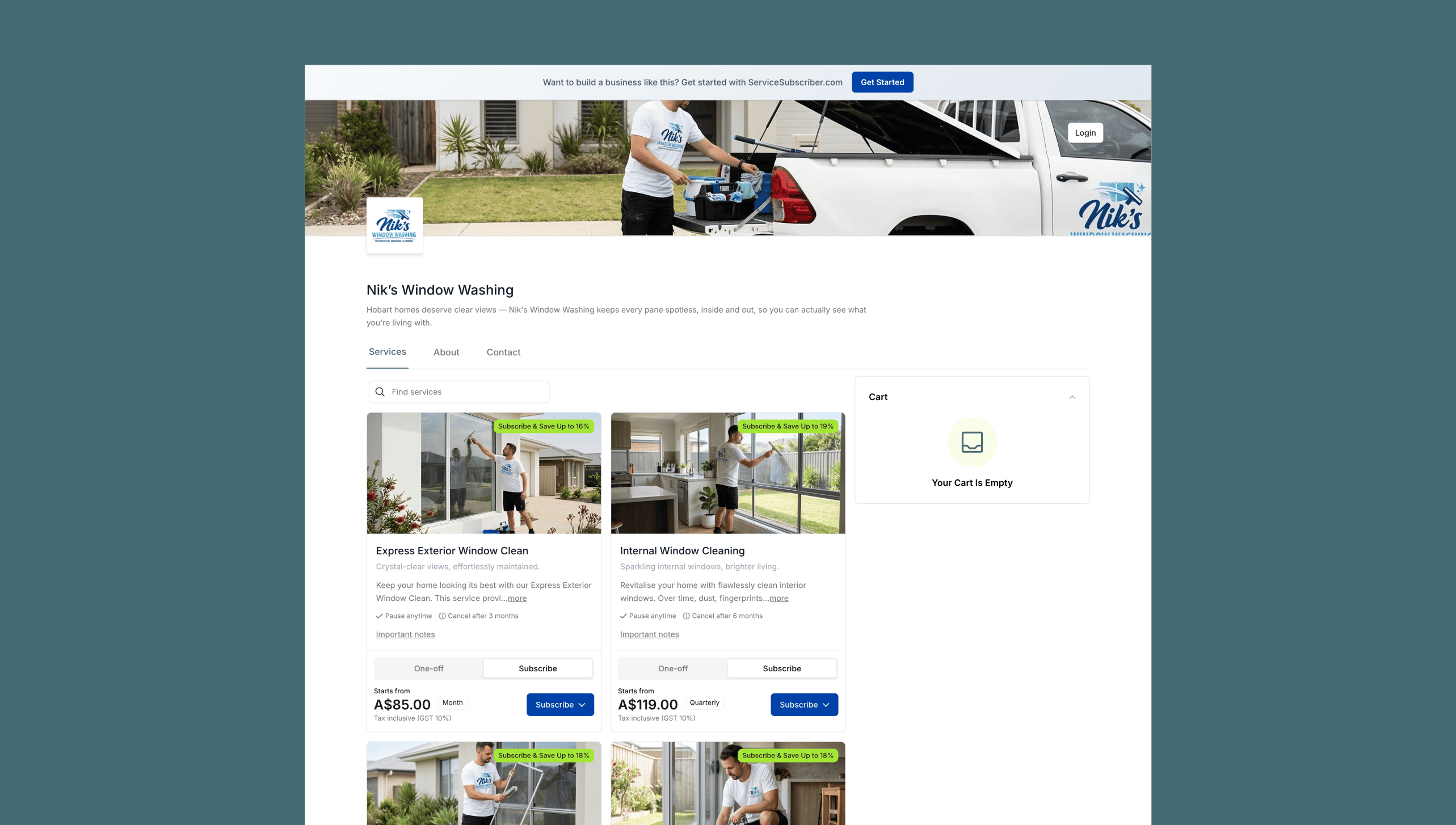
Services and pricing upfront. Clients choose their service and sign up directly. Payment handled at checkout. For commercial clients or non-standard properties, a private subscription invite with a custom price keeps the arrangement clean without cluttering your public page.
Make the First Job Count
The result of a window clean is visible to the client and to every neighbor who looks at the house. Both work in your favor if the job is done well.
No streaks. This sounds obvious and it's what separates a professional from someone who just had a squeegee. A streak-free result on every pane is the baseline. If you're leaving streaks, practice more before you take on paying clients.
Leave the frames and sills clean. Running water down the glass and ignoring the frames and sills signals that you only did half the job. Wipe everything down. It takes a few extra minutes and makes a visible difference to the overall result.
Leave the surroundings as you found them. Drips on decking, water marks on painted sills, ladder marks in garden beds. These are the complaints that cost you a client. Be methodical about what you leave behind.
Point out what you noticed. A cracked seal, a frame with significant mold buildup, a screen that's starting to come away from its frame. Mentioning it briefly is not a sales pitch. It's evidence that you were paying attention. Clients remember this and mention it when they refer you.
Ask before you leave. Is there anything you'd like done differently next time? A simple question that gets you information before a preference becomes a reason to try someone else.
Getting Paid Consistently
Window cleaning is well-suited to a regular scheduled service model. Residential clients on a quarterly exterior clean, monthly express maintenance, or an annual whole-home glass package all represent predictable, repeating income if set up on automatic billing from the start.
The alternative is invoicing after each visit and hoping clients reach out next time. It's time-consuming and creates income that's uneven week to week. A client who has to remember to call you again is a client who might not.
Set up recurring scheduled payments as your default from the first sign-up. A client who commits to quarterly exterior cleaning and pays automatically each quarter is worth considerably more over two or three years than the same client on a one-off arrangement. Building that base is how window cleaning businesses grow from a handful of jobs into a genuinely stable income.
Commercial clients on a fixed weekly or monthly schedule are some of the most valuable recurring relationships you can build. Once established, they tend to run with minimal management and provide a reliable foundation that the residential work adds onto.
Putting It Together
Window cleaning is a business where the result is visible from the street, where almost every property is a prospect, and where clients who experience the difference tend to want it maintained. The startup cost is genuinely low. The technique is learnable. The path from first client to a reliable route of regular subscribers is shorter than most people think.
Get the technique right before you work on paying clients. Invest in a water-fed pole system early if multi-story work is part of your plan. Take the safety side of ladder work seriously from the start. Brand before you prospect. Get your page live before you drop your first door hanger. Make the first job look as good as you can make it. Ask for the regular service before you leave.
That's the starting point. The rest builds from showing up consistently and doing work people are glad they paid for.
Ready to start your window cleaning business?
Create your service page, share the link, and start building your client base. Customers sign up for the service they need, pay at checkout, and you show up on schedule.
14-day free trial. No credit card. 50% off first 3 months.
Did you find this guide helpful?
More guides
Explore other service businesses you can start

How to Start a Service Business
The complete starting point for any service business.
Read guide
How to Start a Cleaning Business
Same residential client base, natural combination service.
Read guide
How to Start a Pressure Washing Business
Outdoor work in the same neighborhoods with complementary demand.
Read guide