How to Start a Bin Cleaning Business in Australia
Bin cleaning is not a new idea, but it's having a moment. Awareness is growing, the demand is obvious once you think about it, and the recurring nature of the work makes it one of the cleaner business models you can start. The wheelie bin that gets emptied every week fills right back up, and without regular cleaning, it gets unpleasant fast.
24+ people found this guide helpful

Why Bin Cleaning Works as a Business
Australia's climate does a lot of the selling for you. In Queensland, the Northern Territory, and large parts of Western Australia, summer temperatures turn an uncleaned general waste bin into something genuinely unpleasant within a week. Bacteria, maggots, smell. In cooler states the problem is less acute but it's still there, building slowly over months of use.
Most households have two or three wheelie bins. General waste, recycling, and green organics depending on the council. The general waste bin gets emptied weekly and is the one that gets dirty fastest. The others less so, but they still accumulate grime over time. Every one of those bins, on every residential street you drive through, is a prospecting opportunity.
What makes this business particularly compelling is how naturally the work recurs. A cleaned bin gets used again immediately. A weekly general waste subscriber gives you a return visit every single week without you having to do anything to earn it. The subscription isn't a nice-to-have addition to the business model. It's the entire foundation of it.
We've seen this category grow considerably in recent years, particularly in warmer states. The operators who got in early and built dense residential routes are doing well. There's still plenty of room in most areas.
Is This the Right Business for You?
Bin cleaning is physical, outdoor work. You'll be handling dirty bins, operating high-pressure equipment, and working through suburban streets in all kinds of weather. If that sounds manageable rather than off-putting, it's worth pursuing.
The work itself is repetitive and routine once you have a system. That's actually a feature of the business rather than a drawback. A tight route of subscribers on a regular schedule is a predictable day. You know what you're doing, where you're going, and what you're earning before you leave the house.
The business side requires attention particularly as you grow. Route optimisation, scheduling, and making sure your subscriber base stays dense enough geographically to keep drive time between jobs low. None of that is complicated, but it rewards operators who think about it rather than those who don't.
If you want a business that runs on a routine, builds predictably, and doesn't require you to be selling yourself constantly, this is a genuinely good fit.
Research and Plan Before You Start
A one-page execution summary before you spend anything is worth the time.
Where will you operate? Define your starting area tightly. A dense cluster of residential streets is the ideal starting point. The closer your subscribers are to each other, the less time you spend driving between jobs and the more bins you can clean in a day. Route density is what turns a decent day rate into a great one.
What bin types will you service? Most Australian councils issue 240-litre wheelie bins for general waste and recycling, and 120-litre or 240-litre bins for green organics. Some areas also have 140-litre bins. Know what's common in your area before you set your services and pricing.
What does the local market look like? Search for bin cleaning operators in your target area. If there are established operators, that confirms demand. Understand how they present and what they charge. If there are no operators yet, that's either a genuine gap or an indication that uptake has been slow. A few conversations with locals or a quick post in a community Facebook group will tell you which it is.
Who else can you serve? Residential streets are the starting point. Strata-managed apartment complexes and townhouse developments have shared bins that often get cleaned less than they should and represent a higher-value contract per visit. Cafes, restaurants, and commercial premises have bins that get extremely dirty extremely quickly and have both a hygiene interest and in many cases a regulatory obligation to maintain clean waste facilities. Both are worth understanding even if you start residential.
The Subscription Model in Bin Cleaning
Bin cleaning might be the most natural subscription service there is. The bin gets emptied. It gets dirty again. You clean it. Repeat.
The general waste bin is the obvious weekly or fortnightly subscriber service. It's the one that fills fastest and gets dirtiest fastest. A homeowner who subscribes to a weekly clean after each emptying never has to think about it. The bin is cleaned on a routine. They pay automatically. You show up, do the work, mark it done.
Recycling and green organics bins don't need cleaning as frequently. A monthly or quarterly clean suits most clients for those. Worth offering as an add-on to a general waste subscription rather than a standalone service.
The sticker approach is worth knowing about. Some operators leave a small sticker on the bin lid after each clean showing the date of the last service and when the next one is due. It's a simple visible reminder to the client that the service is happening and when to expect you next. It also makes it easy for a neighbour who notices it to ask about it.
This is one of the few businesses where the entire customer experience after the first sign-up is essentially automated. Client subscribes, payment processes, you show up on schedule, clean the bin, mark it done. No back and forth. No reminders. No invoicing. That simplicity is a genuine advantage and worth building around from the start.
Startup Costs and Equipment Options
This is where bin cleaning has more range than most service businesses. The professional end of the market uses purpose-built trailer systems specifically designed for bin cleaning. The accessible end uses a pressure washer setup on the back of a ute or van. Both can run a legitimate business. The right choice depends on your starting budget and your ambition for scale.
Purpose-built bin cleaning trailers. Companies like Sprintjett manufacture trailers specifically designed for the job. A complete professional setup runs around $34,000 or more. These systems are built for efficiency at scale, with dedicated bin-tipping mechanisms, hot water systems, and wastewater containment. If you're planning to build a large route quickly and want to project professionalism from day one, this is what the established operators use. It's a significant upfront investment, but it's designed for the work.
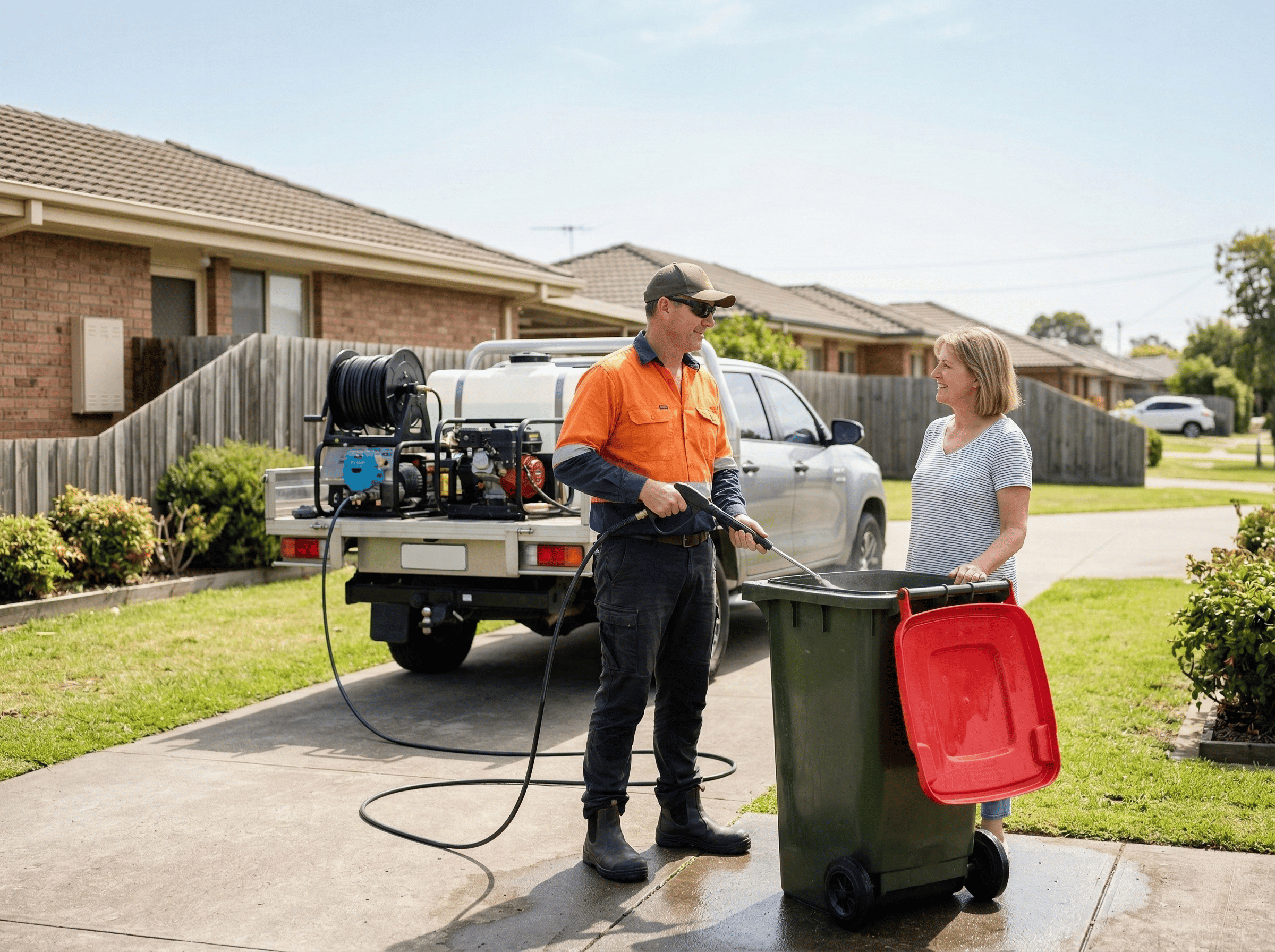
Pressure washer setup on a ute or van. A far more accessible starting point. A quality petrol or diesel pressure washer, a water tank, and a suitable vehicle. You clean the bins manually with the pressure washer rather than through an automated tipping system. It takes longer per bin than a purpose-built trailer, but it works, it's affordable to start, and it lets you build a subscriber base before committing to a larger investment.
Here's a realistic breakdown for a pressure washer-based starting setup:
- ABN registration — Free
- Business name registration (ASIC) — Around $42 for one year, $98 for three years
- Domain name (.com.au or .au) — $20 to $50 per year
- Public liability insurance — $600 to $1,200 per year
- Petrol or diesel pressure washer — $800 to $2,500
- Water tank (200 to 400 litre) — $300 to $700
- Tank pump and fittings — $150 to $400
- Cleaning chemicals and deodoriser — $100 to $250
- Wastewater containment mat or tray — $100 to $300
- Protective gear (gloves, apron, boots, eye protection) — $100 to $200
- Bin stickers for next service reminders — $50 to $100
- Branded clothing — $100 to $200
- Vehicle signage — $200 to $600
- Flyers and door hangers — $100 to $200
- Platform or payment system — $18 to $39 per month
- Logo and basic branding — $0 if you use AI tools, $200 to $500 if you use a designer
A realistic all-in starting figure for a pressure washer setup is $3,000 to $6,000, not including your vehicle. Start here, build your route, and let the upgrade to a professional trailer system be funded by the business once it's generating consistent income.
Your Brand
Bin cleaning is a visible business. Your vehicle is in residential streets during the day, your branding is on the equipment, and the sticker you leave on cleaned bins is a tiny advertisement that neighbours see every time they put their bins out. A professional, consistent brand works harder for you here than in some other service businesses.
Before you settle on a name, run it through the standard checks:
ASIC business name register. Search at business.gov.au. If it's taken, move on.
Trade marks. A registered business name doesn't protect you from trade mark claims. A quick check at ipaustralia.gov.au before you invest in signage is worth doing.
Domain availability. A .com.au or .au extension. Check it before you commit to the name.
Social handles. Check Instagram and Facebook at the same time. When the name, domain, and handles all align, register everything and move on.
On logos, a good prompt in ChatGPT or Claude gets you somewhere useful quickly:
Create a professional logo for [Business Name], a residential bin cleaning business in Australia. Keep it clean and bold. Use [colour preference]. It needs to work on a vehicle door, a work shirt, and a small bin sticker. Provide 3 or 4 variations.
When you're ready to go further:
Create a brand guide for [Business Name], a residential bin cleaning business in Australia. Include a primary colour palette with hex codes, a secondary palette, font recommendations for headings and body text, logo usage rules, and how the brand should appear on vehicle signage, uniforms, flyers, and social media.
Insurance, Licences, and Permits
We're not lawyers or insurance brokers. Get specific advice for your situation. Here's what's worth sorting out before you start.
Public liability insurance. You're operating pressure washing equipment on or near residential and commercial properties. Wastewater runoff, damage to driveways or garden areas, slip hazards. Public liability insurance covers you when something goes wrong. Get it before your first job.
Wastewater disposal. This is worth understanding before you start. The water that comes off a bin clean contains bacteria, food waste residue, and cleaning chemicals. In most residential settings, operators allow this to drain into the kerb and stormwater, but local council rules on this vary. Some councils have specific requirements around wastewater containment or disposal. A wastewater containment mat or tray that lets you contain and dispose of the water more responsibly is a straightforward solution and worth having in your setup regardless of what's required in your area.
Vehicle and equipment insurance. Your pressure washer and water tank represent a meaningful investment. Make sure your vehicle policy covers commercial use and that your equipment is covered.
Commercial premises. If you move into cleaning bins for cafes, restaurants, or other food businesses, there may be specific hygiene requirements relevant to the waste handling equipment on those premises. Worth understanding before you take on that kind of work.
Define Your Services and Pricing
The goal is to productise your services into clear, fixed-price options that clients can subscribe to directly from your page. Bin cleaning structures naturally for this. The variables are the bin type, the bin size, and the cleaning frequency. Define those clearly and you have a menu that most clients can self-select from without any back and forth.
A sensible starting structure:
- General Waste Bin Clean. Your core subscription service. Weekly or fortnightly after council collection. 120-litre and 240-litre bins priced separately if you want to account for the size difference.
- Recycling Bin Clean. Monthly or quarterly. Less frequent than general waste but still benefits from regular cleaning.
- Green Organics Bin Clean. Monthly or quarterly. Often the smelliest of the three depending on what goes in it.
- Full Set Clean. All three bins in one visit. A natural bundle that's easier for clients who want everything handled at once.
- Commercial Bin Clean. For cafes, restaurants, offices, and strata complexes. Higher-value, recurring, and often in genuine need of regular attention. Pricing varies by bin size and frequency. For non-standard setups, a private subscription invite with a custom price works well without needing to list commercial pricing publicly.
On pricing: look at what operators in your area charge and understand your own costs. Factor in your chemicals, water, fuel, and your time per bin including travel between jobs. Once you know your floor, price above it in the middle of the local market.
The weekly general waste subscriber is your most valuable client type. They pay the most frequently, they're the easiest to schedule, and a street full of them makes for an extremely efficient route. Price the weekly option to make it an easy yes for a homeowner who knows how bad a hot-weather bin gets.
This is what Service Subscriber does
A page, payments, and delivery tracking. Live in 20 minutes.
14-day free trial. No credit card.

Route Optimisation: Worth Thinking About Early
On day one this isn't a concern. With a handful of clients spread across a few streets you can run an efficient enough route without much planning.
As you grow it becomes one of the most important levers in the business. The difference between a route where your subscribers are clustered tightly and one where they're spread thinly across a wide area is significant in terms of how many bins you can clean in a day and what your effective hourly rate looks like.
A few things worth keeping in mind as you build:
Prioritise density over reach. Ten subscribers on the same street are worth more than twenty subscribers spread across ten different suburbs. When you prospect, focus your early efforts on areas where you already have clients. A second subscriber on a street you already visit costs you almost nothing in additional travel time.
Council collection days matter. General waste subscribers want their bin cleaned shortly after collection day, when the bin is empty. Different streets in the same suburb often have different collection days. Know the collection schedule in your area and build your route around it. Cleaning a bin that hasn't been emptied yet is a wasted visit.
Plan for growth from the start. When you take on a new subscriber, consider whether they're in a street or area where you're likely to pick up more clients. A concentrated area you can build out over time is more valuable than a scattered one-off client on the other side of the city.
Getting Your First Clients
Every residential street is full of prospects. The challenge in bin cleaning isn't finding people who might want the service. It's making them aware it exists and making it easy to sign up.
Door to door. Particularly effective in bin cleaning because you can time it around council collection day when the evidence of why the service exists is sitting right there at the kerb. A polite knock, a brief introduction, and a mention of what you charge and how it works. Show the bins are cleaned on a schedule, payment is automatic, and they never have to think about it again. That's a short conversation with a clear value proposition.
Door knob hangers. A flyer on the door handle of every house in your target streets. What you do, what you charge, a QR code to your page. Design it in Canva and print through an online printer. Drop 100 or 200 across a tight area on a collection day morning when the bins are out and the connection between the flyer and the problem is immediate.
Lawn signs near collection day activity. A corflute sign near a busy intersection or at the entry to a residential street on collection day catches attention when it's most relevant. Check local council rules on sign placement before you use them. Most councils have guidelines on where signs can go and for how long.
Facebook community groups. Introduce yourself in local suburb groups. Be specific about where you operate, what you offer, and what it costs. Before and after photos are extremely effective in this category. A cleaned bin next to a dirty one is an obvious, compelling image that people share.
Strata managers and body corporates. Apartment complexes and townhouse developments have shared bins that often go uncleaned for long periods. A professional introduction to a strata manager with a clear service description and fixed pricing can open up a contract that covers multiple bins on a recurring basis. Worth pursuing once you have a few residential clients as references.
Cafes, restaurants, and commercial premises. Food businesses generate genuinely foul bin waste quickly, particularly in summer. A direct introduction to the owner or manager, a mention of what you do and what it costs, and the hygiene argument largely sells itself. These clients tend to want a regular service and pay without fuss.
Ask for referrals. After your first few subscribers, ask directly. A client who has a clean bin on a street full of dirty ones is perfectly placed to recommend you to a neighbour. Most will if you ask.
Give Customers a Way to Subscribe
When someone scans your QR code from a door hanger or types in your address after seeing your van, they should land somewhere that shows what you offer, what you charge, and lets them subscribe without having to call you or wait on a response.
The entire experience after sign-up should be automatic. Client subscribes, payment processes on the billing date, you show up on schedule, clean the bin, mark it done. No back and forth. No invoicing. No reminders. The service runs on its own.
Here's an example of what that looks like in practice:
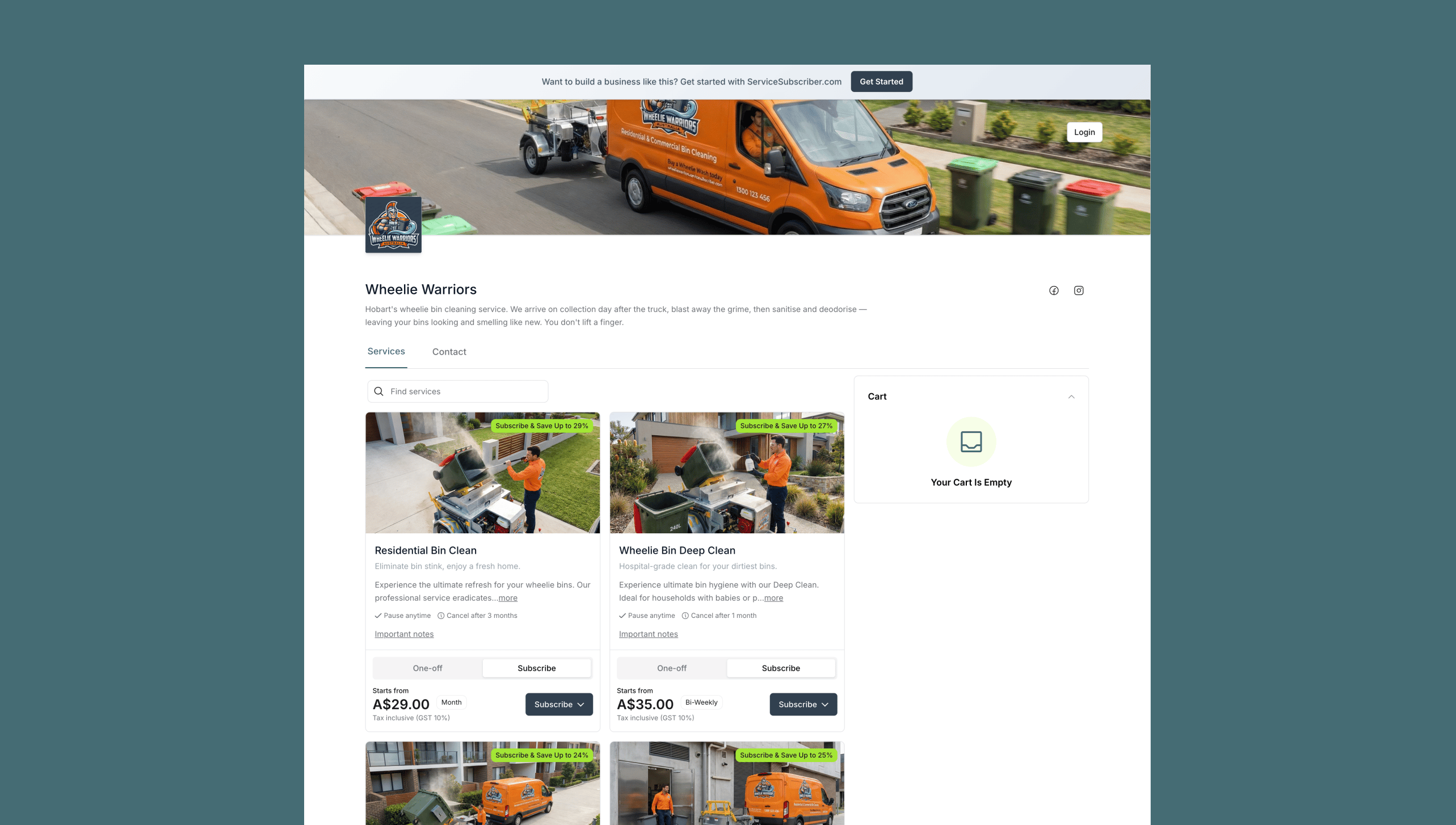
Services and pricing upfront. Clients choose their bin type and frequency, subscribe, and pay at checkout. You get notified. You add them to your route. For commercial clients or non-standard setups, a private subscription invite with a custom price keeps the arrangement clean without cluttering your public page.
Make the First Clean Count
The result of a bin clean is immediately obvious to the client and visible to neighbours. Both of those things work in your favour.
Do a thorough job. Inside, outside, and under the lid. Deodorise as a finish. A bin that smells clean after the service is the detail clients notice and mention when they recommend you.
Leave the bin sticker. A sticker on the lid showing the date of the last clean and when the next one is due. Simple, professional, and a constant visible reminder to the client and their neighbours that this service exists and is happening regularly.
Position the bin neatly. Leave it where the client had it, lid closed, facing the right way. Small detail, but it signals care and professionalism.
The neighbours will notice. A clean bin next to uncleaned bins on the same street is exactly the kind of contrast that prompts a neighbour to ask about it. You don't need to do anything extra for that to happen. Just do the work well and let the result do the prospecting for you.
Getting Paid Consistently
Bin cleaning on a subscription model is about as close to automated income as a service business gets. The client subscribes. The payment processes automatically on the billing date. You show up on your route, clean the bin, mark it done. That's it.
There's no invoice to send. No payment to chase. No wondering whether a client is going to get in touch again before the bin situation gets out of hand. The recurring billing takes care of all of it.
As your route grows, that predictability compounds. A full week of subscribers gives you a known income figure before you've left the house on Monday morning. That's a materially different financial position than a service business where every week starts from zero.
Build your route with subscriptions as the only offer. There's no real reason for a one-off bin clean to exist in this business. The whole value proposition is that it happens regularly without the client having to think about it. Positioning a one-off as an option mostly just invites clients to undercommit. Weekly or fortnightly subscriptions from the start.
Putting It Together
Bin cleaning is one of the more straightforward service businesses to build a recurring income from. The demand is real and growing. The subscription model is a natural fit. Every street you drive through is full of prospects, and a tight geographic route compounds in value as it fills up.
Start with a pressure washer setup if budget is a concern. Build the route. Let the trailer upgrade be funded by the business once the income is there to support it. Get your page live before you drop the first door hanger. Price your services clearly and make subscribing the only option. Leave the sticker. Do the work well enough that the neighbours ask about it.
Plan the route from the start. Dense is better than wide. The difference between a scattered client base and a concentrated one is the difference between a long, inefficient day and a tight, profitable one.
That's the starting point. The rest builds from doing the rounds.
Ready to start your bin cleaning business?
Create your service page, share the link, and start building your route. Clients subscribe, payment processes automatically, and you show up and do the work. That's the whole thing.
14-day free trial. No credit card. 50% off first 3 months.
Did you find this guide helpful?
More guides
Explore other service businesses you can start