How to Start a Cleaning Business in Australia
House cleaning is one of the most accessible service businesses to start in Australia. Low startup cost, consistent demand, and the work naturally repeats. This guide covers what you actually need to know before you begin.
31+ people found this guide helpful


Is Cleaning the Right Business for You?
You don't need to be passionate about cleaning. That's not really how this works.
What you do need is a genuine curiosity about running a business. An interest in building something that's yours. Some satisfaction in the idea of a job done well and a customer who notices.
Cleaning businesses work because the demand is steady, the barrier to entry is low, and the work repeats. A client on a fortnightly subscription is a client you don't have to find again next month. That predictability is what makes it a real business rather than a series of one-off jobs.
If the idea of building that kind of income interests you, and you're not put off by physical work, that's enough to start. Curiosity and willingness. The rest is execution.
Research and Plan Before You Start
Not a 40-page business plan. You don't need that. But some thinking before you spend money is worth doing.
A one-page execution summary is enough. Jot down the answers to these questions before you do anything else:
Where will you service? Pick a specific area. Suburb or suburbs. How far are you willing to travel? What does the population look like? Are there enough households in that area to sustain a full schedule?
Who will you service? Residential or commercial? Budget or mid-market or high-end? The answer shapes everything from your pricing to where you drop flyers to what your branding looks like. You can always expand later. Starting with a clear picture of one customer type makes the early days simpler.
How will you service them? Solo to start, or with help from day one? What's your capacity per week? How many jobs can you realistically take on before you need to grow?
Is it sustainable? Look at the area you're targeting. Search for existing cleaning businesses nearby. If there are ten already, that's not necessarily a problem — it means there's demand. Understand where you'd fit in, and whether there's room.
One page. Answers to those questions. That's your plan. It doesn't have to be more than that at the start.
Capital: What Can You Afford to Lose?
It's a blunt question. But it's the right one.
Business can go south. Not cleaning businesses specifically, but businesses in general. Going in with a clear sense of what you're prepared to invest and potentially lose keeps the decision honest. It also helps you avoid overspending on things that don't matter in the first few months.
Here's a rough breakdown of what starting a cleaning business in Australia typically costs:
- ABN registration — Free
- Business name registration (ASIC) — Around $42 for one year, $98 for three years
- Domain name (.com.au or .au) — $20 to $50 per year
- Public liability insurance — $500 to $900 per year depending on coverage and provider
- Equipment and initial supplies — $300 to $600 (more detail on this below)
- Branded clothing (polo, cap) — $100 to $200
- Flyers and marketing materials — $50 to $150 for an initial print run
- Platform or payment system — $18 to $39 per month
- Logo and basic branding — $0 if you use AI tools, $200 to $500 if you use a designer
A realistic starting budget sits somewhere between $1,200 and $2,500 all in. Budget toward the higher end. Costs have a way of creeping past what you expect, and it's better to have a buffer than to run short before you've found your first regular client.
Your Brand
Brand is more than a business name. It's the whole impression — what you look like on a flyer, how your shirts look when you walk up to a front door, how the name sounds when someone recommends you to a neighbour.
It doesn't have to be expensive. But it pays to do the work properly from the start rather than redo it later when you have customers who already know you by the wrong name.
Start by getting a few names on the board. Think about what says what you do, is easy to remember and spell, and would look right on a work shirt or van door. Then before you get attached to any of them, check:
ASIC business name register. Search at business.gov.au. If the name is already registered, that's a hard stop. Move on to the next option.
Trade marks. Registering a business name doesn't protect you from trade mark claims. A quick check at ipaustralia.gov.au is worth doing, especially for anything distinctive. You don't want a letter from a lawyer six months in.
Domain availability. In Australia, .com.au or the newer .au extension is what most people expect from a local business. Check availability at a domain registrar before you commit to a name.
Social handles. Check Instagram, Facebook, and TikTok at the same time. If the name, the domain, and the handles all line up, that's your name. Register it and move on.
On logos: a good AI prompt in ChatGPT or Claude can get you to a workable starting point in minutes at no cost.
Create a professional logo for [Business Name], a residential cleaning business in Australia. Keep it clean and simple. Use [colour preference]. It needs to work at small sizes on social media and look good on work shirts and printed flyers. Provide 3 or 4 variations.
You'll refine it over time. For now, something consistent is better than nothing. When you're ready to go further:
Create a brand guide for [Business Name], a residential cleaning business. Include a primary colour palette with hex codes, a secondary palette, font recommendations for headings and body text, logo usage rules, tone of voice guidelines with example phrases, and how the brand should appear on social media, uniforms, and printed materials.
It won't replace a designer. But it'll give you something real to work from.
Insurance, Licences, and Permits
We're not lawyers or insurance brokers. Get specific advice for your situation. But here's what most cleaning businesses in Australia need to sort out early.
Public liability insurance. This is the one to prioritise. You're working inside people's homes, handling their belongings, using chemical products near their surfaces and furnishings. If something goes wrong — a breakage, a damage claim, a slip — you want to be covered. Many clients will ask to see proof of insurance before they purchase, particularly in higher-end areas. It's usually more affordable than people expect. Don't wait until something happens.
Police check. Not a legal requirement, but worth doing early. Many clients, especially families and older clients, will ask for one. It's a straightforward trust signal and takes the question off the table.
Workers compensation. If you take on employees or subcontractors, this becomes relevant. If you're operating solo, less so. Worth understanding the rules in your state before you hire anyone.
Licences and permits. General house cleaning doesn't require a specific licence in most states. If you're doing commercial cleaning involving specialist chemicals or working in specific environments, different rules may apply. Check what's relevant for your service type and location.
Define Your Services and Pricing
Before you can quote anyone, you need to know what you're selling and what you're charging for it.
A cleaning business typically offers a combination of recurring services and one-off cleans. Some examples of how to structure your offering:
- Regular House Clean — Weekly or fortnightly. The core of a recurring income model.
- Express Clean — A shorter, lighter clean. Good for clients who want more frequent visits.
- Deep Clean — A thorough top-to-bottom service. Often a first purchase before moving to regular.
- Kitchen and Bathroom Clean — Targeted service for clients who only need specific areas.
- End of Lease Clean — One-off, higher priced, time-intensive. Renters and property managers.
- Spring Clean — Seasonal, one-off. Often attracts clients who convert to regular.
On pricing: look at two things. What others in your area charge, and what it costs you to do the job. The second is the floor. The first tells you the range. Don't price at the bottom of the market unless you plan to compete on volume, and volume is hard to build when you're starting solo.
Direct costs to factor in: travel, cleaning products, equipment wear, your time including setup and pack-down. Once you know the floor, price above it with margin left for things going wrong.
Customers who subscribe to regular cleaning typically pay a lower per-visit rate than one-off clients. That's the trade. They give you predictability. You give them a better price. Build your subscription rate as your primary offer and your one-off rate as the alternative.
This is what Service Subscriber does
A page, payments, and delivery tracking. Live in 20 minutes.
14-day free trial. No credit card.

Equipment and Supplies
You don't need a van full of specialist equipment to start. Most of what you need for residential cleaning is available at Bunnings, which keeps startup costs low and restocking simple.
A solid starting kit covers:
- Microfibre cloths (buy in bulk, different colours for different areas)
- Paper towels
- Cleaning solutions — general purpose, bathroom, kitchen, glass
- Broom and dustpan
- Mop and bucket
- Scrub brushes
- Toilet brushes (dedicate one per client if you want to stand out)
- Spray bottles (label them clearly)
- Nitrile or latex gloves
- Plastic scrapers
- Organisational caddy to carry everything between rooms
- Commercial vacuum cleaner
For cleaning solutions, Bunnings covers the basics. If you want to differentiate with eco-friendly products, specialty cleaning supply stores and online wholesalers carry plant-based and low-chemical alternatives. Some clients will specifically look for this, particularly in higher-end residential areas. Worth considering as part of how you position the business.
Buy quality where it matters (vacuum, microfibre cloths) and don't overspend on the rest until you know what you actually use.
Getting Your First Customers
This is the part most people overthink. You've done the setup. Now you need someone to pay you.
A word on friends and family first. They're sometimes the easiest starting point, but only if their need for your services is genuine. A favour job where someone lets you clean their house out of kindness isn't feedback you can build on. If you have friends or family who genuinely need a cleaner and would otherwise be paying someone, great. Otherwise, start with strangers.
Go to your target area. If you want high-end residential clients, go to those suburbs. Drop 50 flyers on a Saturday morning. Simple design. What you do, what you charge, a QR code to your page. Canva has free templates that make this fast. Print through an online printer and keep costs under $100 for an initial run.
Facebook community groups. Most suburbs have one. Introduce yourself, be specific about where you operate and what you offer, and include your link. Don't post once and disappear. Show up regularly, answer questions, be visible.
Nextdoor. The local neighbourhood app. People post service requests there regularly, and a local business introduction post often gets a response. Create a profile and introduce yourself to the area.
Ask for referrals early. After your first few jobs, ask. Most people are happy to recommend someone who did good work. They just need to be asked directly.
Give Customers a Way to Find You
A flyer with a phone number gets you started. But it's not enough on its own.
When someone scans your QR code or types in your address, they should land somewhere that shows exactly what you offer, what it costs, and lets them purchase without having to call you or wait for a quote. The more friction between interest and payment, the more people drop off.
What that page needs to do: show your services clearly, show your prices, let someone choose between a one-off clean and a recurring subscription, and take payment. That's it.
Here's an example of what that looks like:
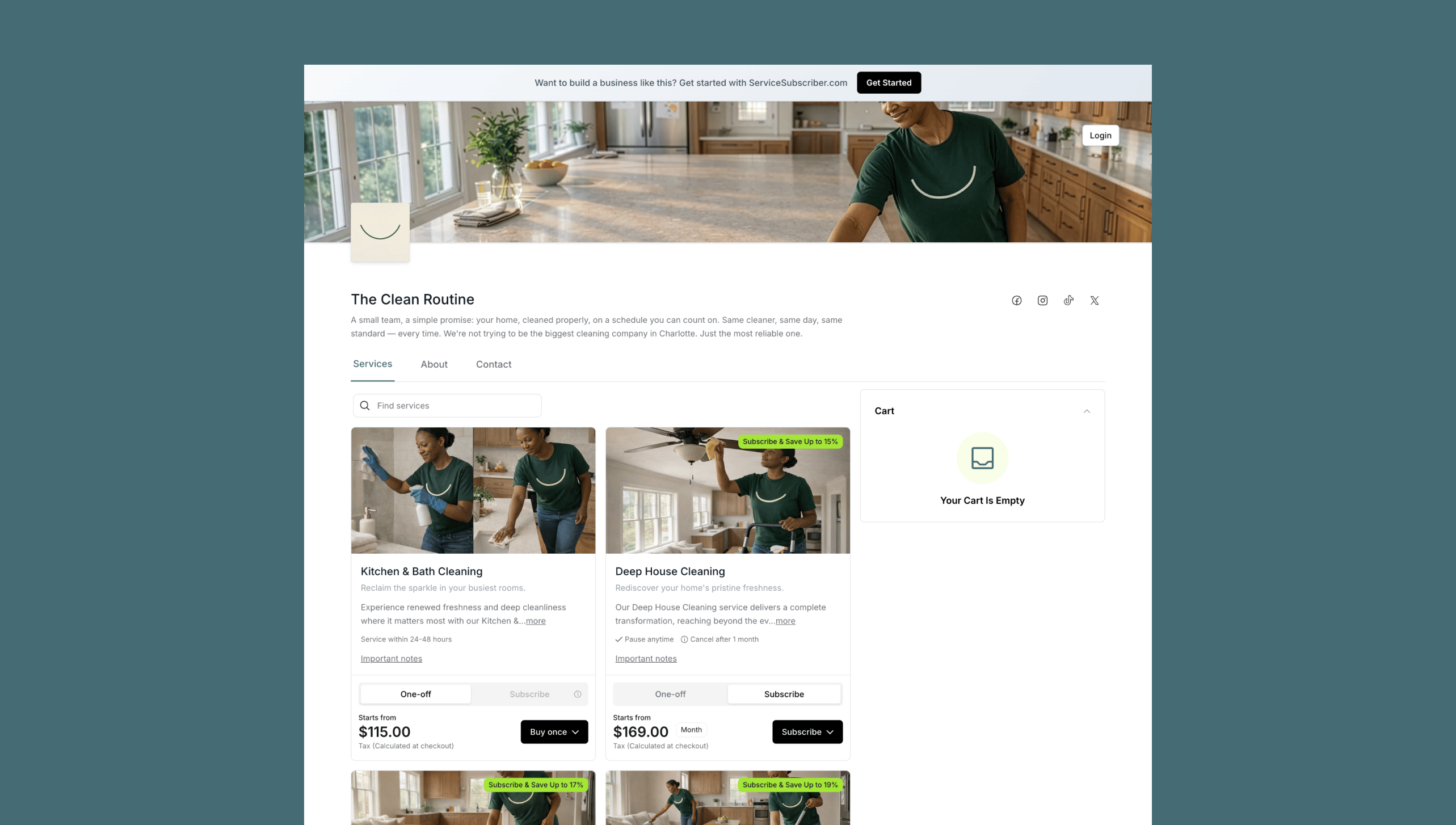
Services listed clearly. Pricing visible upfront. Customers can choose a one-off clean or subscribe for regular service. Payment handled at checkout. That's the whole experience — for you and for them.
Make the First Job Memorable
Your first job isn't just a job. It's an audition.
The client is deciding whether they want to let you back into their home. First impressions are hard to undo in either direction. Get this right and you'll likely have a regular. Get it wrong and no follow-up message will fix it.
The basics matter more than anything else. Be on time. If you're running late, message before you're late, not after. Show up in clean, branded clothing. Be professional in how you communicate.
Then go slightly beyond what they expected.
A small detail that clients notice: finishing a clean with a light spray of a fresh citrus scent through the main living areas. It's inexpensive and it does something that all the scrubbing doesn't — it gives the home a feeling of clean, not just a look of it. Clients notice it. Some will mention it. It's the kind of thing people describe when they recommend you.
Other things that stick: leaving surfaces exactly as they were (don't rearrange), noting anything you noticed and letting the client know, asking once at the end if there's anything they'd like done differently next time. That question signals professionalism and gives you feedback before a small preference becomes a reason to look elsewhere.
Your goal after the first job is a recurring subscription. Everything else follows from that.
Getting Paid Consistently
The billing side of a cleaning business is where most people leave money on the table.
Sending invoices after every job, chasing payments, remembering who paid and who didn't — it takes time, and it creates the kind of unpredictable income that makes it hard to plan anything. You do the work and then hope.
If the work repeats, the billing should too. A client on a fortnightly subscription pays automatically every two weeks. You show up, do the job, mark it done. No invoice. No follow-up. The money is there before you walk through the door.
That structure separates a cleaning round with consistent income from one that's always uncertain. The work is the same. The billing setup is different. And the difference compounds as you grow.
Set it up from the start. It's harder to move existing clients onto a subscription model than to offer it as the default from the first purchase.
Putting It Together
A cleaning business in Australia can be started for under $2,000. Some people have done it for less.
The work is straightforward. The demand is real. The path from first client to a full schedule of regular subscribers is shorter than most people think — if you set it up properly from the beginning.
Plan before you spend. Brand before you prospect. Get your page live before you hand out your first flyer. Make the first job count. Ask for the subscription.
The people who do well at this aren't the ones who waited until everything was perfect. They started with what they had, learned from the first few jobs, and adjusted as they went.
That's roughly how it works.
Ready to start your cleaning business?
Create your service page, share the link, and start getting paid. Customers can purchase a one-off clean or subscribe for regular service. You get paid directly.
14-day free trial. No credit card. 50% off first 3 months.
Did you find this guide helpful?
More guides
Explore other service businesses you can start