How to Start a Mobile Barber Business in Australia
A barber who comes to you. It sounds simple, and it largely is. The skill is the same. The tools travel. The client gets a great cut without leaving the house or the office. And once you have a client who values their appearance and their time, they tend to stay.
22+ people found this guide helpful

Why Mobile Barbering Works as a Business
Hair doesn't stop growing. That's the foundation of the whole business. A client who gets a cut this month needs another one next month, and the month after that. The demand is built in.
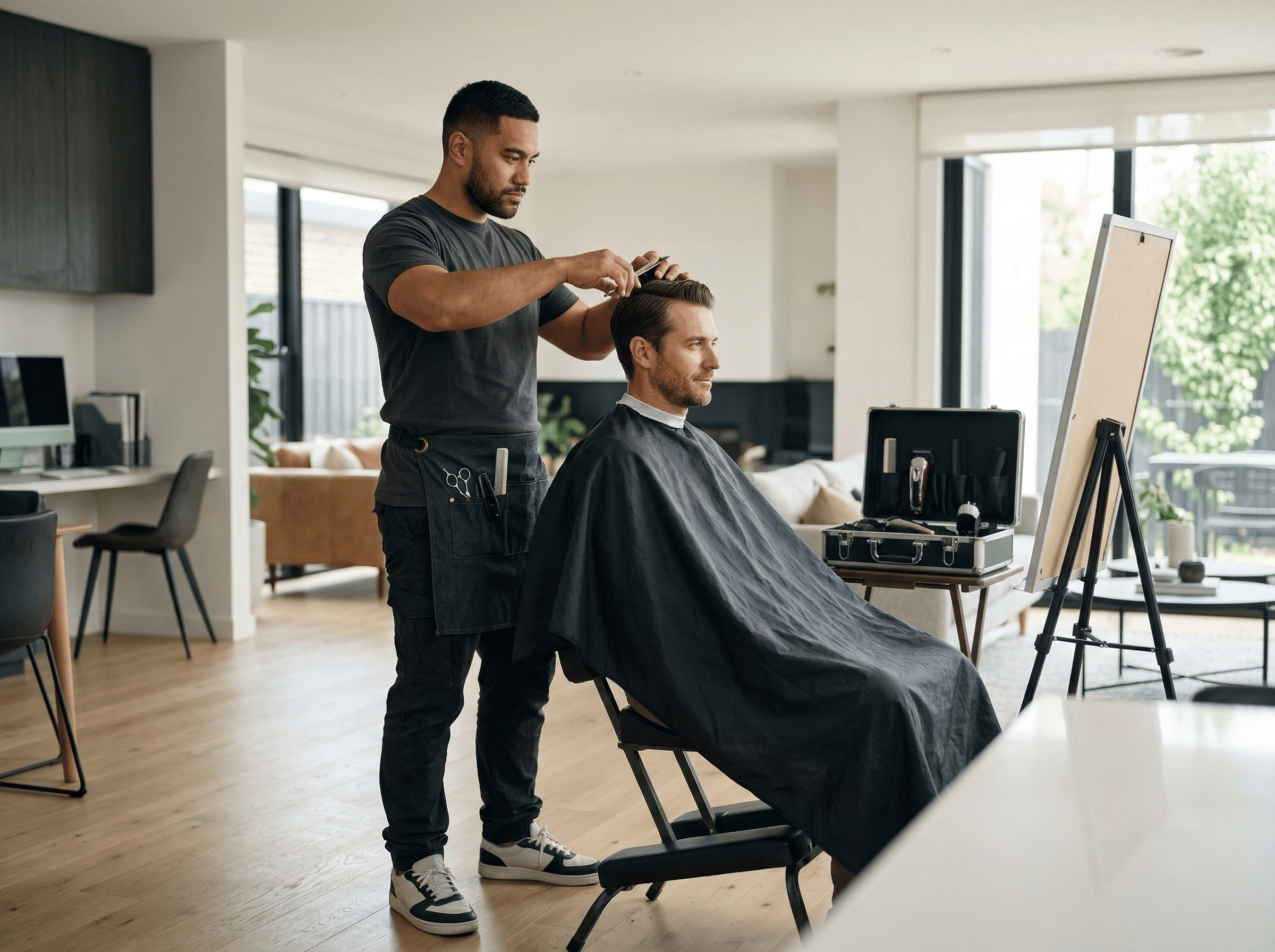
What mobile adds on top of that is convenience. No waiting in a shop. No parking. No fitting it into a lunch break only to find the barber is running behind. You show up at their home or office, do the work, and leave. For professionals, busy parents, and people who value their time, that convenience is worth paying for.
The solo mobile operator model also removes the biggest cost in traditional barbering: the chair rent or shop lease. Your overhead is your kit, your vehicle, and your time. That keeps the margins healthy and the decision to start relatively low-risk compared to opening or buying into a fixed premises.
It's not the right model for everyone. If you want a busy shop floor and the energy of a traditional barber environment, mobile probably isn't it. But if you want to build a loyal client base on your own schedule, with lower overhead and a more personal relationship with each client, mobile is a genuinely compelling way to do it.
Skills, Training, and Experience
This is a business where the quality of your work is the product. That makes what you know and how well you do it more important here than in most service businesses. Being honest with yourself about where you're at before you start taking paying clients is worth doing.
A genuine passion for barbering helps. Not because passion alone makes a good business, but because the skill set is deep. Fade work, skin fades, scissor cuts, beard shaping, hot towel shaves. Operators who care about the craft tend to keep learning and improving in a way that builds a strong reputation over time.
On the formal side, a Certificate III in Barbering or Hairdressing through a registered training organisation (RTO) gives you a recognised qualification and a structured foundation. It also covers important safety and hygiene requirements that are relevant regardless of whether you're operating from a shop or out of a bag. If you haven't completed formal training, it's worth looking into. Several RTOs in Australia offer flexible delivery that fits around other commitments.
Experience matters on top of that. If you've worked in a barbershop, even part-time, you'll have handled the variety of hair types, the awkward conversation angles, and the speed that comes from working on real clients. If you haven't, practice on friends and family before you charge anyone. The technical skill is learnable. Getting comfortable working on a range of people in a range of settings, some of which won't be ideal, is something that only comes from doing it.
A solid starting point is a qualification combined with genuine practice. The clients who'll keep coming back are the ones who trust that you know what you're doing.
Mobile Versus Fixed Premises
This guide is focused on the solo mobile operator. Not because a fixed shop isn't a legitimate path, but because the capital required, the lease commitment, and the complexity of managing a premises is a different conversation entirely, and a bigger one than most people need to have when they're just getting started.
Mobile lets you start with what you have. A quality kit, a reliable vehicle, and the skill to do the work. No rent. No fit-out costs. No waiting for foot traffic to find you.
The trade-off is real and worth understanding. You're working in spaces you don't control: client kitchens, living rooms, driveways, office break rooms. Some setups will be comfortable. Some won't be. You'll spend time driving between jobs, and that time doesn't earn you anything directly. And you carry everything with you, every day, which requires a level of organisation that a fixed setup doesn't.
Factor travel time into how you price and schedule. A 20-minute drive between jobs means you're fitting fewer clients into a day than a shop-based operator working back-to-back chairs. That's not a reason not to do it. It's a reason to price and plan accordingly. More on that below.
Start mobile. Build a client base. If a fixed location or a hybrid model makes sense down the track, you can make that decision from a position of having an income rather than a position of needing one.
Is This the Right Business for You?
Mobile barbering suits a specific kind of operator. Someone who's comfortable working independently, managing their own schedule, and building client relationships one at a time rather than through the volume of a busy shop floor.
You'll spend a portion of every working day in your car. You'll carry your setup in and out of different spaces. You'll have clients who are punctual and clients who aren't, and that has a direct impact on your day. None of that is a reason not to start. It's just useful to go in with a clear picture of what the work actually looks like day to day.
What tends to work well is a genuine interest in the craft, a professional approach to the client relationship, and a willingness to treat the business side, pricing, scheduling, billing, as seriously as the technical side. The operators who build strong, loyal client bases in mobile barbering are usually the ones who make clients feel like the service was worth exactly what they paid, and then some.
The Subscription Opportunity in Barbering
Subscriptions in barbering are relatively new. Most barbers still work on a one-off transaction model. Client comes in when they feel like it, pays, leaves, hopefully comes back. There's nothing wrong with that, but it leaves a lot of value on the table for both sides.
Here's the honest case for subscriptions in this business: a haircut once a month means you look great for the first week and then gradually less great for the next three. A cut every two weeks means you always look sharp. That's not a manufactured selling point. It's just true.
Think about who that matters to. Professionals in client-facing roles: sales, real estate, finance, legal. Anyone who's in front of people regularly and knows that appearance is part of how they're perceived. These are the clients who would genuinely benefit from a fortnightly maintenance subscription, and who are often in a position to pay for it without it being a significant decision.
The subscription offer for a mobile barber might look like this: a monthly cut at one price, or a fortnightly maintenance subscription at a slightly lower per-visit rate that automatically recurs. The client always looks well-groomed. You have predictable income and a locked-in schedule. Both sides get something real out of the arrangement.
It's a newer model for this industry, which also means there's room to differentiate. Most barbers aren't offering it. If you do, and you target the right clients, it becomes a genuine competitive advantage.
Research and Plan Before You Start
A one-page execution summary before you spend anything is worth putting together.
Where will you operate? Define your service area tightly. Travel time between jobs is unpaid time, and a wide geographic radius eats into your effective daily rate fast. A tight area, a cluster of suburbs or a commercial district, keeps driving to a minimum and lets you run more jobs in a day.
Who are you targeting? Residential clients at home, professionals at their workplace, or both? Workplace visits during business hours suit a certain kind of client and a certain kind of schedule. Home visits suit another. Both are viable. Starting with a clear picture of one makes the early prospecting simpler.
What will you charge? Research what mobile barbers in your area charge. Understand the premium your clients are paying over a traditional shop cut. That premium needs to reflect your travel time, your kit quality, and the convenience you're providing. More on pricing below.
What does your week look like? How many clients can you realistically serve in a day, accounting for travel? What days will you work? What hours? Getting specific about this before you start avoids the common trap of underpricing because you haven't worked out what a sustainable day actually looks like.
Capital: What to Expect
Mobile barbering has one of the more accessible startup cost profiles of any service business. The main investment is your kit. There's no lease, no fit-out, no shop signage. Here's a realistic breakdown for getting started in Australia:
- ABN registration — Free
- Business name registration (ASIC) — Around $42 for one year, $98 for three years
- Domain name (.com.au or .au) — $20 to $50 per year
- Public liability insurance — $600 to $1,200 per year
- Clippers (professional grade, 2 pairs) — $300 to $700
- Trimmers and detailers — $150 to $400
- Scissors (professional, 2 pairs) — $200 to $600
- Combs, brushes, and guards — $50 to $150
- Cape and neck strips — $50 to $100
- Portable folding chair (optional but useful) — $150 to $400
- Products (wax, pomade, finishing spray) — $100 to $200
- Disinfectants and sanitation supplies — $50 to $100
- Quality bag or carry case — $100 to $300
- Branded clothing — $100 to $200
- Vehicle signage (optional) — $200 to $600
- Flyers and marketing materials — $100 to $200
- Platform or payment system — $18 to $39 per month
- Logo and basic branding — $0 if you use AI tools, $200 to $500 if you use a designer
A realistic all-in starting figure is $2,000 to $4,500, not including your vehicle. Invest in quality on the clippers and scissors. They're the tools you use on every single client, every single day, and the difference between professional and budget equipment is noticeable in the result and the longevity.
Your Brand
In mobile barbering, your brand is the first signal a potential client gets about the quality of the service before they've seen your work. A professional name, a clean visual identity, and a page that looks like it belongs to someone who takes the craft seriously goes a long way before the first cut.
Before you settle on a name, run it through the standard checks:
ASIC business name register. Search at business.gov.au. If it's taken, move on.
Trade marks. A registered business name doesn't protect you from trade mark claims. A quick check at ipaustralia.gov.au before you invest in branding is worth doing.
Domain availability. A .com.au or .au extension. Check availability before you commit to the name.
Social handles. Instagram in particular. Barbering content performs well visually: before and afters, clean fades, finished looks. When the name, domain, and handles align, register everything and move on.
On logos, a good prompt in ChatGPT or Claude gets you somewhere useful quickly:
Create a professional logo for [Business Name], a mobile barber business in Australia. Keep it clean and sharp. Use [colour preference]. It needs to work on a business card, a work polo, and a service page. Provide 3 or 4 variations.
When you're ready to go further:
Create a brand guide for [Business Name], a mobile barber business in Australia. Include a primary colour palette with hex codes, a secondary palette, font recommendations for headings and body text, logo usage rules, and how the brand should appear on social media, printed materials, and a service page.
Insurance, Licences, and Permits
We're not lawyers or insurance brokers. Get specific advice for your situation. Here's what's worth sorting out before you start.
Public liability insurance. You're working in clients' homes and workplaces with sharp tools and electrical equipment. If something goes wrong, whether a cut, damage to a client's furniture, or an injury, public liability insurance covers you. Some corporate clients and strata-managed buildings will ask to see it before they let you on the premises. Get it before you start, not after.
Qualification and registration. Barbering and hairdressing regulation varies by state. In some states, a registered qualification is required to work professionally. Check what applies in your state before you start taking paying clients. This is the kind of thing that's straightforward to get right at the start and complicated to fix later.
Hygiene and sanitation requirements. Mobile operators are subject to the same hygiene standards as fixed premises in most states. Clean tools between clients, proper disinfection, and appropriate disposal of waste. Understand what's required in your state and build it into your setup from day one. It's not just a legal matter, it's a basic expectation of any professional.
Vehicle insurance. If you're using your personal vehicle for business, check your policy. Many personal vehicle policies don't cover commercial use. Let your insurer know and confirm appropriate coverage.
Define Your Services and Pricing
Before you price yoru services, know what you offer and what you charge for it. A mobile barber service typically covers a clear core menu with optional add-ons:
- Haircut. The foundation service. Classic cut, scissor cut, or clipper cut depending on the client's preference.
- Haircut and Beard Trim. The most common combination. Plenty of clients want both in the same visit.
- Beard Trim and Shape. For clients who want maintenance without a full cut.
- Skin Fade or Taper. Higher skill, higher price point. Worth offering once you're confident in the technique.
- Hot Towel Shave. Premium service. Time-intensive, but high perceived value and an experience a barbershop doesn't always offer at home.
- Kids Cut. Worth considering if you're targeting residential family clients. A useful addition to a home visit where a parent is also getting cut.
On pricing: your mobile premium needs to account for travel time, not just the service itself. A 30-minute cut at a shop is 30 minutes of earning. A 30-minute cut at a client's home, with 20 minutes of driving each way, is 70 minutes of your day. Price that honestly.
Look at what mobile barbers in your area charge as a reference. As a general approach, a mobile cut should sit noticeably above a shop cut. The client is paying for convenience, a personalised service, and your time on the road. That's a reasonable premium and most clients in the right market understand it.
On subscriptions: offer a fortnightly maintenance plan as your primary subscription and a monthly cut as the alternative. Price the per-visit rate slightly lower for subscribers than for one-off clients. They're giving you predictability and a guaranteed place in their schedule. That trade is worth something, and reflecting it in the price makes the subscription an easy decision.
The client who subscribes fortnightly isn't just worth more in revenue. They always look well-groomed, which means they're walking around as a visible endorsement of your work.
This is what Service Subscriber does
A page, payments, and delivery tracking. Live in 20 minutes.
14-day free trial. No credit card.

Equipment
Mobile barbering is a kit-in-a-bag operation. Everything you need for a professional result has to travel with you and set up in whatever space the client has available. Here's what a solid starting kit looks like:
- Professional clippers. Two pairs — one for the bulk of the cut, one for fading and detail work. Wahl, Andis, and BaByliss are the most commonly used professional brands in Australia. Buy at the professional tier, not the consumer tier. The difference is noticeable.
- Trimmers and T-blade detailers. For lining up, beard shaping, and the detail work around ears and neck.
- Scissors. A quality pair of cutting scissors and a pair of thinning scissors. Don't cut costs here — literally. Cheap scissors pull hair and make the work harder.
- Clipper guards (full set). Multiple sizes for the range of lengths you'll be asked to work with.
- Combs and brushes. A range of cutting combs, a neck brush, a barber's brush for removing loose hair.
- Cape and neck strips. Multiple capes. Keep them clean.
- Disinfectant spray and barbicide jar. Mandatory between every client. Non-negotiable.
- Clipper oil and cleaning brushes. Maintenance between clients keeps your tools performing properly.
- Hand mirror. For showing the client the back and sides.
- Finishing products. A small selection — pomade, wax, matte clay, light hold spray. Clients appreciate the finish being applied.
- Portable folding chair. Not always necessary — many clients are comfortable in a kitchen or dining chair — but useful when the client's home setup isn't ideal for a cut.
- Quality carry bag or case. Everything organised, everything protected, easy to carry in and out of client locations.
Charge your tools the night before every working day. Running out of battery mid-fade is the kind of problem that's entirely avoidable and leaves a poor impression.
Getting Your First Clients
Your target client is someone who values their appearance, is time-poor enough to see mobile as worth the premium, and is in a position to commit to regular maintenance. Here's where to find them.
LinkedIn. More directly useful here than for most service businesses. Professionals who care about how they present are exactly your market. A clear, professional post introducing your service, what you offer, where you operate, and what you charge will reach exactly the right people. It doesn't need to be polished. It needs to be direct and professional. Show up consistently.
Local professional environments. Real estate agencies, financial planning offices, law firms, mortgage brokers. These are environments full of client-facing professionals who get regular cuts and would likely value the convenience of not having to leave the office to do it. A polite in-person introduction or a brief email with your service page link is worth trying. You only need a few yes responses to get your schedule moving.
Local business partnerships. Approach complementary businesses: men's clothing retailers, gyms with a professional clientele, grooming or skincare businesses. A referral arrangement or a mention in their marketing costs them nothing and puts you in front of exactly the right audience.
Facebook community groups. Introduce yourself in local suburb groups. Be specific about where you operate and what you offer. Before and after photos, if you have them, do the work for you.
Ask for referrals early and directly. After the first few clients, ask. A professional who just had a great cut at their desk knows other professionals. Most people are happy to pass on a recommendation if you ask for it clearly. "Do you know anyone else who might appreciate this service?" is enough.
Friends and colleagues first. If you have a network of people who'd genuinely use your service, start there. Treat it as professionally as any paying client. Turn up on time, do great work, ask for honest feedback. A few early regulars in your immediate network gives you practice, confidence, and your first word-of-mouth referrals.
Give Clients a Way to Find You and Subscribe
When a potential client hears about you through a referral or sees your LinkedIn post, they should be able to land somewhere that shows exactly what you offer, what you charge, and lets them purchase or subscribe without having to call you or wait for a quote.
That page needs to do a few things clearly: your services and pricing, the option to purchase a one-off cut or subscribe to a regular maintenance plan, and a clean checkout. Nothing more complicated than that.
Here's an example of what that looks like in practice:
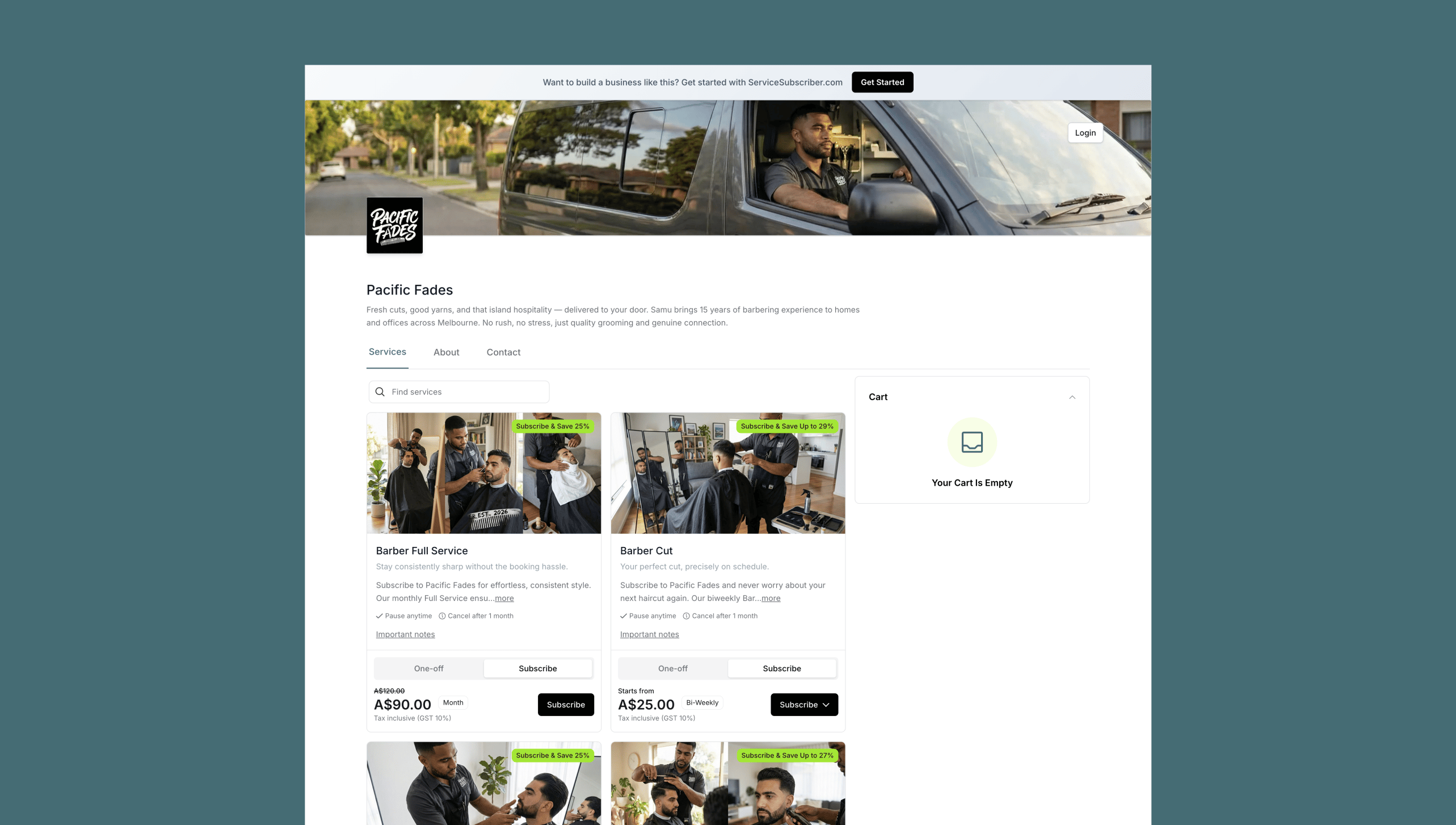
Services and pricing upfront. Clients can purchase a one-off visit or subscribe for fortnightly or monthly maintenance. Payment handled at checkout. You get notified. You show up at the agreed time. The rest is the work.
Make the First Appointment Count
The first visit is where a one-off client decides whether they want a second one. In mobile barbering, where the whole value proposition is a premium, personal service, the first appointment needs to deliver on that.
Arrive on time and set up quickly. The client has organised their schedule around your arrival. Showing up on time and being ready to work within a few minutes of arriving signals that this is a professional service, not a favour.
Ask before you cut. What they want, how they've had it before, what they're trying to maintain or change. Clients who feel heard before the scissors come out are more relaxed throughout and more satisfied with the result.
Be clean and organised. Lay down a mat or towel if you're working near good flooring. Keep your tools visible and clean. Leave the space exactly as you found it. A professional setup in a client's kitchen that looks purposeful and orderly is a different experience from someone rummaging through a bag.
Do excellent work. This sounds obvious. It's still the most important point. A cut that earns a genuine compliment when the client looks in the mirror is the only marketing you actually need in the early days.
Before you leave, mention the subscription. Something like: "Most of my regular clients do fortnightly trims. Keeps everything sharp without having to think about it. If that appeals, I can set it up so it's automatic." Not a pitch. Just an honest offer at the natural end of a service they've just experienced.
Getting Paid Consistently
Hair grows back. Every client you have is a future client, if you've done the work properly. The question is whether you're set up to capture that recurring value or whether you're starting from scratch every time someone's hair gets long enough to need attention.
The subscription model solves that. A client on a fortnightly maintenance plan pays automatically on the billing date. You show up, do the cut, mark it done. No invoice. No following up. No hoping they remember to reach out before they let it go too long.
For a mobile barber, subscriptions also solve a scheduling problem. A confirmed fortnightly client is a confirmed slot in your week. Build enough of those and you have a floor of predictable income before you've done a single one-off visit. That's a materially different business from one that depends on clients remembering to get in touch.
Set this up as the default offer from the start. One-off pricing is there for first-time clients and people who genuinely only want an occasional visit. The goal after the first appointment is always to convert to a subscription before they leave.
Putting It Together
Mobile barbering is a business that rewards skill, professionalism, and the willingness to treat the client relationship seriously. The demand is consistent, the overhead is low, and the client who values looking sharp on a regular basis is exactly the kind of client who stays.
The subscription angle is newer for this industry, and that's an opportunity. Most barbers aren't offering it. A fortnightly maintenance plan for the right client isn't a hard sell. It's an obvious answer to something they already care about. Position it that way.
Get the qualification sorted before you start taking money. Plan your service area before you price your services. Brand before you prospect. Get your page live before you hand out your first business card. Make the first appointment excellent. Ask for the subscription before you pack up your kit.
That's the starting point. The rest builds from there.
Ready to start your mobile barber business?
Create your service page, share the link, and start getting paid. Clients can purchase a one-off visit or subscribe for regular maintenance. You get paid before you turn up.
14-day free trial. No credit card. 50% off first 3 months.
Did you find this guide helpful?
More guides
Explore other service businesses you can start