How to Start a Lawn Care Business in Australia
Australia's outdoor culture, climate, and genuine pride in how properties look makes lawn care one of the more reliable service businesses you can start. The work is visible, the demand is consistent, and a client with a lawn that needs mowing every two weeks is a client who doesn't go away.
28+ people found this guide helpful

Why Lawn Care Works in Australia
Australians spend a lot of time outside. The backyard is part of the home in a way that isn't true everywhere, and there's a genuine culture around keeping lawns and gardens looking right. Drive through almost any suburb on a weekend and you'll see it — people out there with mowers, edgers, and leaf blowers, putting in the work.
A portion of those people would rather pay someone else to do it. They want the result without the Saturday morning. That's your market.
Lawn care also has something that makes it particularly good as a recurring business: the grass doesn't stop growing. A client on a fortnightly subscription in spring will still need you in autumn. The work regenerates on its own, which means the relationship has a reason to continue without you having to go out and find new customers every week.
You don't need to be a horticulturalist to run a lawn care business. A working knowledge of what makes a lawn look good, some reliable equipment, and a professional approach to the business side of things is what actually separates operators who build a full client base from those who stay at a handful of jobs.
Seasonality and State Considerations
Lawn care in Australia isn't the same business in every state. That's worth understanding before you commit to it as your primary income.
In Queensland, the Northern Territory, and large parts of Western Australia, the climate supports lawn growth for most of the year. The wet season brings strong growth, but the dry season doesn't kill demand entirely. Operators in these states tend to have more consistent year-round schedules.
In Victoria, South Australia, Tasmania, and the ACT, there's a more pronounced seasonality. Growth slows significantly in winter, and some clients will pause or reduce frequency. That doesn't make the business unviable — it just means planning for it. Operators in these states often complement their lawn work with other services in the slower months. Gutter cleaning, garden clean-ups, pressure washing. Services that use the same client relationships and similar equipment.
New South Wales sits somewhere in between depending on whether you're coastal, inland, or in the ranges.
The question to ask before you start: if your area has a slow season of three or four months, what does your income look like during that period? If the answer creates a problem, build a plan for it before it arrives rather than after.
Is This the Right Business for You?
You don't need a passion for lawns. What you need is a genuine interest in running a business, a comfort with physical outdoor work, and a willingness to show up reliably week after week.
Clients in lawn care are trusting you with the front face of their property. The lawn is the first thing a visitor or neighbour sees. That matters to people more than they sometimes let on. The operators who build strong, loyal client bases are the ones who understand that — who treat each job as a reflection of the business, not just a task to get through.
Curiosity is enough to start. Curiosity about whether you can build a client base, about what the business side looks like, about whether you can turn a reliable skill into reliable income. That's a reasonable foundation.
Research and Plan Before You Spend
Lawn care has higher startup costs than something like house cleaning. Equipment, a vehicle capable of towing or carrying it, possibly a trailer, signage — it adds up. Spending before you've thought through the basics is an easy way to start in a hole.
A one-page execution summary is worth putting together first. Not a formal business plan. Just honest answers to a few questions:
Where will you operate? Define your service area. Suburbs you'll cover. How far you're willing to travel between jobs. A tight geographic area keeps your drive time low, which keeps your effective hourly rate higher.
Who are you servicing? Residential homeowners, rental properties managed by real estate agents, commercial properties? Each has different needs, different pricing expectations, and different ways of finding you. Start with one. Expand when you have capacity.
What's the local market like? Search for lawn care operators in your target area. Look at what they charge, how they present themselves, what services they offer. If there are established operators, that confirms demand. Your job is to work out where you fit.
Is the area sustainable? Consider the population density and property type in your target suburbs. Apartment-heavy areas have less residential lawn work. Established suburban streets with quarter-acre blocks are the sweet spot for a starting operator.
Get those answers on paper before you buy anything.
Startup Costs: What to Expect
Lawn care sits at a medium startup cost compared to other service businesses. It's not pocket change, but it's not beyond reach either — particularly if you already have a suitable vehicle or can get started with a more modest equipment setup and reinvest as you grow.
Here's a realistic breakdown for getting started in Australia:
- ABN registration — Free
- Business name registration (ASIC) — Around $42 for one year, $98 for three years
- Domain name (.com.au or .au) — $20 to $50 per year
- Public liability insurance — $600 to $1,200 per year depending on coverage and turnover
- Ride-on or push mower — $600 to $4,000+ depending on quality and size
- Line trimmer / whipper snipper — $150 to $500
- Edger — $100 to $400
- Leaf blower — $80 to $350
- Trailer (if required) — $1,500 to $4,000 new, less secondhand
- Vehicle signage — $200 to $600
- Branded clothing — $100 to $200
- Flyers and marketing materials — $50 to $150
- Platform or payment system — $18 to $39 per month
- Logo and basic branding — $0 if you use AI tools, $200 to $500 if you use a designer
A realistic all-in figure for a well-equipped starting setup sits between $4,000 and $8,000, excluding your vehicle. Budget toward the higher end. Equipment decisions made under financial pressure tend to cost more in the long run.
If budget is a constraint, a push mower and basic hand tools is a viable starting point for smaller residential blocks. There's no rule that says you need a full trailer setup before you take your first job. Start with what you can afford, do the work well, and reinvest.
Your Brand
In lawn care, your brand is visible in a way it isn't in some other service businesses. Your vehicle and trailer are parked on the street while you work. Your branded shirt is on display at every job. Neighbours walk past. That visibility is free marketing — but only if the brand looks like something worth noticing.
It doesn't need to be expensive. It needs to be consistent and professional. The name, the logo, the shirt, the trailer signage — when they all match, it signals that this is a real business run by someone who takes it seriously.
Before you settle on a name, run it through these checks:
ASIC business name register. Search at business.gov.au. If someone already has it, move on.
Trade marks. A registered business name doesn't protect you from trade mark claims. A quick search at ipaustralia.gov.au is worth doing before you invest in signage and uniforms.
Domain availability. A .com.au or .au domain is what most Australian clients expect. Check availability before you commit to the name.
Social handles. Check Instagram and Facebook at the same time. When the business name, domain, and handles all align, you've got something worth registering. Do it and move on.
On logos — a good AI prompt in ChatGPT or Claude gets you to a workable starting point at no cost:
Create a professional logo for [Business Name], a residential lawn care business in Australia. Keep it clean and bold. Use [colour preference — greens, earthy tones work well]. It needs to look good on a trailer, a work shirt, and a suburb flyer. Provide 3 or 4 variations.
When you're ready to go further and want something consistent across every touchpoint:
Create a brand guide for [Business Name], a residential lawn care business in Australia. Include a primary colour palette with hex codes, a secondary palette, font recommendations for headings and body text, logo usage rules, and how the brand should appear on vehicle signage, uniforms, flyers, and social media.
Start simple. Refine it as the business grows.
Insurance, Licences, and Permits
We're not lawyers or insurance brokers. Get specific advice for your situation. Here's what's worth understanding early.
Public liability insurance. Working on someone's property with powered equipment creates real risk — flying debris, damaged garden beds, cracked windows, marks on driveways. Public liability insurance covers you when something goes wrong that affects a client's property or a third party. Many clients, particularly those with higher-value properties, will ask for it before they purchase. Get it before you start, not after.
Vehicle and trailer insurance. Your equipment is your livelihood. A trailer full of mowers and trimmers is worth thousands. Make sure your vehicle policy covers commercial use and that your trailer and equipment are insured.
Noise regulations. Power tools have restricted hours in residential areas across most Australian states and councils. Know what the rules are in your operating area. Turning up at 7am with a leaf blower is a quick way to lose a client before you've finished the first job.
Chemical use. If you plan to offer fertilising, weed treatment, or pest control as part of your services, additional licences may be required depending on your state. General mowing and edging don't carry those requirements, but it's worth knowing where the line is if you want to expand your offering later.
Define Your Services and Pricing
Before you quote anyone, you need to know what you're offering and what you're charging for it.
A lawn care business can be structured around a core set of recurring services, with additional one-off services available for clients who need them:
- Regular Lawn Mow — Weekly or fortnightly. Your core recurring service and the foundation of a subscription model.
- Mow, Edge and Blow — The standard full service. Mow, edge along paths and driveways, blow down hard surfaces.
- Lawn and Garden Tidy — Broader service including garden bed edging and general tidy-up.
- Seasonal Clean-Up — One-off. End of winter or autumn leaf removal and tidy. Good for converting one-off clients to regular.
- Fertilise and Treatment — If licensed and equipped. Higher value add-on.
On pricing: two things matter. What the local market charges, and what it costs you to do the job.
On the cost side, factor in your fuel (both the mower and the vehicle), equipment wear and maintenance, travel time between jobs, and your time on site. Once you know what a job actually costs you, you know your floor. Anything below that and you're losing ground.
On the market side, search for lawn care operators in your target area and look at what they're charging. Price in the middle of the range. There's a temptation to undercut to get started — it's a reasonable instinct, but it attracts the wrong clients and sets a ceiling on what you can charge later.
Build your pricing around two rates: a subscription rate for regular clients and a higher one-off rate for single jobs. Recurring clients get a better price because they give you predictability. That trade-off is the core of building a sustainable income from lawn care.
This is what Service Subscriber does
A page, payments, and delivery tracking. Live in 20 minutes.
14-day free trial. No credit card.

Equipment
The right equipment for starting out depends on the size of properties in your target area and what your budget allows. Here's what a well-equipped starting setup looks like:
- Mower — A reliable push mower handles most residential blocks under 500sqm. A self-propelled or ride-on becomes worthwhile when you're regularly working larger properties.
- Line trimmer / whipper snipper — Essential. Edges along fences, walls, and garden beds that the mower can't reach.
- Edger — For that clean line along driveways and paths. Some operators use their trimmer for this; a dedicated edger is faster and more consistent.
- Leaf blower — For clearing clippings from hard surfaces after mowing. The finish on a job is partly about how clean you leave the paths and driveway.
- Hand tools — Secateurs, a hand rake, a long-handled broom. Small tools, but you'll reach for them constantly.
- Fuel cans and mixing equipment — If running two-stroke equipment.
- Trailer or roof rack — How you get equipment from job to job. A trailer gives you more capacity and easier loading; a roof rack or ute tray works for a lighter setup.
Buy quality on the items that work hardest — the mower and the trimmer especially. Budget options tend to cost more in repairs and downtime than the initial saving is worth. On the smaller hand tools, there's less at stake.
Bunnings covers most of what you need for consumables, blades, and protective gear. For commercial-grade equipment, dedicated outdoor power equipment dealers are worth a visit — their range and advice on what suits your use case is usually better than a general hardware store.
Getting Your First Clients
Your first clients are closer than you think. Here's a practical approach.
Start in your target area. If you're going after higher-end residential properties, go to those streets first. Drop 50 flyers on a Saturday morning — what you do, what you charge, a QR code to your page. Keep the design simple. Canva has templates that work fine. Print through an online printer for under $100.
Your vehicle and trailer are signage. Once you have a branded setup, every street you work on is a passive advertisement. Neighbours notice a professional-looking operator. Make sure there's a way for them to find you — a phone number or a URL on the trailer is enough.
Facebook community groups. Introduce yourself in the local suburb groups. Be specific about your service area and what you offer. Show up consistently. Answer questions. Don't make it a sales pitch — just be present and helpful, and the work tends to follow.
Real estate property managers. Rental properties need regular maintenance and landlords generally want it handled without fuss. A short, professional introduction to local property management offices — either in person or by email — can open up a reliable source of work. These clients tend to purchase regularly and pay on time.
Ask for referrals. After your first few jobs, ask directly. A client who's happy with your work will usually refer you if you ask. They won't always think to do it unprompted.
Give Clients a Way to Find You
A flyer with your phone number is a starting point. But when someone scans the QR code or types in your address, they should land somewhere that shows what you offer, what you charge, and lets them purchase without having to call you or wait for a response.
The easier you make it to become a regular client, the more likely that first enquiry turns into a fortnightly subscription rather than a one-off job that doesn't repeat.
Here's an example of what a professional lawn care page looks like in practice:
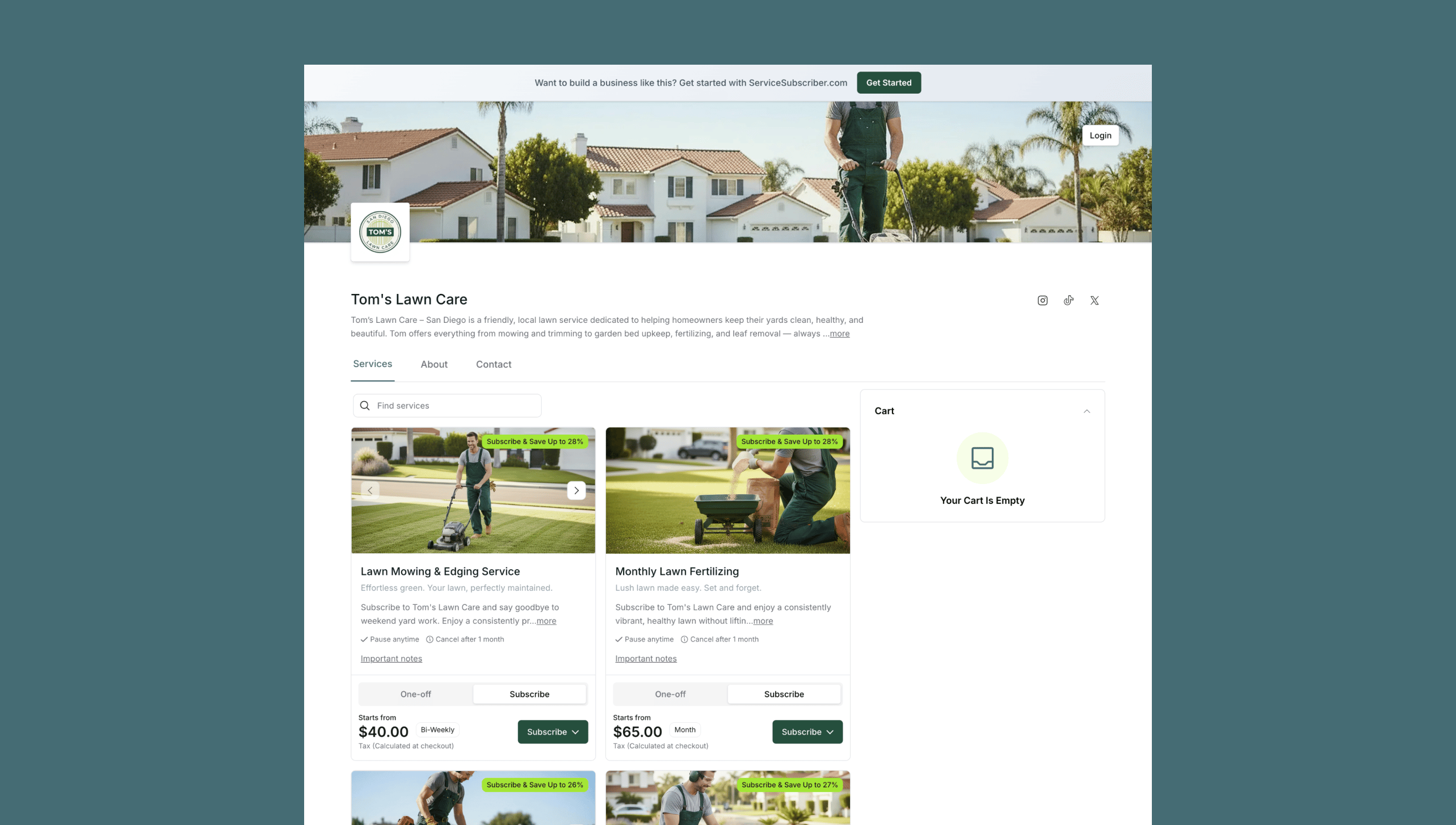
Services listed clearly. Pricing visible upfront. Clients can choose a one-off job or subscribe for regular mowing. Payment handled at checkout. That's the whole experience — for you and for them.
Make the First Job Count
The first job is where a one-off client decides whether they want you back.
The work itself matters — but the things clients remember aren't always the quality of the cut. They're the details around it. Being on time. Leaving the property looking finished, not just mowed. Blowing down the driveway and paths so there are no clippings left sitting on hard surfaces. Closing the gate properly on the way out.
Those things sound basic. They are. They're also the difference between a client who comes back and one who thought it was fine but tries someone else next time.
At the end of the first job, ask a simple question: is there anything you'd like done differently next time? It signals professionalism, gives you information before a preference becomes a reason to switch, and makes the client feel like they're dealing with someone who actually cares about the result.
Your goal after the first job is a recurring subscription. Everything else follows from that.
Getting Paid Consistently
Lawn care should be one of the cleaner businesses to get paid in. The work is visible, the result is immediate, and clients generally don't dispute it.
Where the billing falls apart for a lot of operators is the informality. They finish a job, send an invoice, and wait. Sometimes they wait a while. Then they follow up. It's time-consuming and it creates income that's unpredictable week to week.
The better structure is automatic recurring billing tied to a subscription. A client subscribes to fortnightly mowing. They pay automatically on the billing date. You show up, do the work, mark it done. No invoice. No chasing. The money is there before you start the mower.
Set this up from the beginning, before you have a client base that's used to a different arrangement. Moving existing clients to a subscription model is harder than offering it as the default from the first purchase.
Recurring clients on automatic billing are also, practically speaking, worth more than one-off clients — not just in revenue over time, but in the predictability they give you to plan your schedule, your equipment spending, and eventually whether to take on help.
Putting It Together
A lawn care business in Australia has a lot going for it. The climate creates demand. The culture values a well-kept property. The work naturally repeats. And a client base of regular subscribers gives you something genuinely valuable: income you can count on.
The startup cost is real — higher than some service businesses — but it's not out of reach, and it can be built up gradually if needed. The business side of it is where most operators either build something sustainable or stay stuck at a handful of jobs. Treat the brand, the purchase experience, and the billing structure seriously from the start, and the operational side tends to take care of itself.
Plan before you spend. Brand before you prospect. Get your page live before you hand out the first flyer. Make the first job stand out. Ask for the subscription.
That's the starting point. The rest you figure out as you go.
Ready to start your lawn care business?
Create your service page, share the link, and start getting paid. Clients can choose a one-off mow or subscribe for regular service. You get paid before you start the mower.
14-day free trial. No credit card. 50% off first 3 months.
Did you find this guide helpful?
More guides
Explore other service businesses you can start