

How to Start a Lawn Care Business
Tens of millions of acres of lawn across the country get mowed on a regular schedule. A large portion of that work is done by homeowners who'd genuinely rather pay someone else to do it. A client whose lawn needs cutting every week through the growing season is a client who doesn't go away. This guide covers what you actually need to start, and how to set it up so the income keeps coming.
38+ people found this guide helpful

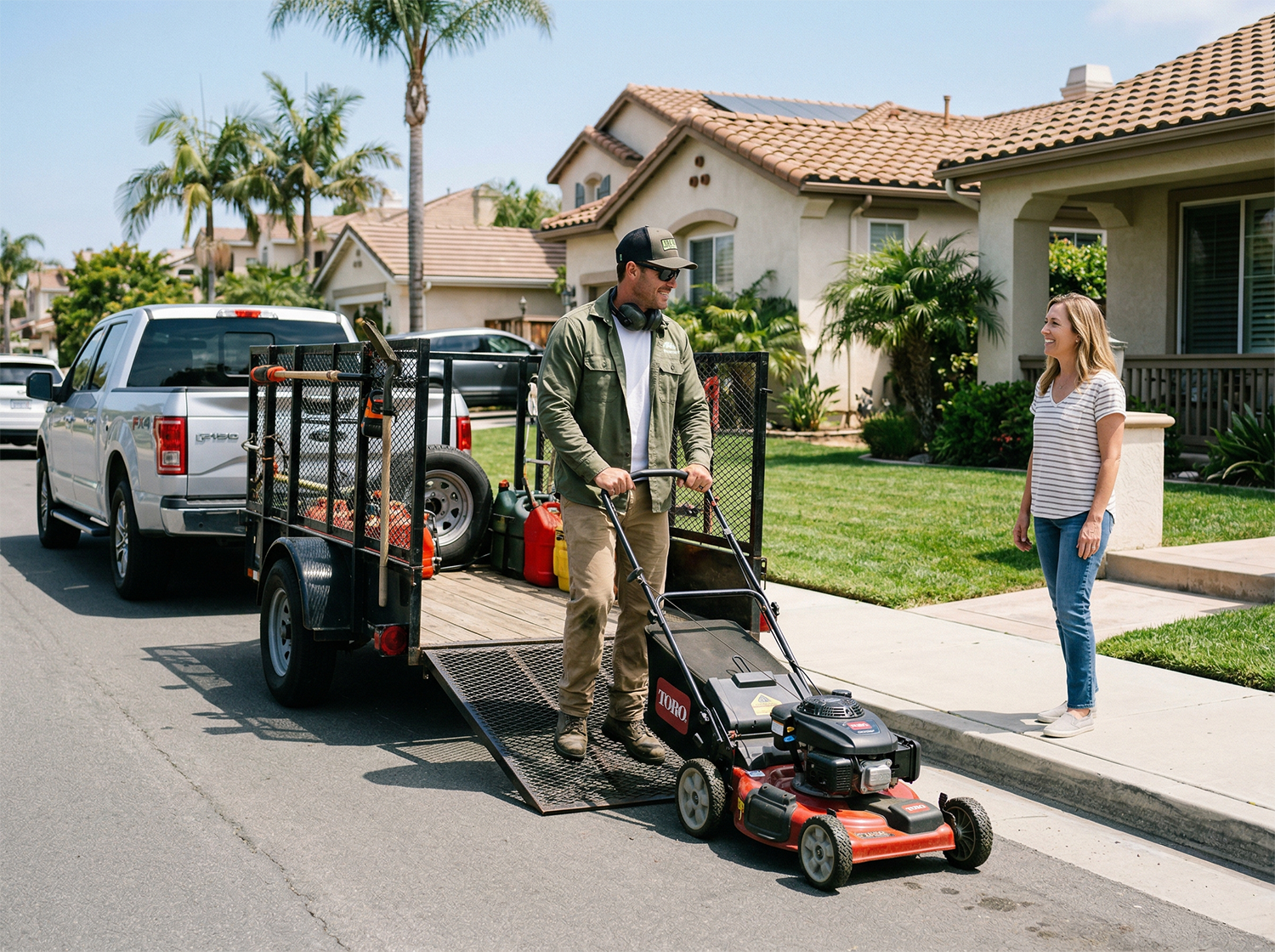
Why Lawn Care Works as a Business
Drive through any suburban neighborhood in America and you'll see the demand playing out in real time. Lawns that need cutting. Edges growing over driveways. Homeowners out on a Saturday morning doing it themselves because they haven't found someone reliable to hand it to.
A portion of those homeowners would genuinely rather pay someone. They want the result without the Saturday morning. That's your market, and in most areas it's larger than it looks.
What makes lawn care particularly good as a recurring business is simple: the grass doesn't stop growing. A client on a weekly schedule in spring is still a client in August. The work regenerates on its own, which means the relationship has a reason to continue without you going out to find new customers every week.
HOA neighborhoods are worth calling out specifically. Homeowners associations have mandatory maintenance standards that residents have to meet. Lawns that fall below those standards trigger notices and fines. That creates a strong incentive for homeowners who don't want to maintain their own lawn to find someone reliable, and it makes HOA communities some of the most productive prospecting territory for a new lawn care operator.
You don't need a background in horticulture to run this business. A working knowledge of what makes a lawn look right, reliable equipment, and a professional approach to the business side is what separates operators who build a full client base from those who stay at a handful of jobs.
Seasonality and Regional Considerations
Lawn care in the US is not the same business in every part of the country. That's worth understanding before you commit to it as your primary income.
In the South and the Sun Belt, including Texas, Florida, Georgia, the Carolinas, and much of the Southwest, the growing season runs most of the year. Some markets are essentially year-round. Warm-season grasses like Bermuda and Zoysia stay active through most of the calendar, and operators in these states tend to have more consistent year-round schedules.
In the Midwest, Northeast, and Pacific Northwest, there's a more pronounced seasonality. The mowing season typically runs from April or May through October. Growth slows significantly in winter, and some clients will pause or reduce frequency. That doesn't make the business unviable. It means planning for it.
Operators in seasonal markets often complement their lawn work with other services during slower months. Leaf cleanup and fall cleanups in October and November. Snow removal in markets that get significant snowfall. Gutter cleaning. Pressure washing. Services that use the same client relationships and similar equipment, and that keep cash flow moving through the winter.
The question to ask before you start: if your area has a slow season of three or four months, what does your income look like during that period? Build a plan for it before it arrives rather than after.
Is This the Right Business for You?
You don't need a passion for lawns. What you need is a genuine interest in running a business, a comfort with physical outdoor work in all kinds of weather, and a willingness to show up reliably week after week.
Clients in lawn care are trusting you with the front face of their property. The lawn is the first thing a visitor or neighbor sees, and it affects how their home looks from the street. That matters to people more than they sometimes let on. The operators who build strong, loyal client bases are the ones who understand this, who treat each job as a reflection of their business rather than just a task to get through.
If the idea of working outdoors, building a route of regular clients, and generating income that doesn't require finding new customers every week appeals to you, it's worth pursuing seriously.
Research and Plan Before You Spend
Lawn care has higher startup costs than something like house cleaning. Equipment, a capable vehicle, possibly a trailer, signage. It adds up. Spending before you've thought through the basics is an easy way to start in a hole.
A one-page execution summary is worth putting together first. Not a formal business plan. Just honest answers to a few questions:
Where will you operate? Define your service area by zip codes, not vague regions. How far are you willing to travel between jobs? A tight geographic area keeps your drive time low and your effective hourly rate higher. Route density matters more in lawn care than almost any other service business.
Who are you servicing? Residential homeowners, rental properties managed by property managers, HOA communities, commercial properties? Each has different needs, different pricing expectations, and different ways of finding you. Start with one. Residential is the natural starting point for most operators.
What does the local market look like? Search for lawn care operators in your target area. Look at what they charge, how they present, what services they offer. If there are established operators, that confirms demand. Your job is to understand where you fit.
Is the area sustainable? Consider property type and density in your target neighborhoods. Apartment-heavy areas have less residential lawn work. Established suburban streets with quarter-acre lots and HOA requirements are the strongest starting environment for a new operator.
Get honest answers to those questions before you buy anything.
Startup Costs: What to Expect
Lawn care sits at a medium startup cost compared to other service businesses. It's not pocket change, but it's not out of reach either, particularly if you start with a more modest equipment setup and reinvest as you grow.
Here's a realistic breakdown:
- Business registration (LLC or DBA filing) — $50 to $200 depending on your state
- EIN from the IRS — Free
- General liability insurance — $600 to $1,200 per year
- Walk-behind mower (commercial quality) — $600 to $2,500
- String trimmer — $150 to $500
- Edger — $100 to $400
- Leaf blower — $100 to $350
- Hand tools (rakes, pruning shears, hand edger) — $75 to $150
- Trailer (if required) — $900 to $3,000 used, more new
- Vehicle signage — $200 to $600
- Branded clothing — $75 to $150
- Door hangers and yard signs — $100 to $200
- Domain name (.com) — $15 to $20 per year
- Platform or payment system — $18 to $39 per month
- Logo and basic branding — $0 if you use AI tools, $150 to $400 if you use a designer
A realistic all-in figure for a well-equipped starting setup sits between $3,000 and $6,500, not including your vehicle. Budget toward the higher end. Equipment decisions made under financial pressure tend to cost more in repairs and downtime than the initial saving is worth.
If budget is a constraint, a push mower and basic hand tools is a viable starting point for smaller residential properties. There's no rule that says you need a full trailer setup before you take your first job. Start with what you can afford, do the work well, and reinvest.
Your Brand
In lawn care, your brand is visible in a way it isn't in most service businesses. Your truck and trailer are parked on the street while you work. Your shirt is on display at every job. Neighbors walk past. That visibility is free marketing, but only if the brand looks like something worth noticing.
It doesn't need to be expensive. It needs to be consistent and professional. The name, the logo, the shirt, the trailer signage. When they all match, it signals that this is a real business run by someone who takes it seriously.
Before you settle on a name, run these checks:
State business name register. Your state's Secretary of State website lets you search whether the name is already registered. If it is, move on.
Federal trade marks. A registered business name doesn't protect you from trade mark claims. A quick check at USPTO.gov before you invest in signage and uniforms is worth doing.
Domain availability. A .com is the standard expectation in the US. Check it before you commit to the name.
Social handles. Check Instagram and Facebook at the same time. When the business name, domain, and handles all align, register everything and move on.
On logos, a good prompt in ChatGPT or Claude gets you to a workable starting point at no cost:
Create a professional logo for [Business Name], a residential lawn care business. Keep it clean and bold. Use [color preference, greens and earthy tones work well]. It needs to look good on a trailer, a work shirt, and a door hanger. Provide 3 or 4 variations.
When you're ready to go further:
Create a brand guide for [Business Name], a residential lawn care business. Include a primary color palette with hex codes, a secondary palette, font recommendations for headings and body text, logo usage rules, and how the brand should appear on vehicle signage, uniforms, door hangers, and social media.
Start simple. Refine it as the business grows.
Insurance, Licensing, and Permits
We're not lawyers or insurance brokers. Get specific advice for your situation. Here's what's worth understanding early.
General liability insurance. Working on someone's property with powered equipment creates real risk: flying debris, damaged garden beds, cracked windows, marks on driveways. General liability insurance covers you when something goes wrong that affects a client's property or a third party. Many clients will ask for proof of coverage before they sign up. Get it before you start, not after. Plan for $600 to $1,200 per year for a solo operator.
Pesticide applicator license. If you plan to offer any chemical treatments, including fertilizers, herbicides, or weed control, most states require a commercial pesticide applicator license. This is not optional. Operating without the required license can void your insurance and expose you to significant liability. Check your state's department of agriculture for the specific requirements before you offer any chemical services. Standard mowing and edging don't carry these requirements.
Vehicle and equipment insurance. Your trailer and equipment are your livelihood. A setup worth several thousand dollars sitting on the street or in your driveway needs to be covered. Make sure your vehicle policy covers commercial use and that your trailer and equipment are insured against theft and damage.
Noise ordinances. Power equipment has restricted hours in residential areas across most US cities and counties. Know what the rules are in your operating area. Running a leaf blower at 7am is a quick way to get a complaint before you've finished the first job.
Business structure. Talk to a free SCORE mentor or your local Small Business Development Center before you decide on sole proprietor versus LLC. Both work to get your first client. The difference matters when something goes wrong on a job. One hour with the right person costs nothing and could save you considerably more.
Define Your Services and Pricing
Before you approach anyone, you need to know what you're offering and what you're charging. The goal is a clear, fixed-price menu that clients can choose from and sign up for without any back and forth.
A lawn care business is built around a core set of recurring services, with one-off services available for clients who need them:
- Weekly Lawn Service. Your core subscription. Mow, edge, and blow. Priced by yard size: small (under 3,000 sq ft), medium (3,000 to 6,000 sq ft), large (6,000 sq ft and up). This is where the predictable income comes from.
- Every Two Weeks Lawn Service. Same service, less frequent. Slightly higher per-visit rate than weekly to account for the additional growth and work. The most common entry point for new residential clients.
- Leaf Cleanup. A fall service. Flat rate per visit or a seasonal add-on to an existing subscription. Natural upsell to your regular mowing clients.
- Hedge and Shrub Trimming. Flat rate per visit. A natural add-on for clients who want full yard maintenance handled in one visit.
- Spring and Fall Cleanups. One-off seasonal services. Good for converting first-time clients to regulars once they've seen your work.
- Snow Removal. In markets with significant snowfall, a natural winter complement to mowing. Keeps cash flow moving in the off-season and retains the client relationship year-round.
On pricing: two things matter. What the local market charges, and what it actually costs you to do the job.
On the cost side, factor in fuel for both the mower and the vehicle, equipment wear and maintenance, travel time between jobs, and your time on site including setup and pack-down. Once you know what a job actually costs you, you know your floor. Anything below that and you're losing ground even when you're busy.
On the market side, look at what established operators in your area charge. Price in the middle of that range, not at the bottom. Undercutting to get started attracts the wrong clients and sets a ceiling on what you can charge later.
Build your pricing around two rates: a subscription rate for regular clients and a higher one-off rate for single visits. Recurring clients get a better price because they give you predictability. That trade-off is the core of building sustainable income from lawn care.
For non-standard properties or commercial accounts, a private subscription invite with a custom price keeps the arrangement clean without cluttering your public page.
This is what ServiceSubscriber does.
A page, payments, and delivery tracking. Live in 20 minutes.
14-day free trial. No credit card.

Equipment
The right equipment for starting out depends on the size of properties in your target area and what your budget allows. Here's what a well-equipped starting setup looks like:
- Mower. A reliable walk-behind mower handles most residential lots under 5,000 square feet. A self-propelled or zero-turn becomes worthwhile when you're regularly working larger properties or running a high-volume route.
- String trimmer. Essential. Edges along fences, walls, and garden beds that the mower can't reach. Buy commercial quality — a trimmer that fails mid-job is a problem that costs more than the saving.
- Edger. For the clean line along driveways and sidewalks. Some operators use their trimmer for this. A dedicated edger is faster and more consistent.
- Leaf blower. For clearing clippings off hard surfaces after mowing. The finish on a job is partly about how clean you leave the driveway and sidewalk.
- Hand tools. Rakes, pruning shears, a hand edger. Small tools you'll reach for on almost every job.
- Fuel cans. Carry enough fuel to get through a full day without stopping. Factor in two-stroke mixing if you're running gas-powered trimmers.
- Trailer or truck bed setup. How you get equipment from job to job. A trailer gives you more capacity and easier loading. A truck bed works for a lighter starting setup.
Buy quality on the items that work hardest: the mower and the string trimmer. Budget options tend to cost more in repairs and downtime than the initial saving is worth. On hand tools, there's less at stake.
Home Depot, Lowe's, and dedicated outdoor power equipment dealers all carry commercial-grade lawn equipment. The specialist dealers tend to have better advice on what suits your specific use case and better service support when something needs maintenance.
Getting Your First Clients
Your first clients are closer than you think. Here's a practical approach.
Door hangers in your target area. Simple design. What you do, what you charge, a QR code to your page. Print 300 and drop them in your target streets on a Saturday morning when people are home and the lawns are visible. Time it to early spring when homeowners are thinking about the season ahead. Expect one to three responses per hundred hangers. That's a reasonable conversion for cold outreach at minimal cost.
Yard signs at every job. A sign in the yard of every property you're working is a passive advertisement to every neighbor who drives or walks past. Ask clients if they're comfortable with it. Most will say yes. One note: HOA neighborhoods often have rules on signage. Check before putting one up in a managed community.
Nextdoor. Introduce yourself in local neighborhood feeds. Be specific about your service area, what you offer, and what you charge. Ask satisfied clients to post a recommendation. A few genuine neighbor endorsements in the same zip code is worth more than any paid advertisement.
Local Facebook groups. Most neighborhoods have an active one. Introduce yourself at the start of mowing season. Post photos of your work. Be helpful when people ask questions about lawn care. Consistent presence in these groups builds name recognition over time.
Google Business Profile. Free to set up at business.google.com. Fill it out completely. When someone searches for a lawn care service in your area, a verified listing with a few reviews means you can show up in local results. Ask your first five clients for a review.
Property managers. Rental properties need regular maintenance and landlords generally want it handled without fuss. A professional introduction to local property management offices can open up reliable, repeating work from clients who tend to pay consistently and stay long-term.
Ask for referrals. After your first few jobs, ask directly. A happy client will almost always refer you if you ask. They won't always think to do it unprompted.
Give Clients a Way to Sign Up
A door hanger with your phone number is a starting point. But when someone scans the QR code or types in your address, they should land somewhere that shows what you offer, what you charge, and lets them sign up without having to call you or wait for a response.
The easier you make it to become a regular client, the more likely that first inquiry turns into a weekly subscription rather than a one-off job that doesn't repeat.
Here's an example of what a professional lawn care page looks like in practice:
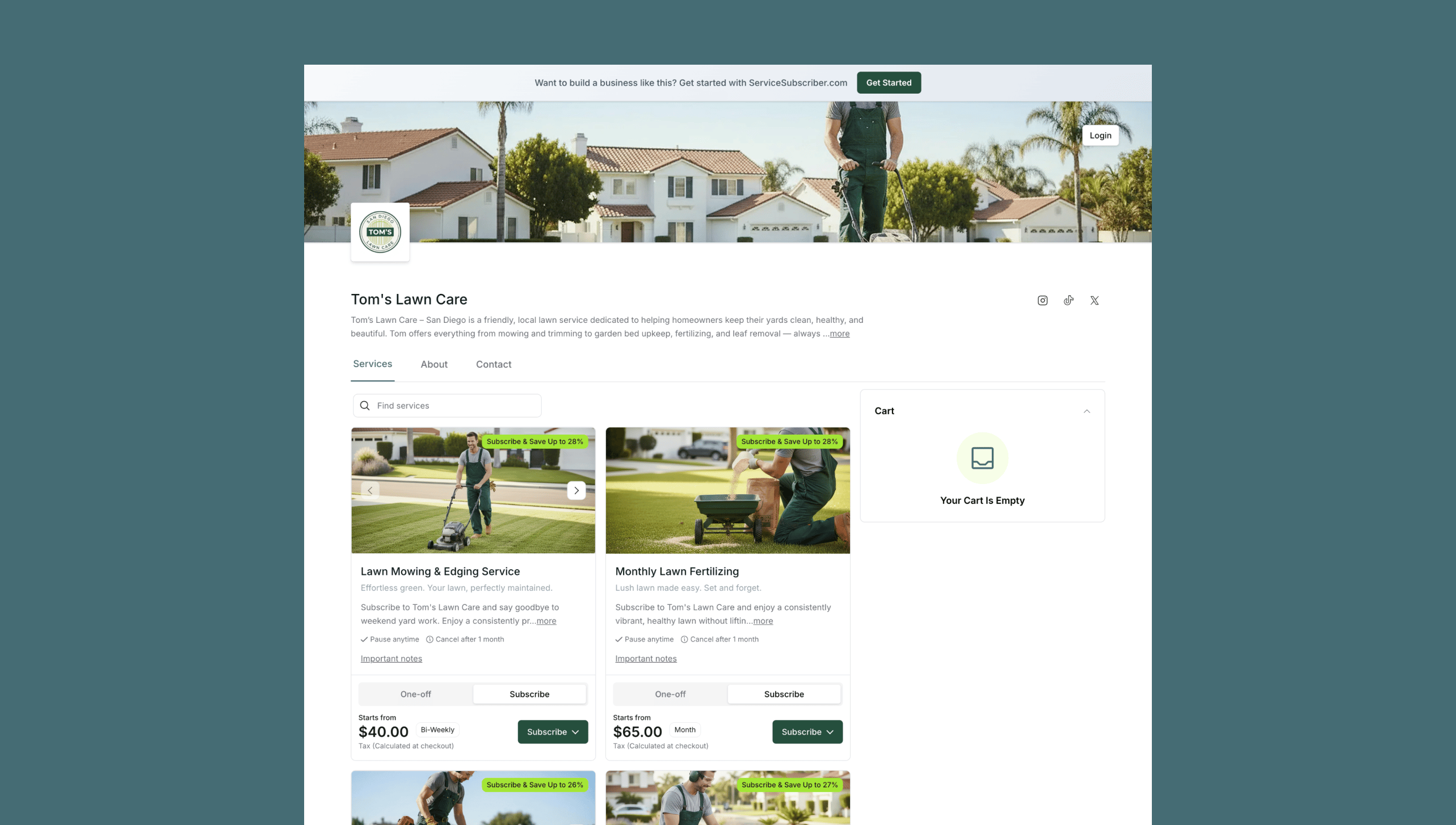
Services listed clearly. Pricing visible upfront. Clients choose a one-off visit or subscribe for regular mowing. Payment handled at checkout. That's the whole experience, for you and for them. For non-standard properties or commercial accounts, a private subscription invite with a custom price keeps things clean without cluttering your public page.
Make the First Job Count
The first job is where a one-off client decides whether they want you back.
The quality of the cut matters. But the things clients remember aren't always what you'd expect. Being on time. Leaving the property looking finished, not just mowed. Blowing clippings off the driveway and sidewalk so there's nothing left sitting on hard surfaces. Closing the gate properly on the way out. These things sound basic because they are. They're also the difference between a client who subscribes and one who thought it was fine but tries someone else next time.
At the end of the first job, ask a simple question: is there anything you'd like done differently next time? It signals professionalism, gives you information before a preference becomes a reason to switch, and makes the client feel like they're dealing with someone who actually cares about the result.
Your goal after the first job is a recurring subscription. Everything else follows from that.
Getting Paid Consistently
Lawn care tends to be straightforward to get paid for. The work is visible and the result is immediate. But payment issues still happen. Clients who forget you came. Seasonal pauses that turn into cancellations without notice. Invoices that sit unreturned.
Where the billing falls apart for a lot of operators is the informality. They finish a job, send an invoice, and wait. Sometimes they wait a while. Then they follow up. It's time-consuming and it creates income that's unpredictable week to week.
The better structure is automatic recurring billing tied to a subscription. A client signs up for weekly mowing. They pay automatically on the billing date. You show up, do the work, mark it done. No invoice. No chasing. The payment processes before you start the mower.
Set this up from the beginning, before you have a client base that's used to a different arrangement. Moving existing clients onto a subscription model is harder than offering it as the default from the first sign-up.
Recurring clients on automatic billing are also worth more in a practical sense, not just in revenue over time, but in the predictability they give you to plan your schedule, your equipment spending, and eventually whether to take on help.
Putting It Together
Lawn care in the US has a lot going for it. The demand is everywhere. The culture values a well-kept property. The work naturally repeats. And HOA communities create a guaranteed, motivated customer base in neighborhood after neighborhood across the country.
The startup cost is real, higher than some service businesses, but it's manageable and can be built up gradually. The business side of things is where most operators either build something sustainable or stay stuck at a handful of jobs. Treat the brand, the sign-up experience, and the billing structure seriously from the start, and the operational side tends to take care of itself.
Plan before you spend. Brand before you prospect. Get your page live before you drop your first door hanger. Make the first job stand out. Ask for the subscription.
That's the starting point. The rest you figure out as you go.
Ready to start your lawn care business?
Create your service page, share the link, and start getting paid. Clients can choose a one-off mow or subscribe for regular service. You get paid before you start the mower.
14-day free trial. No credit card. 50% off first 3 months.
Did you find this guide helpful?
More guides
Explore other service businesses you can start
How to Start a Service Business
The complete starting point for any service business.
Read guide
How to Start a Cleaning Business
Low startup costs, same residential client base.
Read guide
How to Start a Pressure Washing Business
Dramatic results, strong demand in the same neighborhoods.
Read guide