How to Start a Pressure Washing Business
There's something genuinely satisfying about pressure washing. The before and after is immediate and visible, and clients feel it too. Once you've seen what a clean driveway or house exterior does for a property, it's hard not to look at every grimy surface as an opportunity. The demand is everywhere. Getting set up properly is what separates operators who build something from those who stay stuck at one-off jobs.
36+ people found this guide helpful

Why Pressure Washing Works as a Business
Almost every home is a potential prospect. Driveways, sidewalks, siding, decks, fences, patios, roofs. Every exterior surface accumulates grime, algae, mold, and weathering over time. Most homeowners stop noticing the buildup until it's pointed out or until they see a neighbor's property looking freshly cleaned. Then they can't unsee it.
Pressure washing sells itself on sight. A clean driveway next to a dirty one. A freshly washed house on a street of weathered facades. That visual contrast is your marketing working for you without saying anything.
The recurring model is slightly different from cleaning or lawn care. How often surfaces need attention depends heavily on climate, tree coverage, and property type. In humid Southern markets or areas with significant tree canopy, driveways and siding can need cleaning every year or so. In drier climates, every two to three years is more common. Either way, that makes a scheduled repeat service a predictable, returning source of income, and a single job on a street is a visual advertisement to every neighbor who walks past.
Commercial properties, restaurants, gas stations, retail centers, and apartment complexes often need cleaning far more frequently, sometimes monthly. Building those relationships alongside a residential base is how operators in this category build genuinely substantial businesses.
Is This the Right Business for You?
You don't need a background in cleaning or construction. What you need is a willingness to learn the technical side properly, a comfort with physical outdoor work, and a genuine interest in building a business rather than just doing jobs.
There is a real learning curve on the technical side. Different surfaces respond very differently to pressure, water temperature, and chemical application. Getting it wrong on a paying client's property is expensive in more ways than one. That's worth taking seriously before you start, not after.
The good news is the knowledge is accessible. There are active communities of professional operators online who share technique openly and have already made the mistakes you'd otherwise make yourself. More on that below.
If the idea of working outdoors, delivering a visually satisfying result, and building a client base that keeps coming back every season appeals to you, it's worth pursuing.
Knowing Your Surfaces and Techniques
We're not going to walk you through nozzle selection, pressure settings, and dwell times in a guide like this. The experienced operators know far more than we do about surface-specific technique, and the right place to learn that isn't a startup guide. What we can say is that understanding the basics before you work on a paying client's property is non-negotiable.
A few things worth knowing before you start:
Soft washing. Not every surface should see high pressure. Roofs, painted siding, wood, stucco, and vinyl respond much better to a low-pressure, chemical-assisted clean. The detergent does the work. The pressure rinses it off. Getting this wrong strips paint, damages wood, and blows water behind siding. Getting it right is what separates operators who build a reputation from those who generate complaints and chargebacks.
Pressure washing. High pressure is appropriate for hard surfaces: concrete driveways, brick pavers, stone paths, concrete block walls. Even here, distance from the surface, nozzle angle, and movement speed all affect the result. Concrete striping from an inconsistent pass is a common beginner mistake that's visible from the street.
Surface familiarity. Composite decking, wood decking, Hardie board siding, brick, painted concrete, natural stone, asphalt shingles, metal roofs. Each has different tolerances. Before you quote a job on a surface type you haven't worked on before, do the research. Don't learn on a client's property.
Chemical knowledge. Sodium hypochlorite, degreaser, efflorescence remover, wood brighteners. Understanding what to use on what surface, at what dilution, and what not to mix is part of the job. The technical side of chemicals is worth investing time in early.
The operators who build strong reputations in this business treat the technical side seriously from the start. A job done incorrectly isn't just a complaint. It's a costly repair, a lost client, and in some cases a liability claim.
Learn From the Communities Before You Spend
Pressure washing has unusually active and generous online communities compared to most service categories. Experienced operators share technique, equipment recommendations, chemical ratios, pricing strategies, and hard-won lessons openly. Spending time in these communities before you spend money on equipment will save you both.
The places worth finding:
Facebook groups. There are dedicated pressure washing and soft washing groups with tens of thousands of members. Search for them directly. The conversations cover everything from which machine held up after three years of use to how to handle a customer dispute over a damaged surface. Real operators talking about real problems. Genuinely useful.
Reddit. The pressure washing subreddit has active threads on equipment, technique, and business questions. Worth reading through before you make any significant purchase decisions.
YouTube. A significant community of professional pressure washers share technique, equipment reviews, and business content. Before you quote a job type you haven't done before, there's almost certainly a video walking through exactly that surface and situation.
The collective knowledge in these communities represents thousands of hours of trial and error. Use it. You'll arrive at better equipment choices, better technique, and a clearer picture of the business before you've made any expensive mistakes.
Research and Plan Before You Start
A one-page execution summary before you spend anything is worth the time.
Where will you operate? Define your service area. A tight radius keeps travel time low and your effective rate higher. Residential suburbs with established homes are the strongest starting point. Older properties accumulate more grime and tend to have more surfaces worth cleaning.
Who are you targeting? Homeowners who take pride in how their property looks. Property managers who want rental properties presentable between tenants. HOA communities with common areas and exterior standards. Commercial properties that need regular maintenance. The residential homeowner is the most accessible starting point. Commercial and property management relationships are worth building for the longer term.
What will you offer to start? Driveway and sidewalk cleaning, house exterior washing, deck and fence cleaning, roof soft washing. You don't need to offer everything from day one. Start with the services you can deliver confidently and expand as your skills and equipment grow.
What does the local market look like? Search for pressure washing businesses in your area. Look at what they charge, how they present, what services they lead with. Understand where there's room for you and what you'd offer differently.
Startup Costs: What to Expect
Pressure washing sits in a comfortable range for startup costs. Not as cheap as cleaning, not as expensive as a full trailer-based bin cleaning setup. Here's a realistic breakdown:
- Business registration (LLC or DBA filing) — $50 to $200 depending on your state
- EIN from the IRS — Free
- General liability insurance — $600 to $1,400 per year
- Pressure washer (commercial grade) — $800 to $3,500 (more on this below)
- Surface cleaner attachment — $100 to $400
- Hoses, wands, and nozzle set — $150 to $400
- Downstream injector and chemical application setup — $50 to $200
- Chemical starter kit (sodium hypochlorite, degreaser, neutralizer) — $150 to $400
- Water tank (for areas without accessible supply) — $200 to $600
- Vehicle signage — $200 to $600
- Branded clothing — $75 to $150
- Door hangers and marketing materials — $100 to $200
- Domain name (.com) — $15 to $20 per year
- Platform or payment system — $18 to $39 per month
- Logo and basic branding — $0 if you use AI tools, $150 to $400 if you use a designer
A realistic all-in starting figure is $2,500 to $6,500, not including your vehicle. The range depends significantly on the pressure washer you start with. Budget toward the higher end. Cutting corners on the machine is where most early operators end up spending more in the long run.
Equipment: Residential Grade vs Commercial Grade
The most important equipment decision you'll make is the pressure washer itself. And the most important distinction to understand before you make it is the difference between residential-grade and commercial-grade machines.
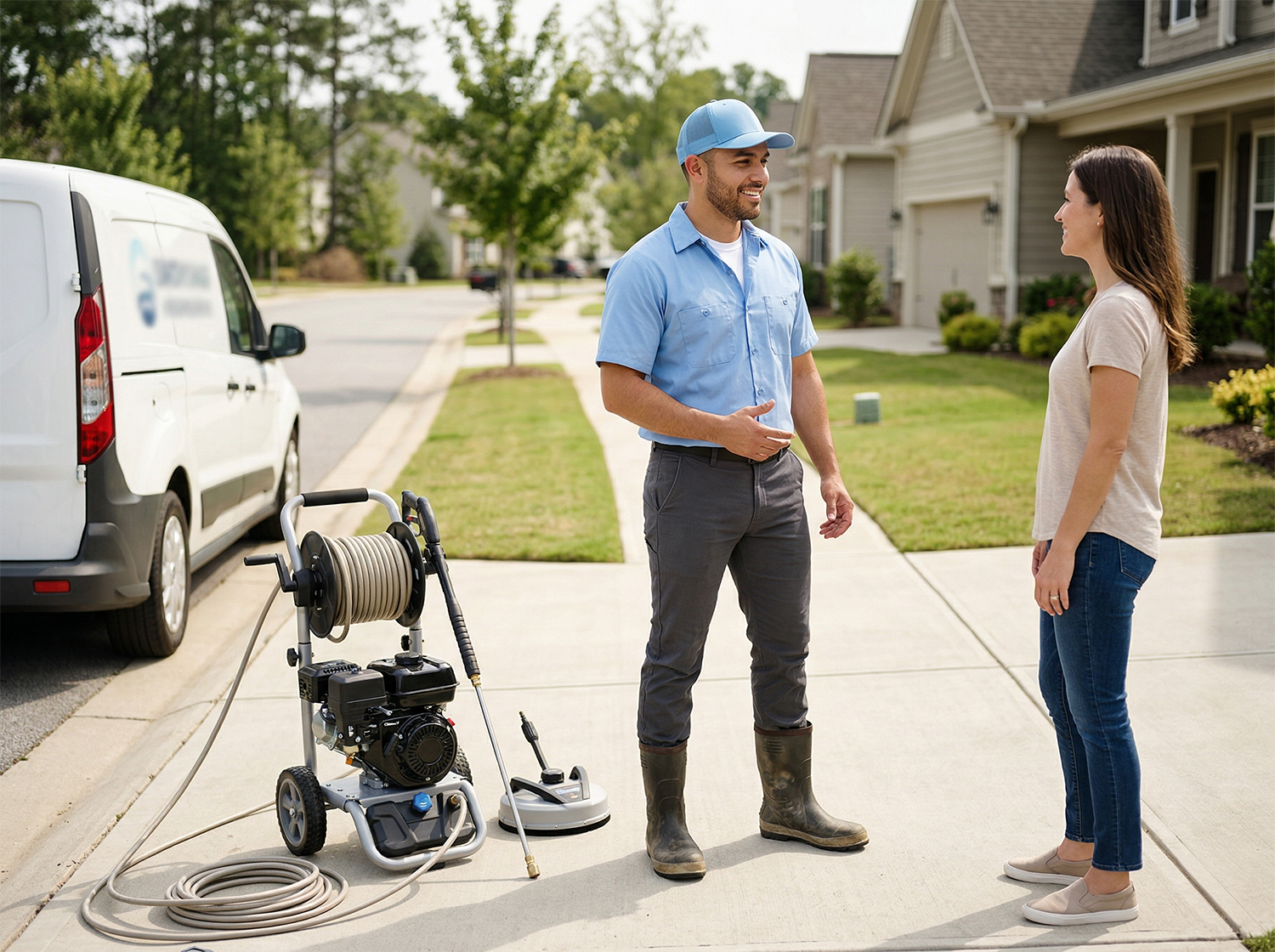
Residential-grade machines are built for occasional home use. Lower PSI, lighter-duty pumps, electric motors or smaller gas engines. They're cheaper upfront and widely available at hardware stores. They're also not built for the daily use of a professional operation. Running a residential machine through a full working day, multiple days a week, will wear it out far faster than its intended use. Repairs, downtime, and replacement costs tend to eliminate the initial saving quickly.
Commercial-grade machines are built for professional use. Higher PSI and GPM (gallons per minute), more durable pumps, larger engines. They cost more upfront but are designed to handle the volume of a working operator. GPM matters as much as PSI for most professional cleaning work. A higher-GPM machine at moderate pressure often cleans more effectively and faster than a high-PSI machine with lower flow.
Hot water machines are a step up again. Heated water significantly improves performance on grease, oil, and organic buildup. Worth understanding as a future investment for commercial work, but not a day-one requirement for most residential operations.
Before you buy anything, spend time in the Facebook and Reddit communities mentioned earlier. Ask what machines operators in your market are running after two or three years of real use. The difference between a machine that's still running well and one that's been rebuilt twice is worth understanding before you commit to a purchase. The community will tell you what the spec sheets won't.
Beyond the machine:
- Surface cleaner attachment. Significantly faster and more consistent on flat concrete surfaces than a wand. Worth buying early.
- Quality hoses and fittings. Cheap hoses fail. Buy once.
- Nozzle set. Different degrees for different applications. Understand what each does before you point it at a surface.
- Chemical downstream injector. For applying soft wash chemicals at low pressure. Essential if you're doing house washing or roof cleaning.
- Protective gear. Safety glasses, non-slip boots, gloves. High-pressure water causes serious injury at close range.
Your Brand
Your vehicle is advertising on every street you work. A professional-looking truck and a clean, consistent brand signal that this is a real business run by someone who takes it seriously. That matters to clients who are deciding whether to let someone with high-pressure equipment near their siding and driveway.
Before you settle on a name, run the standard checks:
State business name register. Your state's Secretary of State website. If it's taken, move on.
Federal trade marks. A quick check at USPTO.gov before you invest in signage and uniforms.
Domain availability. A .com. Check it before you commit to the name.
Social handles. Instagram and Facebook at the same time. When the name, domain, and handles all align, register everything and move on.
On logos:
Create a professional logo for [Business Name], a pressure washing and exterior cleaning business. Bold and clean. Use [color preference]. It needs to work on a truck door, a work shirt, and a door hanger. Provide 3 or 4 variations.
When you're ready to go further:
Create a brand guide for [Business Name], a pressure washing and exterior cleaning business. Include a primary color palette with hex codes, a secondary palette, font recommendations for headings and body text, logo usage rules, and how the brand should appear on vehicle signage, uniforms, door hangers, and social media.
Insurance, Licensing, and Permits
We're not lawyers or insurance brokers. Get specific advice for your situation.
General liability insurance. Non-negotiable before your first job. You're operating high-pressure equipment near homes, vehicles, and people. Broken windows, damaged siding, stripped paint, and slip hazards from wet surfaces are all real risks. A basic policy for a solo operator runs $600 to $1,400 per year depending on your location and revenue. Get it before you start, not after something goes wrong.
Chemical handling. Some states and municipalities have regulations around the storage, transportation, and application of chemicals used in soft washing. Worth checking what applies in your area before you start carrying and applying chemicals on the job.
Wastewater runoff. Pressure washing generates wastewater containing detergents, chemicals, oil, and biological material. In many municipalities, particularly in California, Florida, and other states with strict stormwater regulations, allowing this to run into storm drains is regulated or prohibited. Understanding what applies in your operating area and having a basic containment plan for commercial jobs is worth sorting out early, even if enforcement in your specific market is light.
Business structure. Talk to a free SCORE mentor or your local SBDC about whether sole proprietor or LLC makes sense for your situation. The liability exposure in this business from equipment damage and chemical incidents makes this conversation worth having before you take your first job.
HOA and local permits. Some HOA communities have specific rules around contractor access, vehicle parking, and water usage. Commercial jobs may require permits or certificates of insurance with the property owner named as additional insured. Understand what's required on a job-by-job basis before you show up.
Define Your Services and Pricing
The goal is a clear, fixed-price menu for standard jobs that clients can choose from without back and forth. Many common residential jobs can be estimated from property size alone, which is the point of productized pricing. That said, some jobs genuinely need a look first, whether in person or via photos sent by the client. Staining severity, access, available water source, and size can all affect what a job actually takes. Build your menu around the standard cases, and have a process for quoting the non-standard ones.
- Driveway Cleaning. Standard, two-car, large. Flat rate by size. Your most common residential job and the natural starting point for most new customers.
- House Exterior Wash. Soft wash of siding, fascias, and soffits. Priced by home size: single story, two story, large two story. Recurs on a schedule that depends on your climate and the client's property.
- Deck and Patio Cleaning. Flat rate by deck size: small, standard, large. Composite decking, wood, and concrete each require different approaches, worth noting in your service description.
- Fence Cleaning. Flat rate by fence length: short run, standard yard, full perimeter. Note material type in your service description so clients choose correctly.
- Roof Soft Wash. Priced by roof size. A high-value service that requires proper technique and the right chemical mix. Not a job to offer until you're confident in the method.
- Sidewalk and Walkway Cleaning. Flat rate. Often bundled with a driveway job at a slightly discounted combined price.
- Eco-Friendly Exterior Wash. Worth considering as a distinct service offering if there's demand in your market. Plant-safe, biodegradable detergents are increasingly available and some clients actively seek them out, particularly for homes with garden beds close to surfaces being cleaned. A small premium for the eco option is reasonable and positions you differently from competitors who don't offer it.
- Commercial Cleaning. Parking lots, storefronts, building exteriors, loading docks. Higher value, more frequent, and best handled via a private subscription invite with a custom price rather than a public listing.
On pricing: know your cost per job before you set your prices. Factor in your time including travel, fuel, chemicals, equipment wear, and insurance. That's your floor. Price above it in the middle of your local market.
Bundle logically. A client who wants their driveway cleaned is a natural candidate for their sidewalk and front path at the same visit. The conversation takes two minutes and adds meaningful revenue per job. Think through these combinations before you're standing in front of your first customer.
For recurring clients, scheduled repeat services on a defined cycle work better in this category than open-ended "call when you need us" arrangements. A client who signs up for an annual or twice-yearly exterior wash is worth more in practice than one you have to chase or remind each time.
This is what ServiceSubscriber does.
A page, payments, and delivery tracking. Live in 20 minutes.
14-day free trial. No credit card.

Getting Your First Customers
Every house with a dirty driveway is a prospect. In most neighborhoods, that's most houses.
Door hangers timed to the right season. Early spring is the strongest time to drop door hangers in most US markets. Homeowners are thinking about their property after winter, driveways show months of salt, grime, and debris, and the contrast between a clean and dirty surface is at its most obvious. Print 300 and drop them in your target streets on a weekend morning. Include before and after photos if you have them. A dramatic result image on a door hanger does more work than any copy.
Yard signs at every job. A sign in the yard while you're working is a passive advertisement to every neighbor who drives or walks past. Ask clients if they're comfortable with it. Most will say yes. HOA communities may restrict signage, so check before putting one up in a managed neighborhood.
Nextdoor. Introduce yourself to your local area. Be specific about what you offer and what you charge. Before and after photos perform particularly well on Nextdoor in this category. Ask satisfied clients to post a recommendation. Neighbor endorsements in the same zip code carry real weight.
Local Facebook groups. Post your work. Introduce yourself at the start of the season. Answer questions when people ask about cleaning their surfaces. Consistent presence builds recognition over time.
Google Business Profile. Free at business.google.com. Fill it out completely. Ask your first customers for a review. A verified listing with reviews puts you in front of people searching for a pressure washer in your area.
Property managers and HOA boards. Rental properties and common areas in managed communities need regular exterior cleaning. A professional introduction with fixed pricing can open up recurring contract work that runs on its own once established.
Ask for referrals. After a good job, ask. Most people are happy to refer you to a neighbor if asked directly.
Give Customers a Way to Subscribe
When someone scans your QR code from a door hanger or finds you through Nextdoor, they should land somewhere that shows what you offer, what you charge, and lets them sign up without having to call you or wait for a response.
Services and pricing upfront. Clients choose the service they need, sign up, and pay at checkout. You get notified. You add them to your schedule. For commercial clients or non-standard jobs, a private subscription invite with a custom price keeps the arrangement clean without cluttering your public page.
The entire experience after sign-up should be automatic. Client signs up, payment processes on the billing date, you show up on schedule, do the work, mark it done. No invoice, no chasing, no back and forth about the next visit.
Make the First Job Count
The result of a pressure wash is immediately visible to the client and to every neighbor. Both of those things work in your favor.
Do a thorough job. Don't rush the first visit. The result is your advertisement on that street. A dramatically clean driveway next to the ones that haven't been touched is the most effective marketing you have.
Leave the property tidy. Rinse residual detergent off nearby plants and grass. Clear any debris that ended up somewhere it shouldn't. Leave it the way you'd want someone to leave your own property.
Point out what you noticed. If there's a section of fence that has significant mold buildup, mention it. If the back patio looks like it needs attention, note it. You're not pitching an upsell aggressively. You're being helpful. Clients appreciate it and it often leads to additional work at that visit or the next.
The neighbors will notice. A dramatically clean driveway on a street of dirty ones is the kind of thing people ask about. You don't need to do anything extra for that to happen. Do the work well and let the result do the prospecting.
Getting Paid Consistently
Pressure washing sits between truly recurring services like weekly lawn care and pure one-off trades. The work repeats, but on a longer cycle. That makes the billing structure worth thinking through carefully.
For residential clients on an annual or twice-yearly schedule, a simple automatic payment tied to a scheduled return service is the cleanest setup. The client signs up once. The payment processes before each service visit. You show up, do the work, mark it done. No invoice, no reminder, no wondering whether they want you back.
For commercial clients on a monthly or quarterly schedule, the same structure applies with a shorter cycle. These relationships tend to be more consistent than residential and once established they run largely on their own.
Set up scheduled recurring payments from the start rather than invoicing after every job. It's harder to shift existing clients onto an automatic payment model than to offer it as the default from the first sign-up.
Putting It Together
Pressure washing is a business where the quality of the work is visible from the street, where every job on a residential block is marketing to ten more potential clients, and where the demand for the service exists in almost every market in the country.
Invest in the technical side before you take your first paid job. Spend time in the communities where experienced operators talk openly about what works. Buy equipment that will last rather than equipment that's cheap. Build a brand that looks professional from the truck to the door hanger.
Get your page live before you drop your first door hanger. Price for recurring from the start. Make the first job look as good as you can make it. Let the result do the marketing for you.
That's the starting point. The rest you figure out as you go.
Ready to start your pressure washing business?
Create your service page, share the link, and start getting paid. Customers can sign up for a one-off clean or subscribe for regular service. You get paid before you show up.
14-day free trial. No credit card. 50% off first 3 months.
Did you find this guide helpful?
More guides
Explore other service businesses you can start