How to Start a Car Detailing Business in Australia
Cars get dirty every week. Rain, road grime, dust, bird droppings. It doesn't stop. And most car owners care about how their vehicle looks far more than they're prepared to do anything about it themselves. That gap is where a detailing business lives.
34+ people found this guide helpful

Why Car Detailing Works as a Business
Of all the service businesses you could start, car detailing might be the most natural fit for a subscription model. Not because we're trying to force recurring billing onto something that doesn't need it. Because cars genuinely, reliably get dirty again. Every single week.
Rain carries road grime onto the panels. Bird droppings etch into clear coat if left too long. Dust settles on dashboards. The interior accumulates the residue of daily life. The owner who cares about their car knows it needs attention regularly. The owner who doesn't care enough to do it themselves, which is most of them, is looking for someone they can trust to just take care of it.
That's the client base. It's enormous. It's everywhere. And once you've found a client who values a clean car, they tend to stay.
We've seen people start this business with very little more than a kit, a car, and a willingness to show up on time and do good work. Some have built full-time incomes from it. Others run it alongside other work to build a client base before going all in. Both approaches work. The starting point is accessible in a way that most businesses aren't.
Mobile Versus a Fixed Location
This guide is focused on mobile detailing. Not because fixed workshops aren't a legitimate business, but because for someone starting out, a fixed location requires commercial rent, fit-out costs, and a client base willing to travel to you. That's a significant barrier before you've established anything.
Mobile removes that barrier. You go to the client. Their home, their workplace, their apartment complex car park. You bring everything you need. They hand over the keys and get on with their day.
For clients, that convenience is a genuine selling point. No drop-off. No pick-up. No waiting around. The car is clean when they come home from work or walk back from their desk at lunch. That's a service worth paying for, and worth paying a premium over a fixed-location wash that requires their time as well as their money.
Mobile also means lower ongoing costs. No rent. No utilities beyond what you're already paying. Your vehicle is your premises and your advertisement. The trade-off is that you're working in varied conditions, dependent on the space and water access available at each location, and spending time driving between jobs. That's worth factoring into how you price and schedule.
Start mobile. If a fixed location makes sense later once you have a full client base and a reason to add the overhead, that's a decision you can make from a position of strength.
Is This the Right Business for You?
Car detailing rewards people who take genuine pride in the result. If you enjoy the process of making something look genuinely good, and you can see yourself doing that repeatedly across different vehicles and conditions, that's a reasonable foundation.
It's also a business where technique matters. The products, the application method, the order of operations. Doing a paint correction incorrectly can cause more damage than it fixes. Applying a ceramic coating without proper surface preparation is money wasted for the client and a complaint waiting to happen. There's a real skill set here, and it deepens over time.
You don't need to master everything before you start. A competent wash, decontamination, interior clean, and protection application is a service most clients are delighted with. Start there. Learn the higher-end services as your skills and confidence grow.
What you do need from day one is reliability and communication. Clients are trusting you with their vehicle. They've arranged their day around your arrival time. Show up when you say you will, do what you said you'd do, and leave the car in better condition than you found it. That, more than any product or technique, is what generates repeat clients and referrals.
Research and Plan Before You Start
A one-page plan before you spend anything is worth more than it sounds.
Where will you operate? Define your service area. A tight geographic radius keeps travel time low and your effective hourly rate higher. Residential suburbs with a mix of houses and apartment buildings give you two distinct client types. Workplaces and office parks are worth noting for midday services.
Who are you targeting? Busy professionals who don't have time to detail their own car. Families with multiple vehicles. Business owners who care about how their fleet or personal car presents. Classic or prestige car owners who want specialist care. You don't need to serve everyone. Start with the clients most likely to subscribe to regular maintenance.
What will you offer? Basic wash and interior clean as your entry service, maintenance details for regular subscribers, full detail for new or neglected vehicles, paint protection and ceramic coating as premium add-ons. Map it out before you need to explain it to a client.
What does the local market look like? Search for mobile car detailers in your area. Look at how they present, what they charge, what services they lead with, and where there's room to differentiate. Price, availability, and trust are all factors. Understand where you can compete.
Capital: What to Expect
Mobile car detailing sits at a genuinely accessible startup cost. You don't need a van or trailer to start. A car and a quality kit is enough to take your first clients. The setup can grow as your income does.
Here's a rough breakdown for starting in Australia:
- ABN registration — Free
- Business name registration (ASIC) — Around $42 for one year, $98 for three years
- Domain name (.com.au or .au) — $20 to $50 per year
- Public liability insurance — $600 to $1,200 per year
- Pressure washer or foam cannon setup — $300 to $900
- Portable water tank (if needed) — $200 to $600
- Wet/dry vacuum — $150 to $400
- Polisher (dual action) — $200 to $600
- Starter chemical kit (shampoo, degreasers, protectants, glass cleaner, tyre dressing) — $300 to $500
- Microfibre towels, applicators, and brushes — $100 to $200
- Detail spray, interior protectant, and paint sealant — $150 to $300
- Buckets, wash mitts, and grit guards — $50 to $100
- Branded clothing — $100 to $200
- Vehicle signage — $200 to $600
- Flyers and marketing materials — $100 to $200
- Platform or payment system — $18 to $39 per month
- Logo and basic branding — $0 if you use AI tools, $200 to $500 if you use a designer
A realistic starting figure is $2,500 to $5,000, not including your vehicle. A van or trailer with a dedicated setup comes later when the income justifies it. Start lean. Get your first clients. Invest from there.
Your Brand
Car detailing clients are often buying on trust before they've seen your work. They're handing over their vehicle. A professional brand signals that this is a real business run by someone who cares about the result, before you've had the chance to prove it in person.
It doesn't have to be expensive. It has to be consistent. The name, the polo, the vehicle signage, the page they land on when they scan your QR code. When those things all match, it works.
Before you commit to a name, run it through the usual checks:
ASIC business name register. Search at business.gov.au. If it's taken, move on.
Trade marks. A quick check at ipaustralia.gov.au before you put the name on a van. A business name registration doesn't protect you from trade mark claims.
Domain availability. A .com.au or .au extension. Check it before you settle on the name.
Social handles. Instagram in particular. Car detailing content performs well visually. Before and afters, paint correction close-ups, ceramic coating water beading. When the name, domain, and handles align, register everything and move on.
On logos, a good prompt in ChatGPT or Claude gets you somewhere useful quickly:
Create a professional logo for [Business Name], a mobile car detailing business in Australia. Keep it bold and clean. Use [colour preference]. It needs to work on a vehicle door, a work polo, and a service page. Provide 3 or 4 variations.
When you're ready to go further:
Create a brand guide for [Business Name], a mobile car detailing business in Australia. Include a primary colour palette with hex codes, a secondary palette, font recommendations for headings and body text, logo usage rules, and how the brand should appear on vehicle signage, uniforms, flyers, and social media.
Insurance, Licences, and Permits
We're not lawyers or insurance brokers. Get specific advice for your situation. Here's what's worth sorting out early.
Public liability insurance. You're working on someone's vehicle. A scratch, a product reaction on paint, damage to trim or interior. These things happen, even to careful operators. Public liability insurance covers you when they do. Get it before you start work on a paying client's car.
Vehicle insurance. If you're using your personal vehicle for business purposes, check your policy. Many personal vehicle policies don't cover commercial use. Let your insurer know you're using the vehicle for business and confirm your coverage is appropriate.
Water use. Some local councils and strata complexes have restrictions on water use in common areas or car parks. Worth understanding before you show up to a job and find you can't connect to a tap or discharge onto the ground.
Chemical handling and disposal. The runoff from car washing contains detergents, oils, and residue from brake dust and road grime. In most residential settings this isn't a regulated issue, but in car parks or commercial areas there may be requirements around where wastewater can go. A waterless or low-water wash option is worth having in your kit for situations where drainage is a concern.
Licences. No specific licence is required for car detailing in Australia. The usual business registrations apply.
Define Your Services and Pricing
Before you quote anyone, know what you offer and what you charge for it. Detailing services span a wide range of depth and price, and being clear about what each tier includes saves time and avoids mismatched expectations.
A sensible starting structure:
- Maintenance Wash. Your subscription service. Exterior hand wash, wheel clean, tyre dressing, interior vacuum, dash and console wipe, glass clean. Fast, consistent, and exactly what a regular client needs to keep their car looking good. This is the service you're selling on repeat.
- Full Detail. A deeper clean for new clients or vehicles that haven't been maintained. Everything in the maintenance wash plus decontamination, paint protection or sealant, thorough interior clean including seats and carpets, door jambs. Takes longer, priced accordingly.
- Interior Detail. Interior only. Shampoo seats and carpets, clean and condition all surfaces, glass, odour treatment. Popular for family cars, pet owners, and post-sale preparation.
- Paint Correction. Remove scratches, swirl marks, and oxidation from paint. Requires a polisher and skill. A high-value service but not one to offer before you've practised on your own vehicles.
- Ceramic Coating. Long-term paint protection applied after correction. Premium price point. Requires thorough surface preparation. Worth understanding before you offer it.
- Engine Bay Clean. Less common but valued by car enthusiasts. Useful as an add-on.
On pricing: look at what established mobile detailers in your area charge, and work out what the job costs you. Factor in travel time, chemicals per job, your time on site, and the wear on your equipment. That's your floor. Price above it, in the middle of the local market, not at the bottom. Competing on price alone attracts the clients most likely to leave for someone cheaper.
The maintenance wash is your anchor service. Priced accessibly enough that subscribing is an easy decision, frequent enough to build a reliable schedule, and repeatable enough to get faster and more efficient at it over time.
Cars get dirty every week. A fortnightly or monthly subscription is a genuinely reasonable offer that most regular clients are happy to accept once they've experienced the result of not having to think about it themselves.
This is what Service Subscriber does
A page, payments, and delivery tracking. Live in 20 minutes.
14-day free trial. No credit card.

Equipment
You don't need everything at once. A quality starter kit handles the vast majority of jobs. Here's what a practical mobile setup looks like:
- Pressure washer or foam cannon with hose. A mid-range electric machine works for most residential settings. If water access at client locations is inconsistent, a portable tank becomes necessary.
- Two-bucket wash system. One for shampoo, one for rinse water. A grit guard in each. Basic but essential for avoiding paint contamination during a wash.
- Microfibre wash mitts and drying towels. Quality matters here. Cheap microfibre scratches. Buy from a detailing-specific supplier, not a discount store.
- Wet/dry vacuum. A decent one. Interior work without a proper vacuum is slow and unsatisfying.
- Dual action polisher. Not essential on day one if you're not offering paint correction yet, but worth having as your skill set grows. Less aggressive than a rotary and forgiving to learn on.
- Chemical kit. pH-neutral car shampoo, wheel cleaner, tyre dressing, iron remover, tar remover, glass cleaner, interior protectant, detail spray, paint sealant or wax. A starter set from a reputable detailing supplier covers most of this. Build from there as you understand what you actually use.
- Foam cannon. Applies pre-wash foam that softens contamination before you touch the paint. Once you've used one it's hard to wash without it.
- Detailing brushes. Vent brushes, wheel brushes, interior detailing brushes. A full set is inexpensive and the difference on fiddly jobs is significant.
- Extension leads and adapters. For jobs where power access isn't straightforward.
- Portable lighting. Useful in shaded driveways or car parks. Paint defects and missed spots are obvious under direct light.
Invest in quality on the chemicals, the microfibre, and the vacuum. Everything else can be upgraded over time as the business grows.
Getting Your First Customers
Car detailing clients are everywhere. The question is finding the ones who'll become regulars.
Your network first. Friends, family, colleagues. Offer to detail one or two cars at cost or free in exchange for honest feedback and a photo. A genuine before and after from a real vehicle in your area is your most useful early asset. Just be honest about what it is. Friends and family are great for practice, less useful as a gauge of whether strangers will pay.
Facebook community groups. Introduce yourself in local suburb groups. Include a before and after photo and a clear description of what you offer and what you charge. These posts get engagement. People tag their partners, their neighbours, their workmates. Show up a few times and the name starts to stick.
Flyer drops and door knob hangers. A tight drop in target streets. What you do, what you charge, a QR code to your page. Door knob hangers in particular get seen. They're harder to ignore than a letterbox flyer. A simple Canva design, printed through an online printer, dropped on a weekend in a suburb with the right demographic. See what comes back.
Apartment complexes and residential buildings. A lot of cars, parked in one place, owned by people who almost certainly don't want to wash them. A polite introduction to building management and a flyer in the lobby is worth trying.
Workplaces and office parks. Midday details while clients are at their desks. The car is ready when they finish work. This is a strong selling point for a specific kind of client and worth pursuing once you have a few testimonials to point to.
Before and after content on social media. Car detailing content performs well on Instagram. Clean paint, water beading after a ceramic coating, a neglected interior looking new again. Post the results consistently. Tag the suburb. Build slowly. It compounds.
Ask for referrals. After a job, ask directly. A happy client who owns a car almost certainly knows other people who own cars. It's not complicated. Most people just don't ask.
Give Customers a Way to Find You and Subscribe
When someone scans your QR code or types in your address, they should land somewhere that shows what you offer, what you charge, and lets them purchase or subscribe without having to call you and wait.
That page needs to do a few things clearly: show your service tiers, show your prices, give clients the option to purchase a one-off detail or subscribe to regular maintenance, and take payment at checkout. Nothing more complicated than that.
Here's an example of what that looks like in practice:
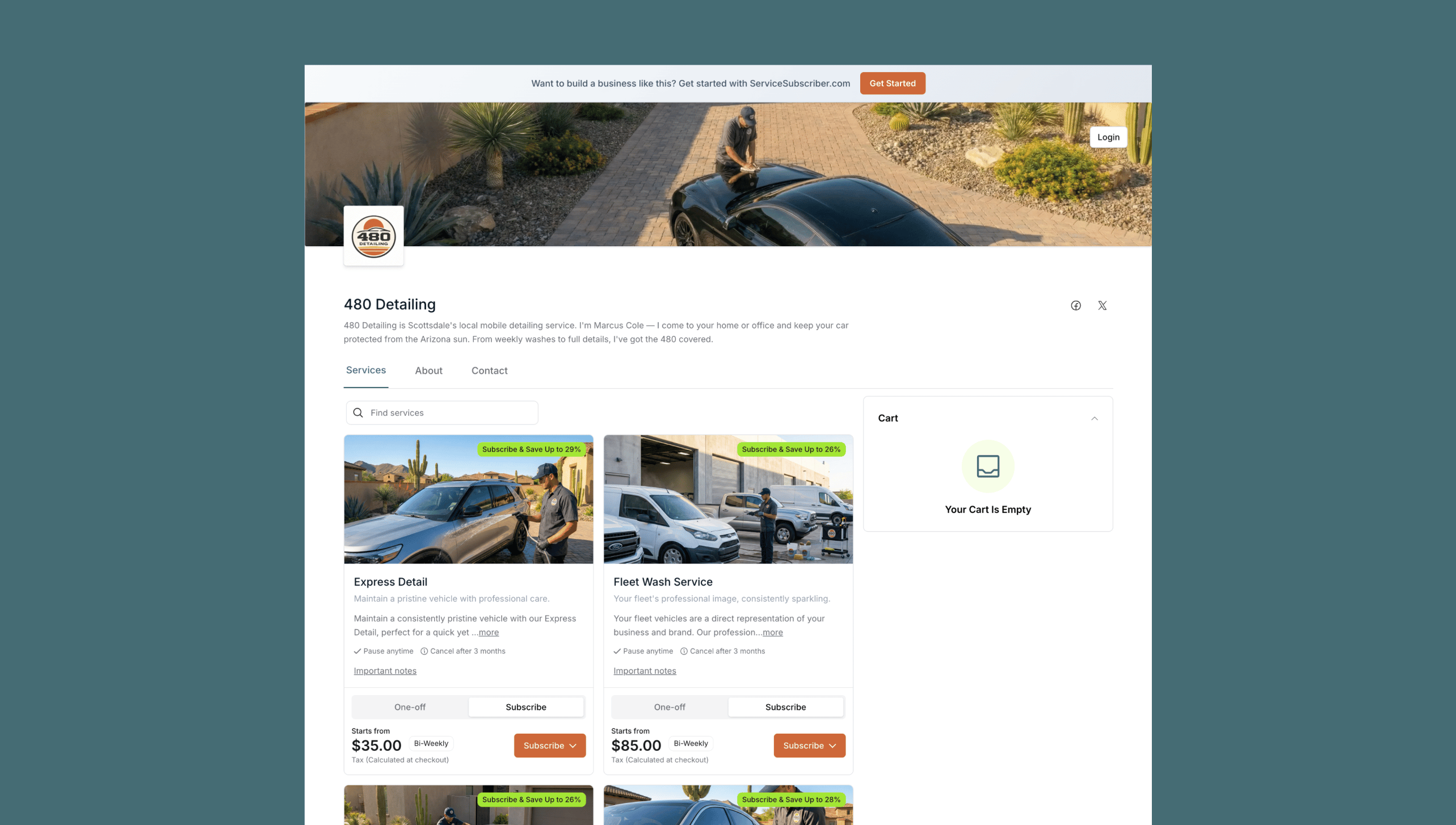
Services, pricing, and a clear way to purchase or subscribe. The client picks what they want, pays at checkout, and you get notified. No back and forth. No invoice to chase. The car is on your schedule and the payment has already cleared.
Make the First Job Count
The first detail sets the expectation. For a subscription to follow, it needs to land well.
Arrive on time and set up professionally. The kit is organised. The products are labelled. You're in branded clothing. Before you've touched the car, the client has already formed an impression.
Do a walk-around before you start. Note any existing scratches, chips, or damage and point them out to the client. Photograph them. This protects you from anything that was already there being attributed to your work.
Communicate what you're doing and why. Most clients don't know the difference between a maintenance wash and a full detail, or why decontamination matters before paint protection is applied. A brief explanation of what you're doing turns a transaction into a service they understand and value. It also plants the seed for higher-value work down the line.
Leave it genuinely immaculate. The result is the advertisement. A car that looks dramatically better than when you arrived is something the owner shows people. They take a photo. They mention it to the person who asks how the car is looking so good.
Before you leave, mention the subscription. Something like: "Most of my clients do a maintenance wash every fortnight or month. Keeps it like this without it ever getting to the point where it needs a full detail again. I can set that up for you now if you'd like." Not a hard sell. Just a natural follow-on from a job well done.
Getting Paid Consistently
Car detailing might be the most natural subscription service there is. Cars get dirty every week without exception. The client who has just had their car looking its best has a clear and obvious reason to keep it that way. You don't have to convince them the service has value. They just experienced it.
The subscription offer is simple: instead of getting in touch every time, they subscribe to a regular maintenance wash, fortnightly or monthly. The payment processes automatically. You show up on schedule, do the job, mark it done. They never have to think about it.
For you, that means income you can plan around. A client base of subscribers gives you a floor of predictable revenue before you've done a single one-off job in a given month. As that base grows, the one-off and premium jobs become upside rather than necessity.
Build from the first client. Get the second. Subscribe as many as you can. The business compounds from there in a way that purely transactional work doesn't.
Putting It Together
Car detailing is one of the more accessible service businesses to start, and one of the more natural fits for building a subscriber base. The demand is consistent. The results are visible and immediate. The clients who care about their vehicle tend to stay.
Go mobile to start. Keep the service area tight. Learn the technique properly before you offer the premium services. Brand before you prospect. Get your page live before you drop the first flyer. Do the first few jobs exceptionally well. Ask for the subscription before you leave.
That's the starting point. The rest comes from showing up reliably and doing work people are glad they paid for.
Ready to start your car detailing business?
Create your service page, share the link, and start getting paid. Clients can purchase a one-off detail or subscribe for regular maintenance. You get paid directly, before you touch the car.
14-day free trial. No credit card. 50% off first 3 months.
Did you find this guide helpful?
More guides
Explore other service businesses you can start