

How to Start a Car Detailing Business
Of all the service businesses you could start, mobile car detailing might be the most natural fit for recurring income. Not because we're forcing the model onto it. Because cars genuinely, reliably get dirty again. Every week. The client base is enormous, the startup cost is accessible, and a client who values a clean car tends to stay.
41+ people found this guide helpful

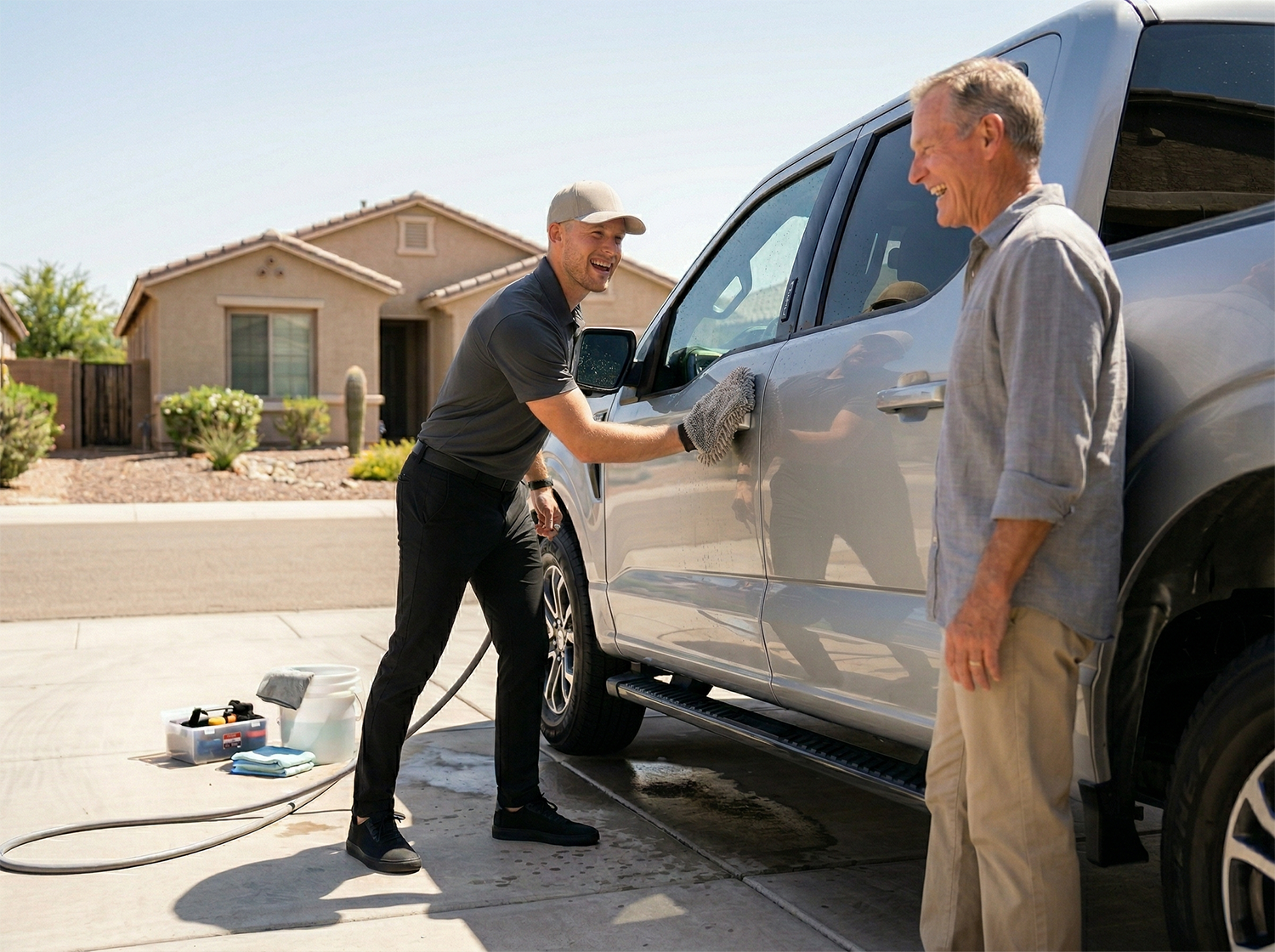
Why Car Detailing Works as a Business
Rain carries road grime onto the panels. Bird droppings etch into clear coat. Dust settles on dashboards. The interior accumulates the residue of daily life. The owner who cares about their car knows it needs attention regularly. The owner who doesn't want to deal with it themselves is looking for someone they can trust to just handle it.
That's the client base. It's large, it's in every market in the country, and once you've found a client who values a clean car, they tend to stay. From what we've seen, people start this business with little more than a kit and a willingness to show up on time and do good work. Some have built full-time incomes from it. Others run it alongside other work while building a client base before going all in. Both approaches work. The starting point is accessible in a way that many businesses aren't.
The US car culture also helps. In most of the country, a car is a significant asset people spend real money on. Trucks, SUVs, performance cars, luxury vehicles. Owners who care about their vehicle want it maintained properly. That's a client who pays without negotiating and comes back without being chased.
Mobile, Not a Fixed Shop
This guide is focused on mobile detailing. Not because fixed detailing shops aren't a legitimate business, but because for someone starting out, a fixed location requires commercial rent, fit-out costs, and a client base willing to bring their car to you. That's significant overhead before you've established anything.
Mobile removes that barrier. You go to the client. Their home, their workplace, their apartment building parking lot. You bring everything you need. They hand over the keys and get on with their day.
For clients, that convenience is a genuine selling point. No drop-off. No pick-up. No waiting around. The car is clean when they come home from work or walk back from their desk at lunch. That's worth paying for, and worth a premium over a fixed-location wash that requires their time as well as their money.
Mobile also means lower ongoing costs. No rent, no utilities. Your vehicle is your premises and your advertisement. The trade-off is that you're working in varying conditions, dependent on the space and water access available at each location, and spending time between jobs on the road. Factor that into how you price and schedule.
Start mobile. If a fixed location makes sense later once you have a full client base, that's a decision you can make from a position of strength.
Is This the Right Business for You?
Car detailing rewards people who take genuine pride in the result. If you enjoy the process of making something look properly good, and you can see yourself doing that consistently across different vehicles and conditions, that's a reasonable foundation.
Technique matters in this business. The right products, the right application method, the right order of operations. Doing a paint correction incorrectly causes more damage than it fixes. Applying a ceramic coating without proper surface preparation is wasted money for the client. There's a real skill set here, and it deepens over time.
You don't need to master everything before you start. A competent exterior wash, interior clean, and paint protection application is a service most clients are delighted with. Start there. Learn the more technical services as your confidence and client base grow.
What you need from day one is reliability and communication. Clients are trusting you with their vehicle and arranging their day around your arrival time. Show up when you said you would, do what you said you'd do, and leave the car in noticeably better condition. That, more than any product or technique, is what generates repeat clients and referrals.
Research and Plan Before You Start
A one-page plan before you spend anything is worth more than it sounds.
Where will you operate? Define your service area. A tight geographic radius keeps travel time low and your effective hourly rate higher. Residential neighborhoods with a mix of houses and apartment buildings give you two distinct client types. Workplaces and office parks are worth noting for midday services.
Who are you targeting? Busy professionals who don't have time to maintain their own car. Families with multiple vehicles. Business owners who care about how their personal car or small fleet presents. Truck and enthusiast owners who want specialist care. You don't need to serve everyone at the start. Focus on the clients most likely to come back on a regular schedule.
What will you offer? A maintenance wash as your recurring service, a full detail for new or neglected vehicles, an interior-only option, and premium services like paint correction and ceramic coating as you build skills. Map it out before you need to explain it to a client.
What does the local market look like? Search for mobile detailers in your area. Look at how they present, what they charge, what services they lead with, and where there's room. Price, availability, and trust are all factors. Understand where you can compete.
Startup Costs: What to Expect
Mobile car detailing sits at a genuinely accessible startup cost. You don't need a van to start. A car and a quality kit is enough to take your first clients. The setup grows as your income does.
- Business registration (LLC or DBA filing) — $50 to $200 depending on your state
- EIN from the IRS — Free
- General liability insurance — $600 to $1,200 per year
- Pressure washer or foam cannon setup — $300 to $1,000
- Portable water tank (if needed) — $200 to $600
- Wet/dry vacuum — $150 to $400
- Dual action polisher — $200 to $600
- Chemical starter kit (shampoo, wheel cleaner, degreaser, glass cleaner, protectants, tire dressing) — $300 to $600
- Microfiber towels, wash mitts, and applicators — $100 to $250
- Buckets, grit guards, and detailing brushes — $75 to $150
- Branded clothing — $75 to $150
- Vehicle signage — $200 to $600
- Flyers and marketing materials — $100 to $200
- Domain name (.com) — $15 to $20 per year
- Platform or payment system — $18 to $39 per month
- Logo and basic branding — $0 if you use AI tools, $150 to $400 if you use a designer
A realistic starting figure is $2,500 to $5,000, not including your vehicle. A van or dedicated trailer setup comes later when the income justifies it. Start lean. Get your first clients. Invest from there.
Your Brand
Car detailing clients are often buying on trust before they've seen your work. They're handing over their vehicle. A professional brand signals that this is a real business run by someone who cares about the result, before you've had the chance to prove it in person.
It doesn't have to be expensive. It has to be consistent. The name, the polo, the vehicle signage, the page they land on when they scan your QR code. When those things all match, it works.
Before you commit to a name, run the usual checks:
State business name register. Your state's Secretary of State website. If it's taken, move on.
Federal trade marks. A quick check at USPTO.gov before you put the name on a vehicle. A business name registration doesn't protect you from trade mark claims.
Domain availability. A .com. Check it before you settle on the name.
Social handles. Instagram in particular. Car detailing content performs very well visually. Before and afters, paint correction close-ups, ceramic coating water beading. When the name, domain, and handles align, register everything and move on.
On logos:
Create a professional logo for [Business Name], a mobile car detailing business. Keep it bold and clean. Use [color preference]. It needs to work on a vehicle door, a work polo, and a service page. Provide 3 or 4 variations.
When you're ready to go further:
Create a brand guide for [Business Name], a mobile car detailing business. Include a primary color palette with hex codes, a secondary palette, font recommendations for headings and body text, logo usage rules, and how the brand should appear on vehicle signage, uniforms, flyers, and social media.
Insurance and Permits
We're not lawyers or insurance brokers. Get specific advice for your situation. Here's what's worth sorting out early.
General liability insurance. You're working on someone's vehicle. A scratch from a contaminated towel, a product reaction on paint, damage to trim or interior. These things happen, even to careful operators. General liability insurance covers you when they do. Get it before you start work on a paying client's car.
Garage keeper's or bailee's insurance. Standard general liability may not fully cover damage to a vehicle in your care. Ask your broker specifically about coverage for client vehicles while you're working on them. This is a common gap that new operators miss until something goes wrong.
Vehicle insurance. If you're using your personal vehicle for business purposes, check your policy. Many personal vehicle policies don't cover commercial use. Let your insurer know you're using the vehicle for business and confirm your coverage is appropriate.
Wastewater and runoff. Car wash runoff contains detergents, oils, and brake dust residue. In some municipalities, what you do with that water is regulated. A waterless or low-water wash option is worth having in your kit for jobs where drainage is restricted, such as covered parking structures or properties without suitable drainage.
Business structure. Talk to a free SCORE mentor or your local SBDC before you decide on sole proprietor versus LLC. You're regularly handling other people's property. The liability conversation is worth having early.
Define Your Services and Pricing
Before you approach anyone, know what you offer and what you charge. Detailing services span a wide range of depth and price. Being clear about what each tier includes, and pricing it by vehicle size, saves time and sets the right expectations before you show up.
The productized approach that works best in this category is to build a tiered menu where clients self-select by vehicle size and service level. No custom quotes for standard jobs. Sedan or hatch, SUV or wagon, large SUV or truck. Those tiers cover most of what you'll encounter and let clients sign up without back and forth.
Wash services. Your most frequent recurring work:
- Exterior Hand Wash. Hand wash, wheels cleaned, windows, tires dressed. Your weekly entry-level service. Priced by size: Sedan/Hatch, SUV/Wagon, Large SUV/Truck, Van/Commercial. Quick, consistent, and what most regular clients want on a weekly or every-two-weeks schedule.
- Wash and Protect. Hand wash plus spray sealant applied at every visit. Builds layers of protection over time. Priced by size. A natural step up from the standard wash for clients who want more than clean.
- Waterless or Low-Water Wash. Worth offering as a distinct service. Waterless and rinseless wash products have come a long way and are increasingly popular with clients in apartments, covered parking structures, or drought-affected areas where running water isn't accessible or welcome. Some clients actively seek it out for environmental reasons. A small premium over a standard wash is reasonable, and it positions you differently from operators who can't offer it.
- Express Detail. Hand wash, interior vacuum, dash wipe, windows inside and out, tires dressed. A fuller refresh in 60 to 90 minutes. Every-two-weeks frequency suits most clients.
Detail packages. Higher value, less frequent:
- Full Detail. Complete exterior wash, clay bar decontamination, polish, wax or sealant, plus full interior: vacuum, shampoo, all surfaces, door jambs. Your most popular single service. 4 to 5 hours. Priced by size.
- Interior Detail. Interior only. Full vacuum, carpet and upholstery shampoo, dash and console detailed, door cards, windows inside, air vents. 2 to 3 hours. Popular for family vehicles, pet owners, and pre-sale prep.
- Showroom Detail. Your premium package. Machine polish, ceramic sealant, full interior, engine bay, wheels detailed, glass coating. 6 to 8 hours. For clients who want the best and are happy to pay for it.
Add-on and specialty services. These extend the value of each visit without significant time overhead:
- Ceramic Coating. Long-term paint protection applied after proper correction and decontamination. Premium price point. Worth understanding thoroughly before you offer it.
- Ceramic Maintenance. For existing ceramic-coated vehicles. Decontamination wash, coating inspection, and boost application. Quarterly. Strong recurring upsell once you have ceramic clients.
- Paint Correction. Remove scratches, swirl marks, and oxidation. Requires a dual action polisher and practice. A high-value service, but not one to offer before you've put time in on your own vehicles first.
- Glass Treatment. Hydrophobic coating on all exterior glass. Water beads and rolls off at speed. Quarterly. Strong safety and convenience angle.
- Leather Care. Clean, condition, and protect leather seats and surfaces. Prevents cracking and fading. Monthly or quarterly depending on use.
- Pet Hair Removal. Specialist tools for embedded pet hair. Best combined with an interior detail. Monthly for heavy pet owners.
- Steam Clean Interior. High-temperature steam sanitizes all surfaces. Chemical-free. Kills bacteria and dust mites. Excellent for allergy sufferers and families.
- Engine Bay Detail. Degrease, clean, and dress. Helps identify leaks. Valued by enthusiasts and buyers inspecting pre-purchase.
- Headlight Care. Polish and UV sealant to maintain clarity and prevent yellowing. Quarterly. Safety angle lands well.
- Wheel and Tire Care. Iron decontamination, polish, ceramic sealant on wheels, tires cleaned and dressed. Monthly add-on for clients who care about the full look.
- Fleet Wash / Fleet Detail. For business clients with multiple vehicles. Volume pricing by number of vehicles. Weekly or monthly. Best handled via a private subscription invite with custom pricing rather than a public listing.
On pricing: look at what established mobile detailers in your area charge and work out your real cost per job. Factor in travel time, chemicals, your time on site, and equipment wear. That's your floor. Price above it in the middle of your local market.
The maintenance wash or express detail is your anchor recurring service. Priced accessibly enough that signing up is an easy decision, frequent enough to build a reliable schedule. Monthly or every two weeks depending on the client's vehicle and how much they drive.
This is what ServiceSubscriber does.
A page, payments, and delivery tracking. Live in 20 minutes.
14-day free trial. No credit card.

Equipment
You don't need everything at once. A quality starter kit handles the vast majority of jobs. Here's what a practical mobile setup looks like:
- Pressure washer or foam cannon with hose. A mid-range electric machine works for most residential driveways. If water access at client locations is inconsistent, a portable tank is worth adding.
- Two-bucket wash system. One bucket for shampoo, one for rinse water, a grit guard in each. Basic but essential for avoiding paint contamination during the wash.
- Quality microfiber wash mitts and drying towels. This is not the place to cut costs. Cheap microfiber scratches paint. Buy from a dedicated detailing supplier, not a discount store.
- Wet/dry vacuum. A proper one. Interior work without a good vacuum is slow and the result shows it.
- Dual action polisher. Not essential on day one if you're not offering correction yet, but worth having as your skills grow. Less aggressive than a rotary and forgiving to learn with.
- Chemical kit. pH-neutral shampoo, wheel cleaner, tire dressing, iron remover, tar remover, glass cleaner, interior protectant, detail spray, paint sealant. Start with a focused selection and expand as you understand what you actually use job to job.
- Foam cannon. Applies pre-wash foam that softens contamination before you touch the paint. Once you've used one it's hard to wash without it.
- Detailing brushes. Vent brushes, wheel brushes, interior brushes. A full set is inexpensive and makes a real difference on fiddly surfaces.
- Extension cords and adapters. For jobs where power access isn't straightforward.
- Portable lighting. Useful in shaded driveways or parking structures. Paint defects and missed spots are obvious under direct light and less obvious without it.
Invest in quality on the chemicals and the microfiber. Everything else can be upgraded as the business grows. The detailing communities on Facebook and Reddit are a genuinely useful resource for equipment recommendations from operators who've used things in real working conditions. Worth spending time there before making any significant purchases.
Getting Your First Customers
Car detailing clients are everywhere. The question is finding the ones who'll become regulars.
Your network first. Friends, family, coworkers. Offer to detail one or two cars in exchange for honest feedback and a photo. A genuine before and after from a real vehicle in your area is your most useful early asset. Just be honest about what it is. Friends and family are useful for practice. Less useful as a gauge of whether strangers will pay what you need to charge.
Facebook community groups. Introduce yourself in local neighborhood groups. Include a before and after photo and a clear description of what you offer and what you charge. These posts get engagement. People tag their partners, neighbors, and coworkers. Show up a few times and the name starts to stick.
Nextdoor. Introduce yourself in your local area. Specific about what you offer, where you operate, and what it costs. Ask satisfied clients to post a recommendation. Neighbor endorsements carry real weight in this category.
Door hangers in target neighborhoods. What you do, what you charge, a QR code to your page. A tight drop in the right streets on a weekend morning. Neighborhoods with newer vehicles, larger driveways, and owner-occupied homes are the strongest starting territory.
Apartment complexes and residential buildings. A lot of cars in one place, owned by people who almost certainly don't want to wash them. A professional introduction to building management and a flyer in the lobby is worth the effort.
Workplaces and office parks. Midday details while clients are at their desks. The car is ready when they finish work. A strong pitch to a specific kind of client and worth pursuing once you have a few reviews to point to.
Instagram and social media. Car detailing content performs well. Clean paint, water beading after a sealant, a neglected interior looking new again. Post the results consistently. Tag the area. Build slowly. It compounds.
Ask for referrals. After a job, ask directly. A satisfied client who owns a car almost certainly knows other people who own cars.
Give Customers a Way to Find You and Sign Up
When someone scans your QR code or types in your address, they should land somewhere that shows what you offer, what you charge, and lets them sign up or purchase without having to call you and wait.
That page needs to do a few things: show your service tiers, show your prices, give clients the option to sign up for regular maintenance or purchase a one-off detail, and take payment at checkout. Nothing more complicated than that.
Here's an example of what that looks like in practice:
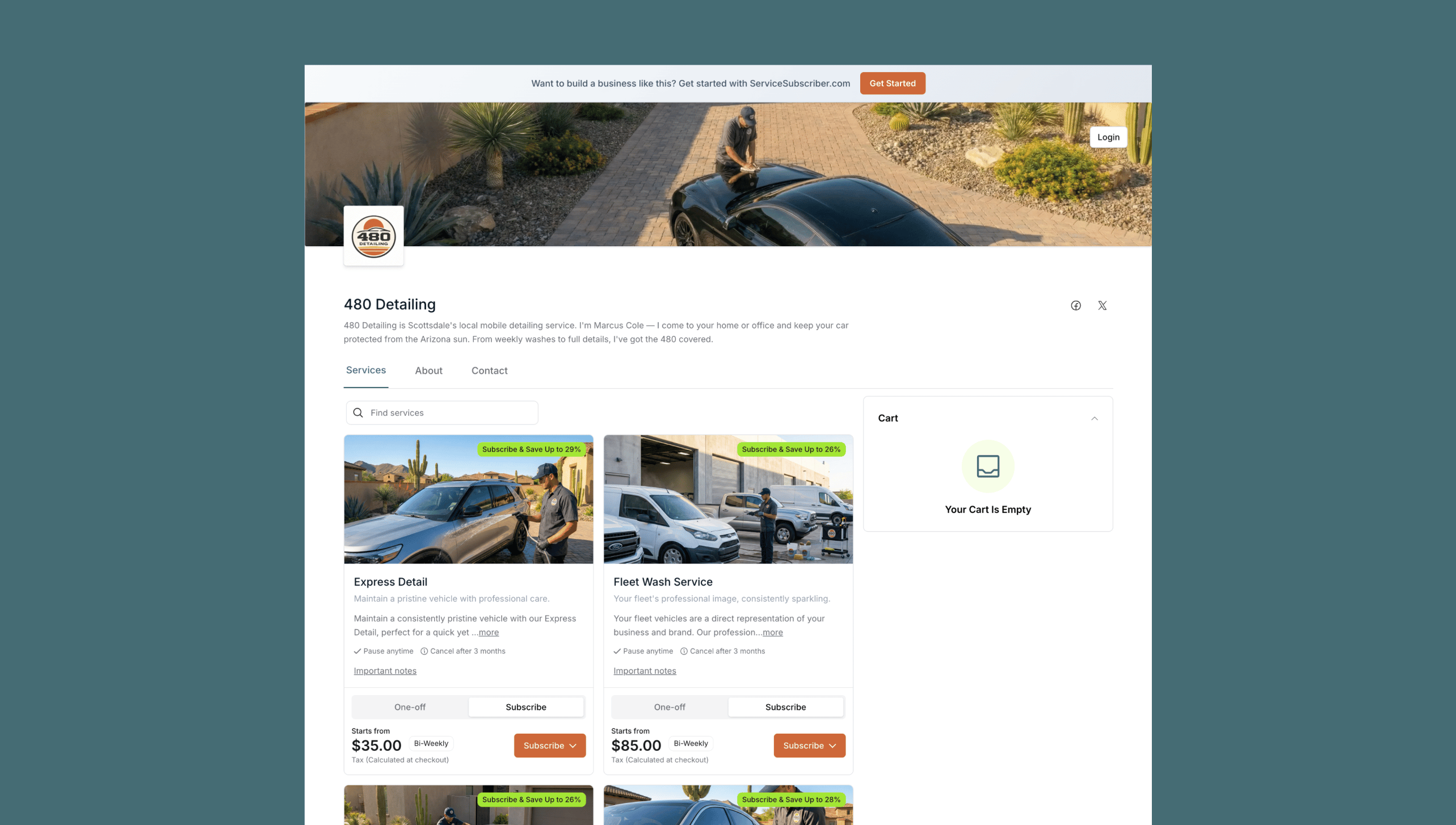
Services, pricing, and a clear way to purchase or sign up. The client picks what they want, pays at checkout, and you get notified. No back and forth. No invoice to chase. The car is on your schedule and the payment has cleared. For non-standard arrangements, a private subscription invite with a custom price keeps things clean without cluttering your public page.
Make the First Job Count
The first detail sets the expectation. For repeat business to follow, it needs to land well.
Arrive on time and set up professionally. The kit is organized. The products are labeled. You're in branded clothing. Before you've touched the car, the client has already formed an impression.
Do a walk-around before you start. Note any existing scratches, chips, or damage and point them out to the client. Photograph them. This protects you from anything that was already there being attributed to your work.
Communicate what you're doing and why. Most clients don't know the difference between a maintenance wash and a full detail, or why decontamination matters before protection is applied. A brief explanation turns a transaction into a service they understand and value. It also opens the door for higher-value work down the line.
Leave it genuinely immaculate. The result is the advertisement. A car that looks dramatically better than when you arrived is something the owner shows people. They take a photo. They mention it to someone who asks how the car is looking so good.
Before you leave, mention the regular service. Something like: "Most of my clients do a maintenance wash every month or every two weeks. Keeps it looking like this without ever getting to the point where it needs a full detail again. I can set that up for you now if you'd like." Not a hard sell. Just a natural follow-on from a job well done.
Getting Paid Consistently
Car detailing might be the most natural recurring service there is. Cars get dirty every week without exception. The client who has just had their car looking its best has a clear reason to keep it that way. You don't have to convince them the service has value. They just experienced it.
The regular maintenance offer is straightforward: instead of getting in touch every time, they sign up for a monthly or every-two-weeks wash. The payment processes automatically. You show up on schedule, do the job, mark it done. They never have to think about it.
For you, that means income you can plan around. A base of regular clients gives you a floor of predictable revenue before you've done a single one-off job in a given month. As that base grows, the one-off and premium services become upside rather than necessity.
Build from the first client. Get the second. Convert as many as you can to a regular schedule. The business compounds from there in a way that purely one-off work doesn't.
Putting It Together
Car detailing is one of the more accessible service businesses to start, and one of the more natural fits for building reliable recurring income. The demand is consistent. The results are visible and immediate. Clients who care about their vehicle tend to stay.
Go mobile to start. Keep the service area tight. Learn the technique properly before you offer the premium services. Brand before you prospect. Get your page live before you drop the first door hanger. Do the first few jobs exceptionally well. Ask for the regular service before you leave.
That's the starting point. The rest comes from showing up reliably and doing work people are glad they paid for.
Ready to start your car detailing business?
Create your service page, share the link, and start getting paid. Clients can sign up for a one-off detail or regular maintenance service. You get paid directly.
14-day free trial. No credit card. 50% off first 3 months.
Did you find this guide helpful?
More guides
Explore other service businesses you can start
How to Start a Service Business
The complete starting point for any service business.
Read guide
How to Start a Pressure Washing Business
Outdoor work, similar equipment overlap, strong local demand.
Read guide
How to Start a Dog Grooming Business
Another mobile service built on loyal recurring clients.
Read guide