How to Start a Window Cleaning Business in Australia
Window cleaning is one of the more accessible service businesses you can start in Australia. The startup cost is low, the equipment is simple, you can be operational within days of deciding to start, and every house on every street is a potential client.
26+ people found this guide helpful

Why Window Cleaning Works as a Business
Windows get dirty. Dust, rain, pollen, salt air, spider webs, hard water marks. It happens constantly and most homeowners either don't notice until it's bad, or they notice all the time and just haven't got around to doing something about it. Both of those people are your market.
What makes window cleaning particularly appealing as a starting point is how quickly you can be up and running. A quality squeegee kit, some cleaning solution, a ladder, and a car. That's roughly the starting point. You can be taking your first client within a week of deciding to start.
The work is also visible in a way that sells itself. Clean windows on a house that hasn't had them done in a year are immediately, obviously better. The before and after is dramatic. Neighbours notice. That visibility turns every job into a prospecting opportunity for the next one.
We've come across plenty of people who've started this business with very modest investment and built solid, regular client bases from it. It's not glamorous, but it's reliable, it repeats, and the barrier to entry is about as low as it gets in the service world.
Is This the Right Business for You?
You don't need a background in cleaning or construction. What you need is a comfort with physical outdoor work, a willingness to work at height safely, and a genuine interest in building a client base rather than just doing one-off jobs.
The work is repetitive in the best sense. Once you have a client, the windows need cleaning again in a few months. That natural recurrence is what turns a window cleaning round into a real business with predictable income rather than a series of one-off jobs you have to keep finding.
If the idea of working independently, building a local reputation, and turning a simple skill into regular income appeals to you, window cleaning is a reasonable place to start.
Knowing Your Surfaces, Glass Types, and Techniques
We're not going to pretend to be experts on the technical side of window cleaning. The experienced operators know far more than we do about the specifics. What we can say is that understanding the basics before you start work on a paying client's property matters, and there's a lot worth learning.
Glass types. Standard float glass, tinted glass, and low-E (low emissivity) glass each respond differently to cleaning products and abrasive tools. Tinted glass in particular can be scratched by certain tools or damaged by some chemical cleaners. If you're not sure what you're looking at, err on the side of the gentler approach and do the research before you pick up a scraper.
Security screens and fly mesh. A lot of Australian homes have aluminium security screens or fly mesh over windows. Getting a proper clean on the glass behind them is one of the more common things clients ask about. Some screens are removable and can be cleaned separately before being refitted. Others are fixed. The approach varies and it's worth understanding what you're dealing with before you set your services. Some operators list screen removal and cleaning as a separate service on their page. Others include it in the standard clean. Either is reasonable as long as the client knows what they're getting.
Hard water stains and mineral deposits. A common problem in many Australian areas, particularly where bore water is used on gardens near windows. Standard squeegee technique won't remove them. Specialist hard water stain removers or mild acid-based treatments are required. Worth having in your kit and worth knowing how to use safely.
Frames, sills, and tracks. A clean window with dirty frames and full tracks is only half a job. Most clients expect the whole thing. Work out what's included in your standard service and communicate it clearly.
The YouTube window cleaning community is substantial and genuinely useful. Operators share technique openly, and a few hours watching how experienced cleaners approach different glass types, frame materials, and problem stains is time well spent before your first paid job.
Safety: Working at Height
This is the part of window cleaning that deserves serious attention. Falls from ladders are one of the more common causes of serious injury in the trades, and working at height on residential properties is something that needs to be approached with care, not casualness.
We're not safety experts and you should seek proper guidance for your specific situation. Here's what's worth understanding at a minimum.
Ladder safety fundamentals. The right ladder for the job, inspected before use. Set at the correct angle (roughly 75 degrees, the 1-in-4 rule: one metre out for every four metres up). Feet on stable, level ground. Never overreaching to either side. Three points of contact at all times when climbing. These aren't complicated rules, but skipping them is how people get hurt.
Ladder types. An extension ladder handles most single and double-storey residential work. A step ladder is useful for accessible ground-floor windows where leaning against the wall or frame isn't ideal. A multi-position ladder that converts between configurations is worth considering as an all-in-one option. Whatever you use, make sure it's rated for the load and in good condition.
Water-fed pole systems. Worth knowing about. A telescoping pole with a brush head and purified water feed lets you clean upper-storey windows from the ground, removing the need for a ladder in many situations. The purified water dries streak-free. It's an investment (a decent setup costs $500 to $1,500 or more) but it removes ladder risk from a significant portion of the work and is faster once you're used to it. Many established operators use this as their primary method for anything above ground floor.
Roof and high access work. If a client asks for windows on a roof line or anything requiring you to work above the top of a standard extension ladder, that's a different category of work entirely. It may require harness equipment, anchor points, or specialist rigging. In most Australian states, working at height above a certain level requires specific competencies or licences. Know where your limit is and don't take on work outside of it.
Footwear and grip. Appropriate non-slip footwear matters. Wet ladders and roof surfaces are genuinely hazardous. Invest in proper work boots before your first job.
Research and Plan Before You Start
A one-page execution summary before you spend anything is worth putting together.
Where will you operate? Define your service area. A tight radius keeps travel time low and lets you complete more jobs in a day. Established residential suburbs with a mix of house sizes are the sweet spot. Newer estates and older weatherboard neighbourhoods both have plenty of windows and different typical client profiles.
Will you do internal and external, or external only? External-only is faster and requires less setup (no shoe covers, no moving furniture, no negotiating around a client's belongings). Internal and external commands a higher price and is what most clients ultimately want. Starting with external only is a reasonable way to get moving quickly. Expanding to internal cleans as your systems and confidence grow is a natural next step.
What does the local market look like? Search for window cleaners in your area. Look at what they charge, what services they lead with, how they present. Understand where there's room for you.
Who are you targeting? Residential homeowners are the most accessible starting point and the foundation of a recurring client base. Commercial properties, strata buildings, and rental properties managed by real estate agents are worth understanding for later. Start with one market and expand when you have the capacity.
Capital: What to Expect
Window cleaning sits at the low end of service business startup costs. For a basic residential setup focused on internal and external cleans up to two storeys, you can be operational for well under $2,000. Here's a realistic breakdown:
- ABN registration — Free
- Business name registration (ASIC) — Around $42 for one year, $98 for three years
- Domain name (.com.au or .au) — $20 to $50 per year
- Public liability insurance — $600 to $1,200 per year
- Professional squeegees (various sizes) — $80 to $200
- T-bar applicators and sleeves — $50 to $120
- Extension poles (2-3 lengths) — $100 to $300
- Scraper and blades — $30 to $80
- Buckets and cleaning solution — $50 to $100
- Microfibre cloths and scrim cloths — $50 to $100
- Extension ladder — $200 to $600 depending on height and quality
- Water-fed pole system (optional at start) — $500 to $1,500+
- Hard water stain remover — $30 to $80
- Non-slip work boots — $100 to $200
- Branded clothing — $100 to $200
- Vehicle signage — $200 to $600
- Flyers, door hangers, and lawn signs — $150 to $300
- Platform or payment system — $18 to $39 per month
- Logo and basic branding — $0 if you use AI tools, $200 to $500 if you use a designer
A realistic all-in starting figure without a water-fed pole is $1,500 to $2,500. With one, add another $500 to $1,500. If you're starting lean, the pole system can come later once you've built a regular client base and have the income to invest in it.
Your Brand
In window cleaning, your vehicle is parked on the street while you work and your ladder is visible from the road. That's free advertising, but only if what people see looks like a real business. A magnetic door sign, a branded polo, a clean vehicle. When those things match, it signals professionalism before you've said a word.
Before you settle on a name, run it through the standard checks:
ASIC business name register. Search at business.gov.au. If it's taken, move on.
Trade marks. A registered business name doesn't protect you from trade mark claims. A quick check at ipaustralia.gov.au is worth doing before you invest in signage.
Domain availability. A .com.au or .au extension. Check it before you commit to the name.
Social handles. Check Instagram and Facebook at the same time. When the name, domain, and handles all align, register everything and move on.
On logos, a good prompt in ChatGPT or Claude gets you somewhere useful quickly:
Create a professional logo for [Business Name], a residential window cleaning business in Australia. Keep it clean and simple. Use [colour preference]. It needs to work on a vehicle door sign, a work polo, and a flyer. Provide 3 or 4 variations.
When you're ready to go further:
Create a brand guide for [Business Name], a residential window cleaning business in Australia. Include a primary colour palette with hex codes, a secondary palette, font recommendations for headings and body text, logo usage rules, and how the brand should appear on vehicle signage, uniforms, flyers, and social media.
Insurance, Licences, and Permits
We're not lawyers or insurance brokers. Get specific advice for your situation. Here's what's worth sorting out early.
Public liability insurance. You're working on someone's property with ladders, water, and cleaning chemicals near glass, frames, and interior furnishings. A broken window, water damage to a floor, a slip on a wet path while carrying a ladder. These things happen. Public liability insurance covers you when they do. Some clients, particularly strata managers and real estate agencies, will ask for a certificate of currency before they purchase. Get it before you start, not after.
Working at height. General residential window cleaning doesn't require a specific high-risk work licence in most cases. However, if you move into commercial work, working off elevated platforms, or anything involving roof access, the requirements change depending on your state. Check what applies to the type of work you plan to take on.
Vehicle insurance. If your personal vehicle is being used for business purposes, check your policy. Many personal vehicle policies don't cover commercial use. Let your insurer know and confirm appropriate coverage.
Lawn signs and roadside advertising. If you want to use corflute signs on nature strips, fence lines, or near roadsides, check with your local council first. Most councils have rules about signage placement, permitted durations, and where advertising boards can and can't go. Getting this wrong can result in fines and confiscated signs. A quick call to your council before you print is worth the time.
Chemical handling. Some specialist cleaners, including acid-based hard water removers, require careful handling and appropriate storage. Read the safety data sheets for any product you're using and understand the requirements before you put them in your kit.
Define Your Services and Pricing
Before you take your first client, know what you're offering and what you charge for it. The goal is to productise your services into clear, fixed-price options that clients can purchase directly from your page without any back and forth. A window cleaning business structures naturally around a few core services:
- External Window Clean. The entry service. All accessible external glass, squeegeed clean, frames wiped, sills cleared. Fast to deliver once you have the routine dialled in.
- Internal and External Window Clean. The full service. Both sides of every window, frames and tracks included. Takes longer and commands a higher price. Most clients who want the job done properly want this.
- Screen Clean. Removing, cleaning, and refitting fly screens or security screens. Often added to an internal and external clean. Worth pricing separately so clients understand what's included.
- Hard Water Stain Treatment. Specialist treatment for mineral deposits on glass. A higher-value add-on that most operators charge well for, since it requires specific products and more time.
- Post-Construction Clean. Removing paint overspray, silicone residue, and construction dust from newly installed glass. Specialist work, worth a premium, and worth learning the right technique for before you offer it.
- Solar Panel Clean. An increasingly common add-on. Solar panels degrade in output when dirty, and a lot of clients with panels on their roof don't get them cleaned as often as they should. Pairs naturally with a house window clean.
On pricing: look at what established window cleaners in your area charge and work out what it costs you to do the job. Factor in travel, chemical costs, your time on site, and equipment wear. That's your floor. Price above it in the middle of the local market.
Frequency varies by location and client preference. Coastal areas with salt air and dusty inland regions might need cleans every two to three months. Other clients are happy with twice a year. Be honest about what makes sense for the property rather than overselling frequency, and the clients you do lock in will stick around.
A quarterly subscription is a natural fit. Clients who subscribe to regular maintenance always have clean windows. You have predictable income and a guaranteed visit. That's a reasonable arrangement and worth presenting as your default offer.
This is what Service Subscriber does
A page, payments, and delivery tracking. Live in 20 minutes.
14-day free trial. No credit card.

Equipment
Window cleaning equipment is straightforward and available from cleaning supply wholesalers, trade suppliers, and in some cases Bunnings for the basics. Here's what a solid starting kit looks like:
- Squeegees. Multiple sizes. A 35cm or 45cm for large panes, a 25cm or smaller for divided lights and awkward shapes. Ettore, Unger, and Moerman are the brands most commonly used by professional operators.
- T-bar applicators and scrubbing sleeves. For applying solution to the glass before squeegeing. Multiple sizes to match your squeegees.
- Extension poles. A range of lengths for reaching upper windows from ground level without a ladder where possible. Lightweight aluminium or fibreglass. A 3-metre pole handles most single-storey work; a 6-metre pole covers most two-storey external work.
- Scraper and replacement blades. For removing paint spots, adhesive residue, and stubborn deposits. Use with care on tinted or coated glass.
- Buckets. At least two. One for solution, one for clean rinse water.
- Cleaning solution. A professional window cleaning detergent concentrate. A small amount goes a long way. Don't use household detergents that leave residue or streaks.
- Microfibre cloths and scrim cloths. For detailing edges, wiping frames, and finishing off any streaks. Scrim (a traditional linen cloth) is still preferred by many professionals for the final wipe.
- Extension ladder. Minimum 6-metre for two-storey residential work. Fibreglass is heavier but non-conductive. Aluminium is lighter. Quality matters here. Don't cut costs on a ladder you'll be standing on regularly.
- Ladder standoff or stay. Keeps the ladder away from the wall and guttering, giving you better access to upper windows and protecting the gutters from damage.
- Non-slip rubber ladder feet. Essential. Standard rubber feet wear quickly. Replacement non-slip pads are inexpensive and worth keeping fresh.
- Water-fed pole system. A telescoping carbon fibre or aluminium pole connected to a purified water supply via a brush head. Lets you clean upper-storey windows from the ground. The purified water dries streak-free without squeegeeing. An investment, but it removes a lot of ladder work and is faster on multi-storey homes once you've got the technique right.
- Hard water stain remover. A specialist product for mineral deposits. Test on an inconspicuous area first. Follow the manufacturer's instructions.
- Carry bag or apron. To keep your squeegees and tools accessible while you're working rather than walking back to the bucket every thirty seconds.
Getting Your First Clients
Every house on every street is a prospect. The question is finding the most efficient way to reach them.
Door to door. More effective for window cleaning than for most service businesses, because the evidence that the service is needed is often right there on the front windows. A polite knock, an introduction, and a mention of what you charge. It's direct, it costs nothing, and the conversion rate on a house with obviously dirty windows is higher than you'd expect. Not for everyone, but worth trying in the early days when you're building from nothing.
Door knob hangers. A step down from knocking in terms of directness, but much more scalable. A well-designed flyer on every door handle in a target street. What you do, what you charge, a QR code to your page. Canva has templates. Print through an online printer. Drop 100 on a Saturday morning and see what comes back.
Lawn signs and roadside signage. Corflute signs placed on nature strips or at busy intersections in your operating area can generate consistent enquiries with very little ongoing effort. Check your local council rules before you place them (most have guidelines on location, size, and how long they can stay up). A simple design with your service, phone number, and website is enough. Replace them regularly as weather fades them.
While you're working, prospect the street. If you're cleaning windows on one property, the neighbours can see you. Leave a door knob hanger on the adjacent three or four properties on each side while you're there. You're already in the street. The job is visibly being done well. The timing is ideal.
Facebook community groups. Introduce yourself in local suburb groups. Be specific about your service area and what you offer. A before and after photo is worth more than a paragraph of text. Show up consistently.
Real estate property managers. Investment properties need regular maintenance and landlords want it handled without fuss. A short professional introduction to local property management offices can open up a reliable stream of jobs. These clients tend to purchase regularly and pay without drama.
Ask for referrals directly. After the first few jobs, ask. A client who can see the difference in their own windows is in the best possible frame of mind to recommend you to a neighbour. Most people are happy to if you ask clearly.
Give Customers a Way to Find You and Subscribe
When someone scans your QR code from a door hanger, looks you up after seeing your van, or gets your name from a neighbour, they should land somewhere that shows what you offer, what you charge, and lets them purchase or subscribe without having to call you or wait on a response.
The idea is to productise your services into clear, fixed-price options. External clean, internal and external, screen clean. Clients pick what they want, pay at checkout, and you get notified. For jobs that don't fit a standard service, you can send a private subscription invite with a custom price that won't appear on your public page.
That page needs to do a few things clearly: your services and pricing, the option to purchase a one-off clean or subscribe to regular maintenance, and a checkout that handles payment. Nothing more complicated than that.
Here's an example of what that looks like in practice:
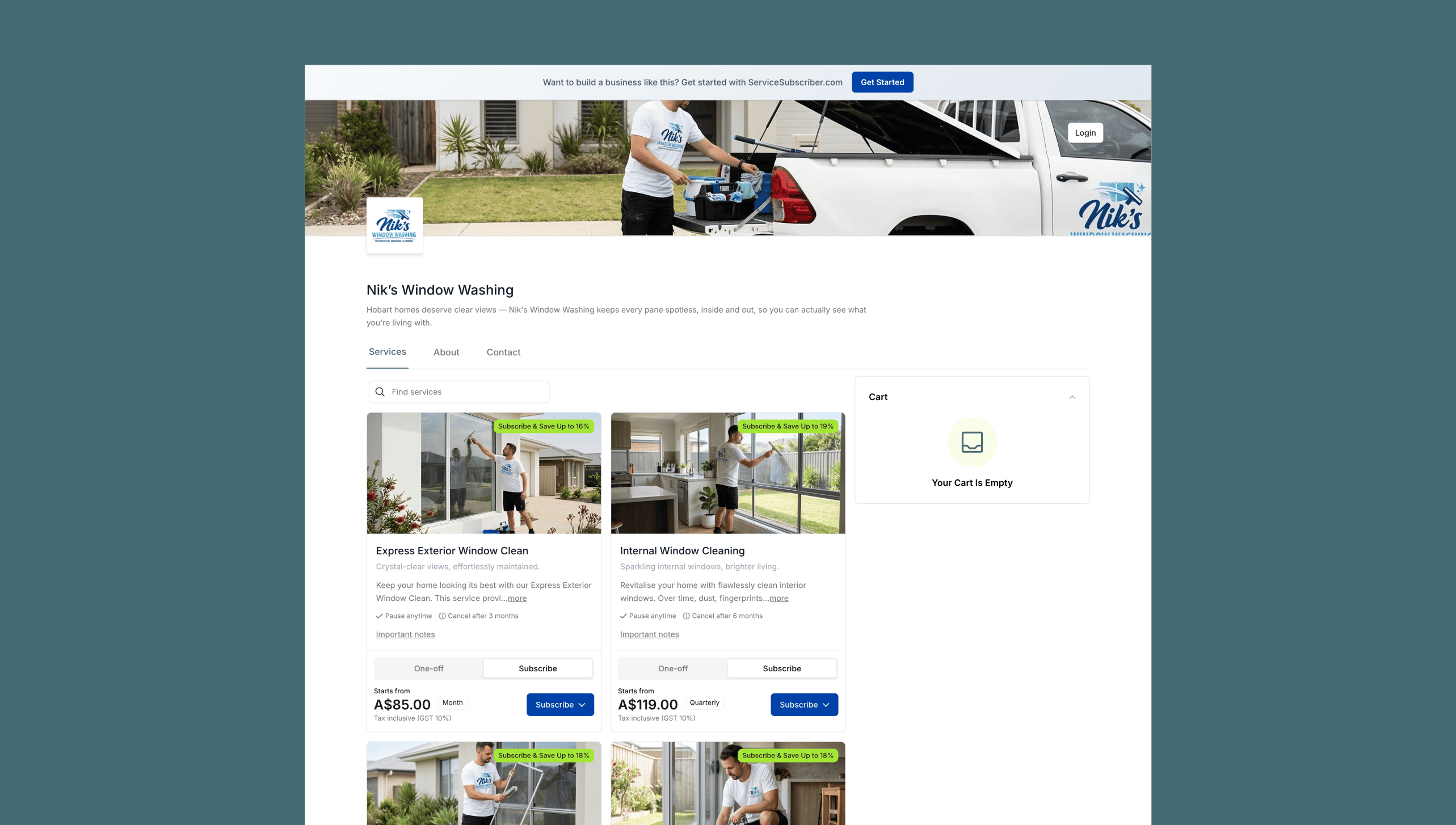
Services and pricing upfront. Clients can purchase a one-off clean or subscribe for regular maintenance. Payment handled at checkout. You get notified. You show up and do the work.
Make the First Job Count
The result on a window clean is immediate and obvious. That works in your favour. A house that looks noticeably better after you've finished is the best advertisement you have, and the neighbours can see it from the street.
Be thorough on the detail. Clean frames, not just glass. Clear the sills. Wipe the tracks. Leave the windows streak-free in all lighting conditions, not just the flat light of an overcast morning. Clients check the result in direct sun and notice what you missed.
Protect the interior. If you're doing internal cleans, lay a towel under the window before you start. Keep your bucket and tools tidy. Don't drip across a client's floor. Small things that take thirty seconds and prevent the kind of feedback that undoes a perfectly good clean.
Point out what you found. A cracked pane, a broken latch, a security screen that's coming loose from its frame. Mentioning it signals professionalism and is genuinely useful to the client. They appreciate it, and it gives you something to talk about that reinforces your expertise.
Before you leave, mention the subscription. Something like: "Most of my regular clients do a clean every three months. Keeps them looking like this without letting the build-up get ahead of you. I can set that up automatically if you'd like." Not a pitch. Just an honest offer at the end of a job they can see the value of.
Getting Paid Consistently
Windows don't stay clean. Dust, rain, pollen, and coastal salt air mean every client is a future client if you've set things up properly. The question is whether you're capturing that recurring value or starting from scratch each time.
A subscription solves that. A client on a quarterly clean subscribes, pays automatically on the billing date, and you show up on schedule, do the work, and mark it done. No invoice. No following up. No hoping they remember to reach out before the windows are embarrassingly dirty.
For your business, subscriptions turn a series of disconnected jobs into a schedule you can plan around. A floor of confirmed quarterly clients gives you predictable income before you've done a single one-off job in a given month. As that base grows, the one-off and specialist work becomes upside rather than necessity.
Set up subscriptions as your default offer from the start. One-off pricing is there for clients who genuinely only want an occasional clean. The goal after the first job is always a subscription before you pack up the car.
Putting It Together
Window cleaning is one of the fastest service businesses to get off the ground. Low startup cost, simple equipment, no complex licensing for standard residential work, and a prospecting opportunity on every street you drive down.
The things that separate operators who build a proper client base from those who stay at a handful of irregular jobs are the same things that matter in every service business: brand before you prospect, page live before you drop the first door hanger, first job done to a standard that earns a referral, subscription offer made before you leave.
Take the safety side seriously from the start. A ladder fall is a business-ending event, and the precautions aren't complicated. Learn the surfaces before you work on them. Understand what you're looking at before you pick up a scraper.
Get started. The rest you learn from doing the work.
Ready to start your window cleaning business?
Create your service page, share the link, and start getting paid. Clients can purchase a one-off clean or subscribe for regular maintenance. You get paid before you turn up.
14-day free trial. No credit card. 50% off first 3 months.
Did you find this guide helpful?
More guides
Explore other service businesses you can start