

How to Start a Cleaning Business
House cleaning is one of the most accessible service businesses to start. Low startup cost, consistent demand, and the work naturally repeats. A client who signs up for a clean every two weeks is income you don't have to find again next month. This guide covers what you actually need to know before you begin.
52+ people found this guide helpful

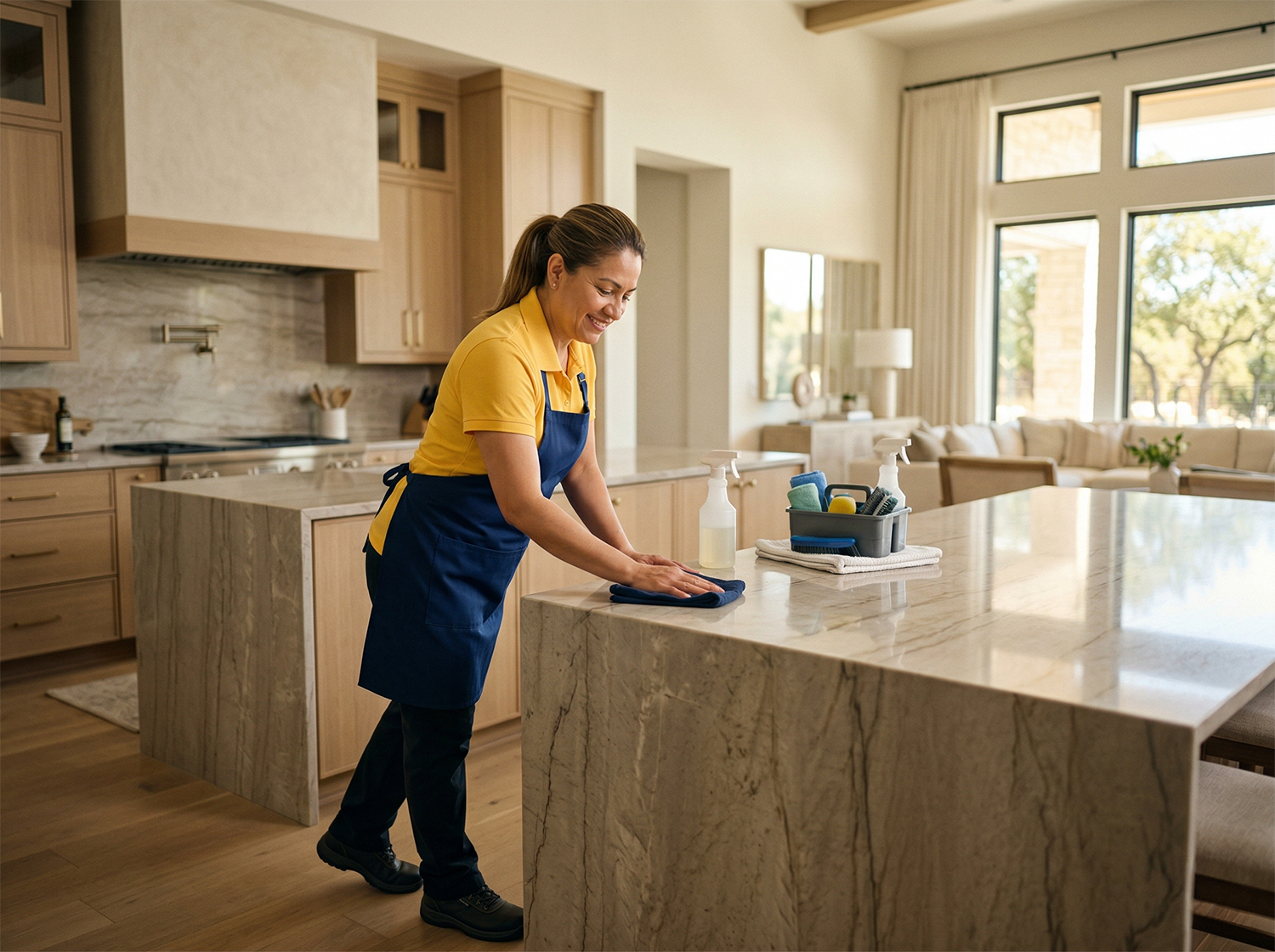
Is Cleaning the Right Business for You?
You don't need to be passionate about cleaning. That's not really how this works.
What you do need is a genuine interest in building something that's yours. Some satisfaction in a job done well and a customer who notices. A willingness to show up reliably and do physical work.
Cleaning businesses work because the demand is steady, the barrier to entry is low, and the work repeats. A client on a regular schedule is income you don't have to chase. That predictability is what makes it a real business rather than a series of one-off jobs.
If the idea of building that kind of income interests you and you're not put off by physical work, that's enough to start. The rest is execution.
Research and Plan Before You Start
Not a 40-page business plan. You don't need that. But some thinking before you spend money is worth doing.
A one-page execution summary is enough. Work through these questions before you do anything else:
Where will you service? Pick a specific area. Zip codes, not vague regions. How far are you willing to travel? What does the population density look like? Are there enough households in that area to sustain a full schedule? Neighborhoods with high owner-occupancy and double-income households tend to be the strongest starting markets.
Who will you service? Residential or commercial? Standard homes or higher-end? Vacation rentals or Airbnb properties? The answer shapes everything from your pricing to where you drop flyers to what your branding looks like. Starting with a clear picture of one customer type makes the early days simpler. You can always expand later.
How will you service them? Solo to start, or with help from day one? What's your capacity per week? How many jobs can you realistically take on before you need to grow?
Is there room? Search for existing cleaning businesses in your target area. If there are twenty already, that confirms there's demand. Understand where you'd fit, and whether the gap you'd be filling is one people actually care about.
One page. Answers to those questions. That's your plan. It doesn't have to be more than that at the start.
Startup Costs: What You Actually Need to Spend
Cleaning has one of the lowest startup costs of any service business. Here's a realistic breakdown before you spend anything:
- Business registration (LLC or DBA filing) — $50 to $200 depending on your state
- EIN from the IRS — Free
- General liability insurance — $500 to $900 per year
- Cleaning supplies (initial stock) — $150 to $300
- Commercial vacuum cleaner — $150 to $400
- Mop, bucket, and scrub brushes — $50 to $100
- Supply caddy or carry tote — $20 to $50
- Branded clothing (shirts, cap) — $75 to $150
- Door hangers and flyers — $75 to $150 for an initial print run
- Domain name (.com) — $15 to $20 per year
- Platform or payment system — $18 to $39 per month
- Logo and basic branding — $0 if you use AI tools, $150 to $400 if you use a designer
A realistic starting budget sits between $1,200 and $2,000 all in. Budget toward the higher end. Costs have a way of creeping past what you expect, and it's better to have a buffer than to run short before you've built a regular client base.
Your Brand
Brand is more than a business name. It's the whole impression: what you look like on a door hanger, how your shirt looks when you walk up to a front door, how the name sounds when someone recommends you to a neighbor.
It doesn't have to be expensive. But it pays to do the work properly from the start rather than redo it later when clients already know you by the wrong name.
Start by getting a few names on the board. Think about what says what you do, is easy to remember and spell, and would look right on a work shirt or a yard sign. Then before you get attached to any of them, check:
State business name register. Your state's Secretary of State website lets you search whether the name is already registered. If it is, move on.
Federal trade marks. Registering a business name doesn't protect you from trade mark claims. A quick check at USPTO.gov is worth doing, especially for anything distinctive. You don't want a letter from a lawyer six months in.
Domain availability. A .com is the standard expectation in the US. Check availability at a domain registrar before you commit to a name.
Social handles. Check Instagram and Facebook at the same time. If the name, the domain, and the handles all line up, that's your name. Register everything and move on.
On logos: a good prompt in ChatGPT or Claude gets you to a workable starting point in minutes at no cost.
Create a professional logo for [Business Name], a residential cleaning business. Keep it clean and simple. Use [color preference]. It needs to work at small sizes on social media and look good on work shirts and printed door hangers. Provide 3 or 4 variations.
You'll refine it over time. For now, something consistent is better than nothing. When you're ready to go further:
Create a brand guide for [Business Name], a residential house cleaning business. Include a primary color palette with hex codes, a secondary palette, font recommendations for headings and body text, logo usage rules, tone of voice guidelines with example phrases, and how the brand should appear on social media, uniforms, and printed materials.
It won't replace a designer. But it gives you something real to work from.
Insurance and Business Setup
We're not lawyers or insurance brokers. Get specific advice for your situation. Here's what most cleaning businesses need to sort out before they start.
General liability insurance. This is the one to prioritize. You're working inside people's homes, handling their belongings, using chemical products near their surfaces and furnishings. If something goes wrong, a breakage, a damage claim, a slip, you want to be covered. Most clients will ask to see proof of insurance before they sign up, particularly for recurring service. It's usually more affordable than people expect. A basic policy for a solo operator runs $500 to $900 per year. Don't wait until something happens to find out you needed it.
Bonding. A surety bond protects clients against theft by you or your employees. Not always required for solo operators, but worth considering once you plan to hire. Some clients specifically ask for a bonded cleaner and having it removes a common objection.
Business structure. Many solo operators start as a sole proprietor and formalize later. An LLC separates your personal assets from business liability and is worth considering once you're earning consistently. Formation typically costs $50 to $200 through your state's Secretary of State website. Talk to a CPA or a free SCORE mentor if you're not sure which structure makes sense for your situation before you decide.
Background check. Not legally required, but worth running on yourself early. Clients who are deciding whether to hand you a key to their home will sometimes ask. Having one available takes the question off the table before it becomes a reason to choose someone else.
EIN. Free from the IRS at irs.gov. Takes five minutes. Get it early even if you're operating as a sole proprietor.
Define Your Services and Pricing
Before you can get anyone to sign up, you need to know what you're selling and what you're charging. The goal is a clear, fixed-price menu that clients can choose from without any back and forth.
A cleaning business typically offers a combination of recurring services and one-off cleans:
- Standard Clean. The core recurring service. Bathrooms, kitchen, floors, dusting, surfaces. Priced by home size: studio or one bedroom, two bedroom, three bedroom, four-plus bedroom. Offered weekly or every two weeks.
- Deep Clean. A thorough top-to-bottom service. Inside appliances, baseboards, ceiling fans, detailed scrubbing. Priced higher than a standard clean. A natural first purchase before moving to a recurring subscription.
- Move-In / Move-Out Clean. Vacant properties getting ready for a new occupant. The most thorough and highest-priced single clean you offer.
- Vacation Rental Turnover. Timed to checkout and check-in windows. If you're in a market with Airbnb and VRBO activity, this can become a significant and very consistent revenue stream.
- Add-Ons. Interior windows, inside the oven, inside the refrigerator. Flat-rate additions to any clean rather than custom pricing that slows down the checkout process.
On pricing: look at what established operators in your area charge and understand your own costs. Factor in supplies, travel time, and your time per job including setup and pack-down. The standard market rate in your area is a reference point, not a ceiling. If your work is reliable and your communication is professional, price in the upper middle of your market.
Customers who sign up for recurring service get a lower per-visit rate than one-off clients. That's the trade. They give you predictability. You give them a better price. Build your recurring rate as the primary offer and the one-off rate as the entry point.
For non-standard situations, a private subscription invite with a custom price keeps the arrangement clean without cluttering your public page.
This is what ServiceSubscriber does.
A page, payments, and delivery tracking. Live in 20 minutes.
14-day free trial. No credit card.

Equipment and Supplies
You don't need a van full of specialist equipment to start. Most of what you need for residential cleaning is available at Home Depot, Lowe's, or a wholesale cleaning supply store, which keeps startup costs low and restocking straightforward.
A solid starting kit covers:
- Microfiber cloths — buy in bulk, different colors for different areas (kitchen, bathroom, general)
- Paper towels
- Cleaning solutions — all-purpose, bathroom, kitchen, glass cleaner, disinfectant
- Broom and dustpan
- Mop and bucket
- Scrub brushes
- Toilet brushes — one per client if you want to stand out
- Spray bottles, clearly labeled
- Nitrile gloves
- Plastic scrapers
- Caddy or tote to carry supplies between rooms
- Commercial vacuum cleaner
For cleaning solutions, the major home improvement stores cover the basics. If you want to differentiate with eco-friendly products, specialty cleaning supply distributors carry plant-based and low-chemical alternatives. Some clients specifically look for this, particularly in higher-end residential areas. Worth considering as part of how you position the business.
Buy quality where it matters most: the vacuum and the microfiber cloths. Don't overspend on the rest until you know what you actually use through a full working week.
Getting Your First Customers
This is the part most people overthink. You've done the setup. Now you need someone to pay you.
A word on friends and family first. They're sometimes the easiest starting point, but only if their need for your services is genuine. A favor job where someone lets you clean their house out of kindness isn't feedback you can build on. If you have friends or family who genuinely need a cleaner and would otherwise be paying someone, great. Otherwise, start with strangers.
Drop door hangers in your target area. Simple design. What you do, what you charge, a QR code to your page. Canva has free templates that make this fast. Print through an online printer and keep costs under $100 for an initial run. Drop 200 on a Saturday morning and see what comes back.
Nextdoor. The neighborhood social network. People post service requests there constantly and recommendations from actual neighbors carry real weight. Introduce yourself to your area, be specific about what you offer and what you charge, and ask your first few satisfied clients to post a recommendation. A handful of genuine neighbor endorsements is worth more than any paid ad in the same zip code.
Facebook community groups. Most neighborhoods have an active one. Introduce yourself, be specific about where you operate and what you offer, include your link. Don't post once and disappear. Show up regularly, answer questions, be visible.
Google Business Profile. Free to set up at business.google.com. Fill it out completely. When someone searches for a cleaner in your area, a verified listing with a few reviews means you can show up in local results. Ask your first five clients for a review. Five genuine reviews puts you ahead of most new operators.
Thumbtack and Angi. Both connect homeowners with local service providers. The leads cost money and margins are thinner than direct clients, but they're a legitimate way to get early jobs and reviews while your own page and reputation are getting established. Think of them as a starting point, not a long-term home.
Ask for referrals directly. After your first few jobs, ask. Most people are happy to recommend someone who did good work. They just need to be asked.
Give Customers a Way to Sign Up
A door hanger with a phone number gets you started. But it's not enough on its own.
When someone scans your QR code or types in your address, they should land somewhere that shows exactly what you offer, what it costs, and lets them sign up without having to call you or wait for a response. The more friction between interest and payment, the more people drop off.
What that page needs to do: show your services clearly, show your prices, let someone choose between a one-off clean and a recurring subscription, and take payment. That's it.
Here's an example of what that looks like in practice:
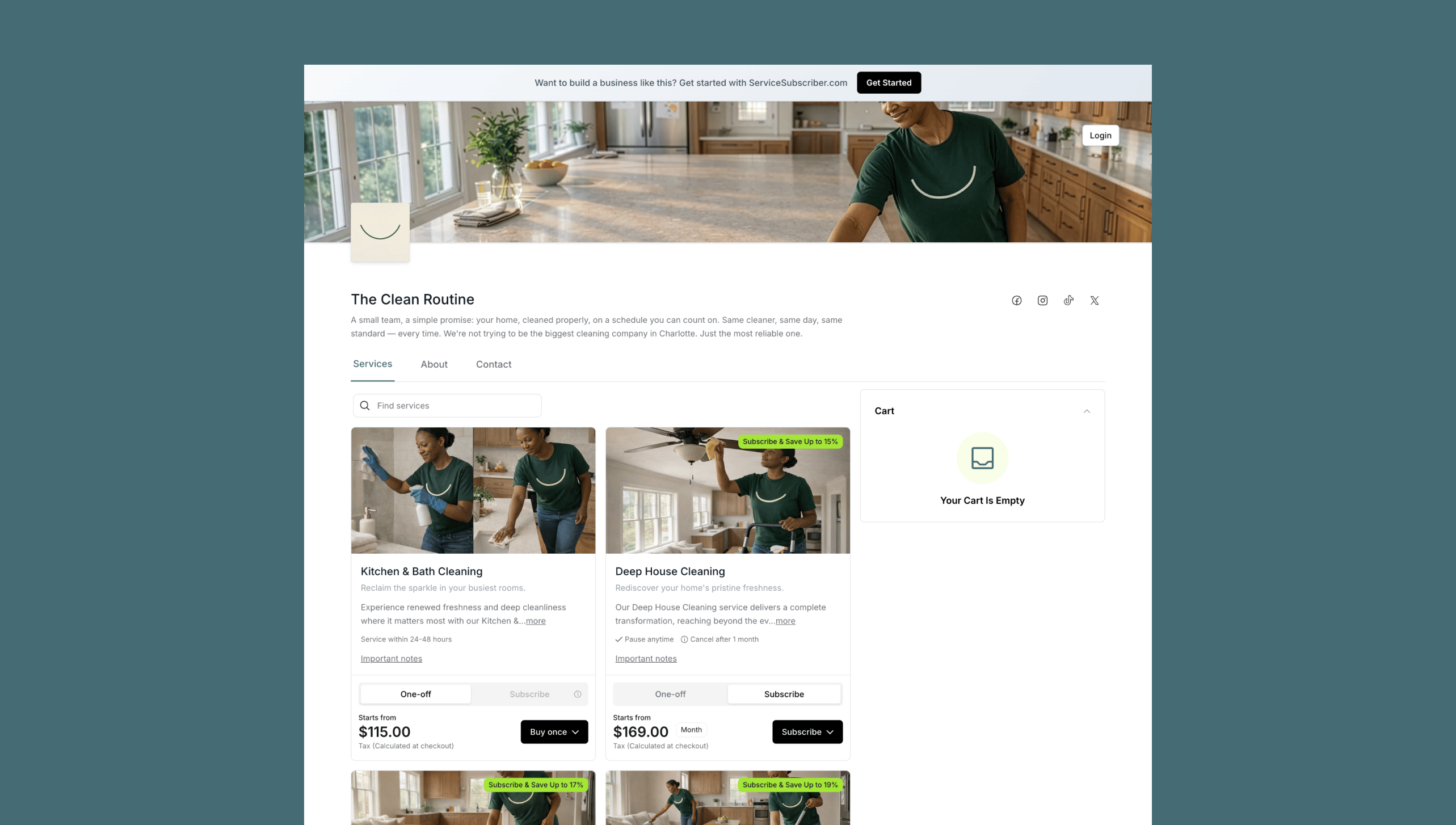
Services listed clearly. Pricing visible upfront. Customers choose a one-off clean or subscribe for regular service. Payment handled at checkout. That's the whole experience, for you and for them. For non-standard arrangements, a private subscription invite with a custom price keeps things clean without cluttering your public page.
Make the First Job Count
Your first job isn't just a job. It's an audition.
The client is deciding whether they want to let you back into their home. First impressions are hard to undo in either direction. Get this right and you'll likely have a regular. Get it wrong and no follow-up message will fix it.
The basics matter more than anything else. Be on time. If you're running late, message before you're late, not after. Show up in clean, branded clothing. Be professional in how you communicate.
Then go slightly beyond what they expected.
A small detail that clients notice: finishing a clean with a light spray of a fresh citrus scent through the main living areas. It's inexpensive and it does something that all the scrubbing doesn't. It gives the home a feeling of clean, not just the look of it. Clients remember it. It's the kind of thing people mention when they recommend you to a neighbor.
Other things that stick: leaving surfaces exactly as they were, noting anything you noticed and letting the client know, asking once at the end if there's anything they'd like done differently next time. That last question signals professionalism and gives you feedback before a small preference becomes a reason to look elsewhere.
Your goal after the first job is a recurring subscription. Everything else follows from that.
Getting Paid Consistently
The billing side of a cleaning business is where most people leave money on the table.
Sending invoices after every job, chasing payments, remembering who paid and who didn't. It takes time, and it creates the kind of unpredictable income that makes it hard to plan anything. You do the work and then hope.
If the work repeats, the billing should too. A client on a regular subscription pays automatically on each billing date. You show up, do the job, mark it done. No invoice. No follow-up. The payment processes before you walk through the door.
That structure separates a cleaning business with consistent income from one that's always uncertain. The work is the same. The billing setup is different. And the difference compounds as you grow.
Set it up from the start. It's harder to move existing clients onto a subscription model than to offer it as the default from the first sign-up.
Putting It Together
A cleaning business can be started for under $2,000. Some people have done it for less.
The work is straightforward. The demand is real. The path from first client to a full schedule of regular subscribers is shorter than most people think, if you set it up properly from the beginning.
Plan before you spend. Brand before you prospect. Get your page live before you hand out your first door hanger. Make the first job count. Ask for the recurring subscription.
The people who do well at this aren't the ones who waited until everything was perfect. They started with what they had, learned from the first few jobs, and adjusted as they went.
That's roughly how it works.
Ready to start your cleaning business?
Create your service page, share the link, and start getting paid. Customers can sign up for a one-off clean or subscribe for regular service. You get paid directly.
14-day free trial. No credit card. 50% off first 3 months.
Did you find this guide helpful?
More guides
Explore other service businesses you can start

How to Start a Service Business
The complete starting point for any service business.
Read guide
How to Start a Lawn Care Business
Weekly recurring work in your own neighborhood.
Read guide
How to Start a Window Cleaning Business
Low startup cost, natural add-on to a cleaning client base.
Read guide