

How to Start a Mobile Barber Business
Many men get their hair cut every two to four weeks. The ones who've found a barber they trust are often reluctant to switch. The mobile model takes that relationship and removes the main inconvenience left: the trip to the shop. You show up, they get a great cut, everyone saves time. That's a business worth building.
32+ people found this guide helpful

Why Mobile Barbering Works
Barbering has one of the strongest natural recurring cadences of any service business. A good cut lasts two to four weeks. After that, the client needs another one. A client who trusts you and values their appearance isn't looking to switch. They want the same result, on a schedule, without having to think about it.
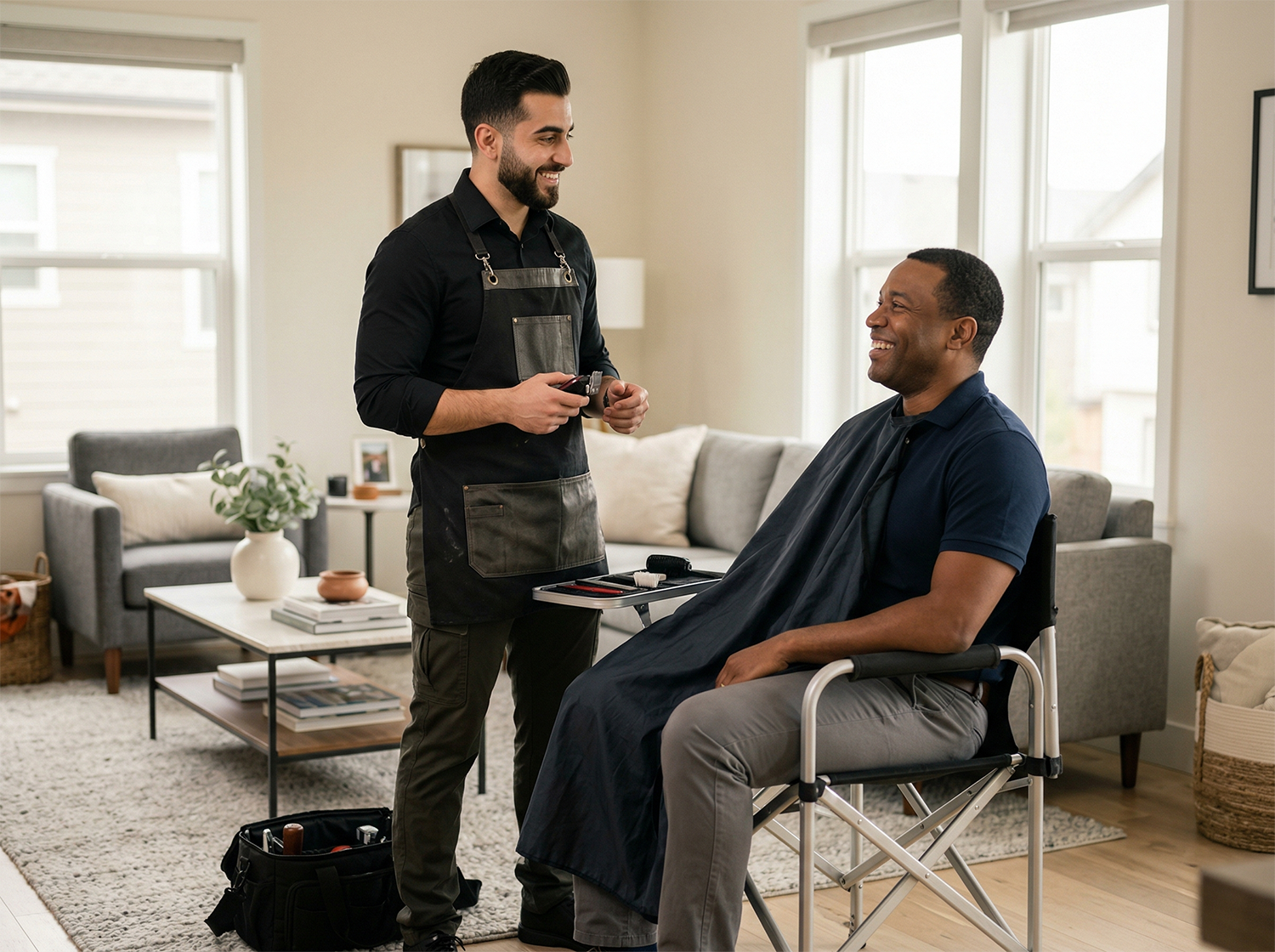
The mobile model adds a dimension to that relationship that a fixed shop can't offer: convenience. No parking. No waiting. No commute. The barber comes to you, at your home or your office, and the whole thing takes 30 to 45 minutes. For busy professionals, executives, and people who simply value their time, that convenience has real worth and they're willing to pay a premium for it.
The US market for mobile and in-home personal services has grown consistently. Demand for convenience-based personal care has expanded well beyond what traditional shop models serve. Mobile barbers who position themselves well in the right markets, particularly dense professional environments, corporate campuses, and higher-income residential areas, are building solid, loyal client bases that hold up because the relationship is genuinely personal.
From what we've seen, the operators who build the most durable client bases in this category are the ones who combine genuine skill with genuine reliability. The skill earns the first client. The reliability is what keeps them on a recurring schedule. You need both.
Skills, Training, and Licensing
Mobile barbering is a licensed trade in every US state. This is one of the most important distinctions between this guide and most of the others in this series. You cannot legally cut hair for compensation without a valid state barber or cosmetology license. That's not a technicality. It's a real regulatory requirement enforced by state licensing boards.
Barbering programs. Most states require completing a state-approved barbering program, typically 1,000 to 1,500 hours of training depending on the state, followed by a written and practical exam. Programs are available at community colleges, trade schools, and dedicated barber schools. The duration varies but most full-time programs run 9 to 18 months.
Cosmetology license as an alternative. Some states allow cosmetologists to cut men's hair. A cosmetology license typically requires more training hours than a barber license but covers a broader range of services. Worth understanding which path makes more sense in your state before you enroll.
State license portability. If you move to a different state or want to operate across state lines, check whether your license transfers or requires additional steps. Licensing reciprocity between states varies considerably.
Mobile-specific permits. Some cities and counties require a separate mobile business permit or inspection on top of your state barber license for operating as a mobile service. Check with your local city or county licensing office before you start working.
If you're already a licensed barber looking to go independent and mobile, this section is background you already know. If you're earlier in the process, factor the training time and cost into your planning before anything else. Everything else in this guide assumes your license is in order.
Mobile vs. a Fixed Shop
This guide is about mobile barbering. Not because fixed shops aren't a legitimate and sustainable business, but because for someone starting out independently, a fixed location means commercial rent, fit-out costs, and a client base willing to come to you. That's significant overhead before you've established anything.
Mobile removes that barrier. You go to the client. Your chair, your kit, your skills. They don't have to go anywhere. That convenience is a genuine selling point and it commands a premium over a standard shop visit in most markets.
The trade-off is that you're working in varied settings, dependent on the space available at each location, and spending time between appointments on the road. That drives how you price, how you schedule, and how tight you keep your service area.
Start mobile. If a fixed location makes sense down the track once you have a loyal client base and a reason to add the overhead, that decision can be made from a position of strength.
Is This the Right Business for You?
Mobile barbering rewards people who are genuinely good at what they do and genuinely reliable about showing up. Those two things, skill and reliability, are what build the loyal client base that makes this business sustainable.
You'll be working in people's homes and offices. That requires a professional manner, an ability to read the room, and the kind of interpersonal ease that makes clients comfortable enough to become regulars. The actual cutting is table stakes. The relationship is what keeps people on a recurring schedule.
The scheduling side requires discipline. Managing a route of clients across different locations, keeping appointments on time, and communicating clearly when something changes. It's manageable, but it doesn't run itself, particularly in the early months when you're still building the system.
If you're a skilled barber who values independence, enjoys building client relationships, and is willing to put in the work to establish a route, the mobile model is worth pursuing seriously.
The Subscription Opportunity in Barbering
Haircuts recur on their own. The question is whether you capture that recurrence or whether you leave it to chance and hope the client reaches out before they go somewhere else.
Most barbers, including mobile ones, operate on an informal appointment basis. Client texts when they need a cut. Barber finds a slot. This works until it doesn't: the client gets busy or forgets, tries a convenient alternative once, and a recurring relationship quietly ends without anyone noticing.
The alternative is a scheduled recurring service with automatic billing. Client signs up for a cut every two weeks or every month. Payment processes automatically. You show up on the agreed schedule. This model requires more upfront effort to establish than informal arrangements and not every client will want it. But for professional clients who value predictability, the set-and-forget convenience is a genuine part of the value proposition and worth offering clearly.
This model works particularly well with professional clients who value consistency and predictability. A busy executive who knows their barber is coming to their office every other Tuesday doesn't have to think about it. That set-and-forget convenience is a meaningful part of the value proposition for this kind of client, and worth positioning explicitly when you're building your service offering.
It also makes your own schedule far more plannable. A base of clients on recurring schedules gives you a known floor of income before you've filled a single open slot. Build that base and the business becomes genuinely stable.
Research and Plan Before You Start
A one-page plan before you spend anything is worth the time.
Where will you operate? Define your service area. A tight radius keeps travel time low and your effective hourly rate higher. Dense professional neighborhoods, office districts, and higher-income residential areas are the strongest starting markets for mobile barbering.
Who are you targeting? The mobile barber premium makes most sense for clients who value their time and have some disposable income. Busy professionals, executives, entrepreneurs, and remote workers are the natural client base. Corporate campuses and office parks are worth mapping as a prospecting environment.
What does the local market look like? Search for mobile barbers in your area. If there are established operators, that confirms demand. Understand what they charge and how they position themselves. If you're entering a market where mobile barbering is new, there may be more education required before clients understand the value proposition.
Home-based clients vs. workplace clients. These are two distinct client types with different scheduling patterns. Home-based clients tend to book on weekends or early mornings. Workplace clients during business hours. Understanding which you want to focus on shapes your schedule and your prospecting approach.
Startup Costs: What to Expect
Mobile barbering has a lower startup cost than most personal service businesses because there's no premises to fit out. The main investment, beyond your license if you don't have one yet, is a quality portable kit. Here's a realistic breakdown:
- State barber license (if not yet licensed) — $1,500 to $5,000+ for training program tuition, plus exam and licensing fees that vary by state
- Business registration (LLC or DBA filing) — $50 to $200 depending on your state
- EIN from the IRS — Free
- General liability insurance — $400 to $800 per year
- Professional clippers (two pairs minimum) — $200 to $600
- Cordless trimmers and outliner — $150 to $400
- Portable barber chair (foldable, professional) — $300 to $800
- Scissors, combs, brushes, and capes — $150 to $400
- Hot towel steamer or portable warm towel setup — $100 to $300
- Shaving supplies (razor, cream, aftershave) — $75 to $200
- Sanitizing and disinfecting supplies — $50 to $100
- Carrying case or rolling bag — $100 to $300
- Branded clothing — $75 to $150
- Business cards and marketing materials — $75 to $150
- Domain name (.com) — $15 to $20 per year
- Platform or payment system — $18 to $39 per month
- Logo and basic branding — $0 if you use AI tools, $150 to $400 if you use a designer
A realistic all-in starting figure, assuming you're already licensed, is $1,500 to $3,500, not including your vehicle. The foldable chair is the largest single item and worth spending on. A shaky or uncomfortable portable chair undermines the premium positioning the mobile model relies on.
Your Brand
Mobile barbering is a personal service business at the premium end of the market. Your brand needs to reflect that. Clients paying above shop rates for the convenience of having you come to them are expecting professionalism in every detail, including how you present yourself before you've arrived.
Before you settle on a name, run the standard checks:
State business name register. Your state's Secretary of State website. If it's taken, move on.
Federal trade marks. A quick check at USPTO.gov before you invest in printed materials and branded clothing.
Domain availability. A .com. Check it before you commit to the name.
Social handles. Instagram in particular. Barbering is a highly visual category and before-and-after content performs very well. When the name, domain, and handles all align, register everything and move on.
On logos:
Create a professional logo for [Business Name], a mobile barbering business. Clean, bold, and premium. Use [color preference, darker palettes tend to work well]. It needs to work on a business card, a work shirt, and a website. Provide 3 or 4 variations.
When you're ready to go further:
Create a brand guide for [Business Name], a mobile barbering business targeting professional clients. Include a primary color palette with hex codes, a secondary palette, font recommendations for headings and body text, logo usage rules, tone of voice guidelines with example phrases, and how the brand should appear on social media, uniforms, business cards, and a service page.
Insurance and Compliance
We're not lawyers or insurance brokers. Get specific advice for your situation. Here's what's worth sorting out before you take your first client.
State barber license. Required before you cut hair for compensation in any US state. Carry proof of your license. Clients can ask to see it and state inspectors in some markets do conduct compliance checks on mobile operators.
General liability insurance. You're working in clients' homes and offices. A nick from a razor, a chemical reaction from a product, something damaged in a client's space. General liability insurance covers you when something goes wrong. A basic policy for a solo mobile barber typically runs $400 to $800 per year. Get it before your first appointment.
Tool sanitation compliance. State barber boards have specific requirements for sanitizing tools between clients. Clippers, combs, scissors, razors. These requirements aren't optional and apply regardless of whether you're working in a shop or a client's home. Know your state's specific requirements and have a compliant sanitation setup in your kit.
Mobile business permits. Some municipalities require a mobile service business permit on top of your state license. Check with your local city or county business licensing office before you start operating commercially.
Business structure. Talk to a free SCORE mentor or your local SBDC about sole proprietor versus LLC before you decide. A brief conversation is worth having before you take your first paid client.
Define Your Services and Pricing
The goal is a clear, fixed-price menu that clients can choose from and sign up for without back and forth. Barbering services price naturally by service type rather than by variable tiers, though some operators offer tiered pricing for maintenance visits.
Core recurring services:
- Barber Cut. Your core service. Consultation, wash, cut, and style. Offered as: Standard Cut, Skin Fade, Buzz Cut, or Scissor Cut. Every two weeks or monthly. This is what most clients sign up for on a recurring schedule.
- Beard Trim and Shape. Trim, shape, and line up. Beard oil finish. 15 to 20 minutes. Weekly or every two weeks for clients who maintain a beard. A natural add-on to any cut appointment or a standalone recurring service for clients who cut their own hair.
- Haircut and Beard. Full haircut plus beard trim and shape in a single visit. 45 to 60 minutes. Every two weeks or monthly. Your highest-frequency recurring package and what most clients with both a cut and a beard will choose. Offered as: Standard cut plus beard, Skin fade plus beard, Buzz cut plus beard.
- Maintenance Visit. For returning clients who want the same style kept fresh between full appointments. Cut only, fade only, cut and beard, or full refresh. 20 to 45 minutes. Every two weeks. A natural lower-cost tier for clients who want more frequent upkeep without the full service every time.
Premium and occasional services:
- The Full Service. Haircut, beard trim, hot towel shave, and styling. 75 to 90 minutes. Monthly. Your premium offering for clients who want the full experience. A strong first appointment for new clients who want to understand what you offer before committing to a regular schedule.
- Hot Towel Shave. Traditional straight razor shave with hot towel and aftershave. 30 minutes. Every two weeks or monthly. A premium standalone service that positions you clearly above a quick shop visit.
- Kids Haircut. For children under 12. Patient, child-friendly service. 20 to 30 minutes. Monthly. A natural add-on when you're already visiting a household for the adults.
On pricing: mobile barbering commands a premium over shop rates in most markets. The premium reflects the convenience of a home or office visit, not just the quality of the cut. Understand what shops in your area charge and price your mobile service 20 to 40 percent above that. The client who values convenience enough to seek out a mobile barber is not your most price-sensitive customer.
The every-two-weeks haircut and beard package is your anchor recurring service. Price it to make signing up an easy decision for a client who knows they need a cut on that schedule anyway. The convenience of not having to think about it is real value that justifies the premium.
This is what ServiceSubscriber does.
A page, payments, and delivery tracking. Live in 20 minutes.
14-day free trial. No credit card.

Equipment
Your kit is your business. Everything you need to deliver a professional result in a client's home or office has to fit in what you carry. Here's what a well-equipped starting setup looks like:
- Professional clippers (two pairs). One primary pair for cutting, one backup. Cordless is strongly preferable for mobile work. Power availability at client locations is not always convenient. Quality matters here, both for the result and for how the equipment holds up in daily use.
- Cordless trimmers and outliner. For detailing, fading, and line work. A detailing trimmer is essential for sharp lines around the ears and neck.
- Scissors. At least one quality pair of cutting scissors and a pair of thinning shears. Dull scissors make every cut harder and slower.
- Portable barber chair. A foldable chair that is genuinely comfortable and stable. Not a consumer folding chair. A professional portable barber chair. This is the single item most worth spending on. An unstable or uncomfortable chair undermines the entire premium positioning.
- Barber capes and neck strips. Multiple capes, clean for each client. Neck strips for every cut.
- Combs and brushes. Styling combs, a neck brush, a boar bristle brush for finishing.
- Hot towel steamer or portable warming solution. For the hot towel service. A compact portable steamer is worth carrying if hot towel shaves are part of your offering.
- Shaving supplies. Straight razor or shavette, shaving cream or soap, pre-shave oil, aftershave. Quality matters for client comfort.
- Sanitizing station. Clipper spray, disinfectant jar for combs and scissors, disposable blade guards or fresh blades per client. State sanitation requirements apply whether you're in a shop or a client's kitchen. Non-negotiable.
- Hand mirror. For the back-of-head check with the client before you pack up.
- Quality rolling or carry bag. Everything needs to fit, stay organized, and travel without damage. A professional carrying solution signals professionalism before you've opened it.
Invest in quality on the clippers, scissors, and the chair. The rest can be upgraded as the business grows.
Getting Your First Clients
Mobile barbering clients come from personal networks and professional environments more than from traditional service business channels. The approach is slightly different from dropping door hangers or posting on Nextdoor.
Start with your personal network. If you're a licensed barber going independent, your existing clients are your most immediate opportunity. A professional message explaining that you're now offering mobile visits and what you charge is often enough to convert a significant number of your existing client relationships to the new model.
LinkedIn. Mobile barbering for professional clients has a natural home on LinkedIn in a way that almost no other service business does. A professional post explaining what you offer, where you operate, and what the experience looks like tends to perform well in professional networks. Be specific. Tag your location. Reach out directly to professionals in your target area. This is the most underused channel in this category.
Office buildings and corporate environments. A professional introduction, either in person at reception or via a well-written email to an office manager, explaining that you offer in-office haircuts during lunch breaks or before or after business hours. Many offices in professional industries have services come to them as a perk or convenience. Being the person who makes that offer directly is how you get into those environments.
Residential neighborhoods and referrals. A satisfied client in a high-income residential area is a referral engine. Ask after the first appointment. Most people who've experienced the convenience of a mobile barber will mention it to their neighbors, colleagues, or friends if asked.
Instagram. Clean before-and-after content performs well in barbering. A consistent posting presence with sharp results, location tags, and engagement with local community accounts builds visibility over time. It's a slow channel but it compounds and serves as a portfolio for new clients who find you any other way.
Google Business Profile. Free at business.google.com. Fill it out completely with your service area and what you offer. Ask your first clients for a review. People searching for mobile barbers in your area will find you.
Give Clients a Way to Sign Up
When someone finds you through LinkedIn or a referral and wants to know more, they should land somewhere that shows what you offer, what you charge, and lets them sign up or get in touch without friction. The easier you make the first step, the more likely a curious person becomes a recurring client.
A service page that shows your offering clearly, with pricing visible and a way to sign up for a recurring schedule or purchase a first appointment, handles the conversion without you having to be available to respond to every inquiry manually.
Here's an example of what that looks like in practice:
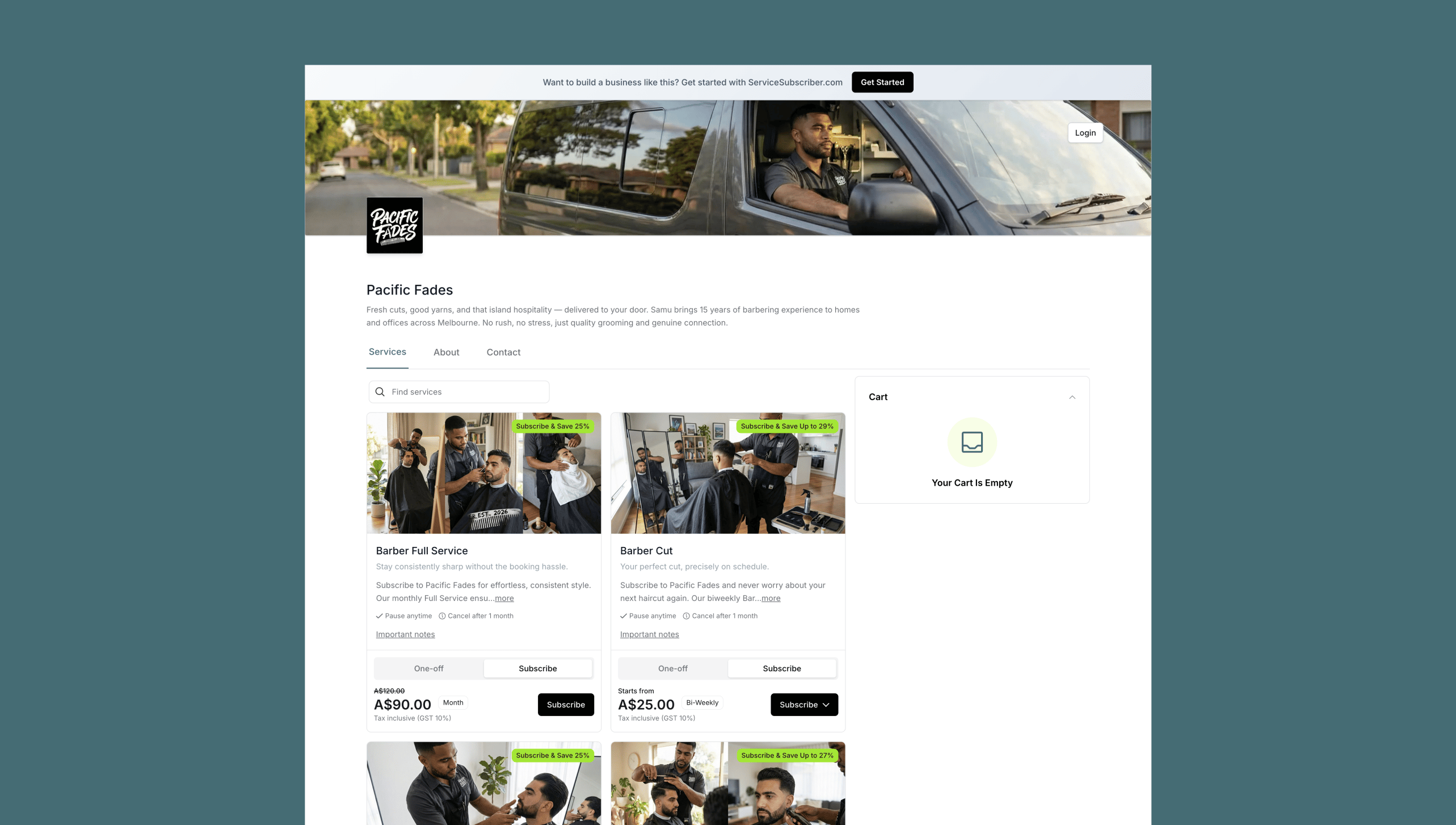
Services and pricing upfront. Clients choose their service and sign up directly. Payment handled at checkout. For non-standard arrangements, a private subscription invite with a custom price keeps things clean without cluttering your public page.
Make the First Appointment Count
The first appointment is where a new client decides whether they're going to put you on a recurring schedule or treat it as a one-off experience. Getting this right matters more here than in almost any service business because the relationship is personal.
Arrive on time and set up professionally. Chair, cape, tools laid out properly. You're in branded clothing. Before you've touched a hair, the client has already formed an impression of whether this is a premium service or just a guy with clippers.
Take a proper consultation. Ask about the style they want, how often they typically cut, and what they like or don't like about their current cut. Listening for two minutes before you start signals that you care about the result, not just the speed.
Deliver a result that's clearly better than a rushed shop visit. The standard you're being compared to in most cases is a 15-minute chain barbershop cut. That's not a high bar technically. The client is paying a premium for convenience, but they also expect the quality to justify it. Make sure it does.
Do the hand mirror check. Show the client the back before you start packing up. It signals professionalism and catches any adjustment before you've left.
Mention the recurring option before you leave. Something like: "Most of my clients do this every two weeks or every month, same day, same time. Takes the thinking out of it. I can set that up for you if you'd like." Not a hard sell. Just a natural offer at the right moment.
Getting Paid Consistently
Mobile barbering built on a recurring schedule is one of the more stable personal service businesses you can build. The client signs up for a cut every two weeks or every month. Payment processes automatically on the billing date. You show up, do the appointment, mark it done. The coordination that does exist is mostly scheduling adjustments rather than chasing people to rebook.
As the client base grows, that predictability lets you plan your week with confidence. A base of clients on recurring schedules gives you a known income floor before you've filled a single open slot. The open slots then become upside rather than necessity.
That said, churn happens. Clients relocate, change their routine, or find a shop more convenient when circumstances change. The goal isn't to lock clients in but to make the recurring arrangement so convenient and consistent that staying is the easier choice. Do that, and the base stays largely stable over time.
Putting It Together
Mobile barbering is a business that rewards skilled, reliable people. The technical skill is the foundation. The reliability is what builds the recurring client base. Together they create a business that's genuinely personal, resistant to being undercut on price, and capable of generating stable recurring income from a relatively small number of clients.
Get your license sorted first if you don't have one. Invest in a quality portable chair. Brand professionally from the start. Get your page live before you approach your first corporate client. Make every first appointment good enough that the client wants to put you on a schedule. Ask before you leave.
The clients who find a mobile barber they trust tend to stay. Your job is to be that person for enough of them to build the income you're after. Start with who you know. Expand from there.
Ready to start your mobile barber business?
Create your service page, share the link, and start building your client base. Clients sign up for the service they need, payment processes automatically, and you show up on schedule.
14-day free trial. No credit card. 50% off first 3 months.
Did you find this guide helpful?
More guides
Explore other service businesses you can start
How to Start a Service Business
The complete starting point for any service business.
Read guide
How to Start a Dog Grooming Business
Another mobile personal service built on loyal recurring clients.
Read guide
How to Start a Car Detailing Business
Mobile service, premium positioning, same professional client base.
Read guide