

How to Start a Pool Cleaning Business
The US has one of the highest rates of residential pool ownership in the world. Millions of those pools need professional maintenance every week or every two weeks, and a significant portion of pool owners would rather pay someone else to handle it. This is technical work that rewards operators who invest in proper training. Get that part right and the recurring income is about as reliable as service businesses get.
38+ people found this guide helpful

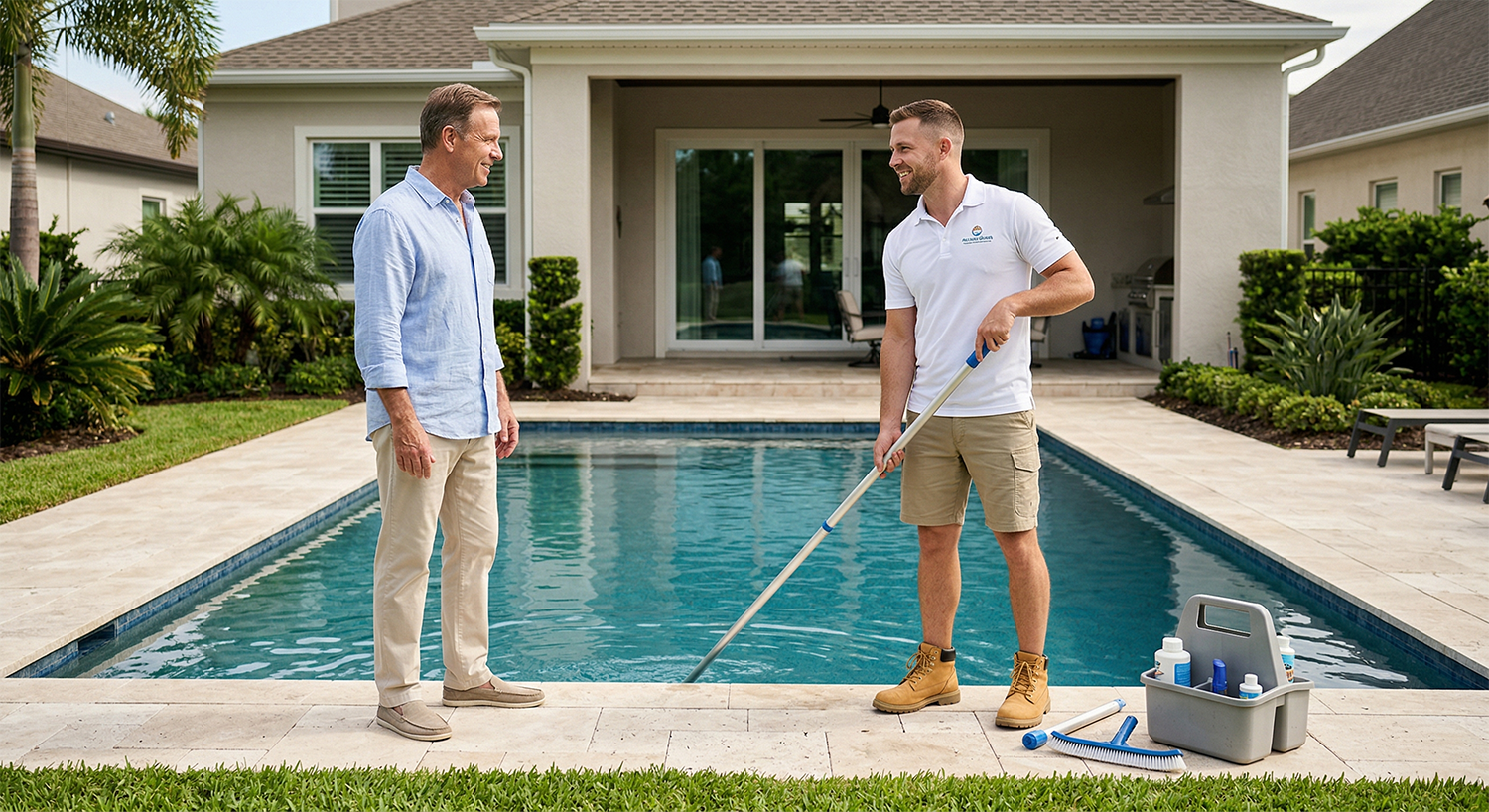
Why Pool Cleaning Works as a Business
Estimates vary, but millions of residential pools exist in the United States, concentrated heavily in Sun Belt states like Florida, Texas, California, Arizona, and the Southeast. In many suburban neighborhoods in these markets, a third or more of homes have a pool. That's a significant density of potential clients within a short driving radius.
Beyond traditional in-ground pools, hot tubs and spas are widespread across much of the country regardless of climate. A backyard spa gets used year-round in most regions and needs maintenance just as consistently as a full pool. Operators who include hot tub and spa service alongside pool work give themselves a larger addressable market and smoother year-round income.
What makes pool cleaning particularly compelling as a business is the ongoing nature of the maintenance. A pool that isn't serviced regularly becomes unsanitary, unusable, and potentially damaging to its own equipment. Owners need to maintain it regularly, and those who don't want to handle it themselves need someone they can trust to do it consistently. Finding that person and keeping them is what most pool owners struggle with.
The recurring model here is natural and strong. A weekly or every-two-weeks client who is happy with the work tends to stay. The income compounds as the route grows, and the effort to keep a satisfied client is significantly less than the effort to find a new one.
Mobile, Not a Shop
There are two versions of a pool business. One is a retail shop that sells chemicals, equipment, and accessories alongside a service operation. The other is a mobile operator who drives a route, services pools at residential and commercial properties, and keeps overheads low.
The retail model is a different business with a different set of challenges: lease commitments, inventory, and staff. It's not what this guide is about.
The mobile model is where the opportunity sits for someone starting out. A vehicle, the right equipment, a solid understanding of water chemistry, and a growing route of regular clients. Lower entry cost, no lease, and a business that scales by adding clients to your schedule rather than by expanding a storefront.
Everything in this guide assumes you're building a mobile operation.
Is This the Right Business for You?
Pool cleaning is technical work. That's the single most important thing to understand before anything else. You're not just skimming leaves. You're testing and balancing water chemistry, identifying equipment issues, and making judgment calls about what a pool needs to stay safe and clean. Getting that wrong has real consequences, for the pool, for the equipment, and potentially for the people swimming in it.
The technical side is learnable. Many operators with no background in pool maintenance have built successful businesses by investing in proper training before they started. The question isn't whether you can learn it. It's whether you're willing to invest the time before you start charging clients.
Beyond the technical side, this is outdoor physical work year-round in warmer markets. You'll be managing a route, keeping detailed records for each pool, and building relationships with clients who are trusting you with something they've spent real money on. If that combination sounds manageable, it's worth pursuing seriously.
The Technical Side: Get Trained Before You Start
We're not going to walk you through water chemistry, chemical dosing, or equipment diagnostics in this guide. That's not because those things are unimportant. It's because they're genuinely complex, and a startup guide isn't the right place to learn them. Getting the chemistry wrong in a pool people are swimming in matters.
What we'd suggest instead:
Get formal training. The Pool and Hot Tub Alliance (PHTA) offers the Certified Pool Operator (CPO) certification, which is widely recognized across the industry and required by law for commercial pool operators in many states. For residential operators it's not always legally required, but it's a meaningful credential that clients recognize and that insurers and state regulators increasingly look for. The National Swimming Pool Foundation (NSPF) runs the certification program. It's worth doing before you take your first paid client.
Check your state's licensing requirements. Several states require a specific license to service residential or commercial pools for compensation. Florida has specific contractor licensing requirements for pool service businesses. Requirements vary significantly by state. Check with your state's Department of Business and Professional Regulation or equivalent before you start operating. Better to know early than to discover it later.
Find the communities. There are active online communities of pool and spa technicians across Facebook groups and Reddit where operators share knowledge, discuss equipment, and answer questions from newer operators. These communities are genuinely useful when you encounter something unfamiliar on a job. Find them, spend time in them before you start, and keep them close once you do.
Work alongside an experienced operator first if you can. A few weeks with someone who has been doing this for years is worth more than almost anything else for building practical confidence. If that option is available in your area, take it.
Seasonality and the Year-Round Opportunity
Pool cleaning has a pronounced geographic shape in the US. In Florida, Texas, Southern California, Arizona, and much of the Gulf Coast, pools are in use most of the year and maintenance runs on a year-round schedule. These are the strongest markets for pool service businesses and account for the majority of the industry's volume.
In northern and Midwest markets, pools close for winter and the mowing season analogy applies: the work has a defined season, and operators need a plan for the slower months. Some northern operators add winterization and spring opening services, or complement pool work with other outdoor services during the off-season.
Hot tubs and spas are the seasonality smoothers. A spa gets used year-round in most climates, including cold ones. Operators who include hot tub maintenance alongside pool work have year-round recurring income even in markets where pool season ends in October. The maintenance requirements are similar, the service cadence is typically every two weeks, and the client base often overlaps directly with pool owners.
Strata and HOA communities with shared pools are another year-round opportunity. Apartment buildings and townhouse complexes often maintain their pools for resident use on an extended or year-round schedule. These contracts are higher value, more consistent, and tend to stay once established.
If you're planning to operate in a seasonal market, build your income model around what the off-season looks like before you commit to the business as a primary income source.
Research and Plan Before You Start
A clear picture of your market before you spend anything on equipment is worth the time.
Where will you operate? Pool density varies significantly by zip code. Established residential areas with older homes and larger lots tend to have higher pool ownership. Newer developments vary. Map the pool density in your target area before you plan a route. In strong Sun Belt markets, a tight starting radius of a few zip codes can hold enough pools to build a full schedule.
What does the local market look like? Search for pool service businesses in your area. In most strong pool markets there are established operators. Understand how they're positioned, what they charge, and where there might be gaps. Reliability and communication are the most common complaints about existing operators. That's a consistent opening for a new entrant who simply shows up on schedule and communicates clearly.
What will you offer beyond standard pools? Hot tubs, spas, and above-ground pools all have distinct maintenance needs. Above-ground pools are common in northern markets. Decide before you start which types you'll service and which you won't, and be clear about it on your page.
HOA and strata pools. If commercial and common-area pool work interests you, understanding how property management works in your area before you approach HOA boards or strata managers will save time. Most of these relationships go through a property manager or HOA management company rather than directly to homeowners.
Startup Costs: What to Expect
Mobile pool cleaning sits in the mid range for service business startup costs. The training investment is a significant and non-negotiable line item that doesn't exist at the same level in most other service categories. Here's a realistic breakdown:
- Business registration (LLC or DBA filing) — $50 to $200 depending on your state
- EIN from the IRS — Free
- CPO certification (NSPF/PHTA) — $250 to $450 including course and exam
- State licensing fees (where required) — Varies by state, $100 to $500+
- General liability insurance — $800 to $1,600 per year
- Telescopic pole with brush, net, and vacuum head — $200 to $500
- Vacuum hose (commercial length) — $100 to $250
- Water testing kit (digital photometer) — $150 to $500
- Chemical starter kit (chlorine, pH adjusters, algaecide, clarifier, stabilizer) — $400 to $800
- Chemical transport containers (compliant) — $100 to $250
- Service log or tablet for client records — $0 to $300
- Branded clothing — $75 to $150
- Vehicle signage — $200 to $600
- Door hangers and marketing materials — $100 to $200
- Domain name (.com) — $15 to $20 per year
- Platform or payment system — $18 to $39 per month
- Logo and basic branding — $0 if you use AI tools, $150 to $400 if you use a designer
A realistic all-in starting figure is $3,000 to $6,500, not including your vehicle. Training and certification is a genuine investment but it's the foundation everything else rests on. Don't defer it.
As the route grows, a robotic pool cleaner becomes a meaningful efficiency tool. It handles the vacuuming autonomously while you focus on testing, dosing, and maintenance checks. Not a day-one requirement, but worth adding once the route is generating consistent income.
Your Brand
Pool cleaning is a trust-based business. Clients are giving you ongoing access to their backyard and trusting you with something they've invested real money in. A professional brand signals you take the work seriously before you've had the chance to demonstrate it in person.
Before you settle on a name, run the standard checks:
State business name register. Your state's Secretary of State website. If it's taken, move on.
Federal trade marks. A quick check at USPTO.gov before you invest in signage or uniforms.
Domain availability. A .com. Check it before you commit to the name.
Social handles. Instagram and Facebook at the same time. When the name, domain, and handles all align, register everything and move on.
On logos:
Create a professional logo for [Business Name], a mobile pool cleaning and maintenance business. Clean, trustworthy, and professional. Use [color preference]. It needs to work on a truck door, a work shirt, and a service report. Provide 3 or 4 variations.
When you're ready to go further:
Create a brand guide for [Business Name], a mobile pool and spa maintenance business. Include a primary color palette with hex codes, a secondary palette, font recommendations for headings and body text, logo usage rules, and how the brand should appear on vehicle signage, uniforms, service reports, and social media.
Insurance, Licensing, and Permits
We're not lawyers or insurance brokers. Get specific advice for your situation. Pool cleaning has more regulatory complexity than most service businesses and it's worth sorting this out properly before you start.
State licensing. Some US states require a license to provide pool cleaning and maintenance services commercially. Florida's pool contractor licensing requirements are among the most involved. Other states have varying registration or certification requirements, and some have minimal requirements for basic residential service. The PHTA's website has state-by-state regulatory information as a starting point. Confirm directly with your state's relevant authority before you operate. It's worth checking early rather than discovering a requirement after you've already started.
General liability insurance. Non-negotiable before your first job. You're working at residential and commercial properties, handling chemicals, and responsible for water that people swim in. A basic policy for a solo operator runs $800 to $1,600 per year. Some residential clients and most commercial clients will ask for a certificate of insurance before they hire you.
Chemical handling and transport. Pool chemicals, particularly chlorine compounds and acid, can be classified as hazardous materials at higher concentrations. There are guidelines around how they're stored, transported, and labeled in your vehicle. Worth understanding the basics before you start carrying chemicals, both for regulatory awareness and for your own safety.
Pool barrier and safety regulations. You are not a pool inspector, but some states have notification obligations for service technicians who identify obvious pool barrier safety issues during the course of their work. Worth understanding what applies in your state.
Business structure. Talk to a free SCORE mentor or your local SBDC before you decide on structure. You're handling chemicals and responsible for water safety at client properties. The liability conversation is worth having before your first job.
Define Your Services and Pricing
Pool service pricing is typically fixed per visit rather than tiered by pool size for standard residential work, though above-ground versus in-ground and pool size can reasonably justify different rates. The goal is a clear menu clients can choose from and sign up for directly.
Pool cleaning and maintenance services:
- Pool Cleaning. Skim surface, brush walls and floor, vacuum, empty skimmer and pump baskets. Weekly or every-two-weeks. Your entry-level recurring service. Fixed price per visit.
- Pool Cleaning and Chemical Balancing. Everything in a standard clean plus test and balance water chemistry: pH, chlorine, alkalinity, stabilizer. Weekly. Your core full-service offering and what most clients who want the pool genuinely maintained will choose.
- Full Pool Maintenance. Cleaning, chemical balancing, and equipment check: pump, filter, heater, and automation systems. Weekly or every two weeks. Your premium residential service. For clients who want everything handled and nothing to think about.
- Pool Equipment Inspection. Systematic check of pump, filter, heater, valves, and automation without a full clean. Monthly or quarterly. A natural add-on for clients on a cleaning-only plan who want periodic equipment oversight.
- Green Pool Recovery. A pool that has gone to algae bloom needs a rescue treatment before regular maintenance can resume. A natural one-off service on your page rather than a subscription entry point. Often the first job with a new client who then converts to a regular plan once the pool is back in condition.
Hot tub and spa services:
- Hot Tub Maintenance. Test and balance water chemistry, wipe surfaces, clean filter, check equipment. Weekly or every two weeks. Spas have smaller water volumes and higher bather loads relative to their size, which means chemistry needs more frequent attention than a standard pool. Price accordingly, and be clear that this is a distinct service from pool cleaning.
- Spa Cleaning and Water Treatment. Full drain, clean, and refill with fresh balanced water. Every two to three months depending on use. A higher-value service than maintenance visits. Natural recurring upsell for hot tub clients on a maintenance plan.
Commercial and HOA pools. Higher value, more complex, and best handled via a private subscription invite with a custom price rather than a public listing. These relationships typically involve a property manager or HOA board and often require a certificate of insurance and a formal service agreement.
On pricing: look at what established operators in your area charge and understand your real cost per job including chemicals, travel, and time. Factor in that pool service pricing varies significantly by region. What's standard in Phoenix or Tampa may be quite different from what the market bears in Atlanta or Dallas. Price in the middle of your local market. Operators who build durable client bases in this category compete on reliability and communication, not price.
This is what ServiceSubscriber does.
A page, payments, and delivery tracking. Live in 20 minutes.
14-day free trial. No credit card.

Equipment
You don't need everything at once. A functional starting kit covers the core tasks. Add to it as the route grows and specific client needs become clear.
- Telescopic pole. The backbone of manual pool cleaning. A good quality commercial pole takes attachments interchangeably. Buy once.
- Brush, net, and vacuum head. Brush for walls and floor, net for surface skimming, vacuum head for the floor. Different brush types suit different pool surfaces: nylon for vinyl-lined pools, stainless steel bristles for plaster.
- Vacuum hose. Long enough to reach the full pool from the edge. Length requirements vary. Carry more than you expect to need.
- Water testing kit. Accurate testing is the foundation of correct chemical dosing. A digital photometer gives more precision than test strips for professional use. The specific parameters to test for and how to respond to results are part of your CPO training.
- Chemical kit. Your starter stock covers the core adjustments: chlorine (liquid and granular), pH up and down, alkalinity increaser, cyanuric acid (stabilizer), algaecide, and clarifier. Build toward a trade account with a pool supply distributor as the route grows. The margins on chemicals bought retail compound against you over time.
- Chemical transport containers. Compliant, labeled, and appropriate for the chemicals you're carrying. Not the place to cut corners.
- Service records. Recording water chemistry readings and treatments at every visit is good practice and protects you if a client ever questions something. A tablet with a dedicated pool service app or a simple spreadsheet both work. Some operators use purpose-built pool route software once the route reaches a meaningful size.
- Robotic pool cleaner. A later addition but a meaningful one. Handles autonomous vacuuming while you focus on testing, dosing, and checks. On a route of ten or more pools, the time saving per visit adds up significantly.
Getting Your First Clients
In strong pool markets, demand is rarely the problem. Finding a reliable operator is what pool owners consistently struggle with. That's your opening.
Door hangers in pool-dense neighborhoods. Established residential streets with larger lots in Sun Belt markets are your target. What you offer, what you charge, a QR code to your page. Drop 300 in your target area on a weekend morning. Timing to spring, when pool owners are thinking about opening their pools and often frustrated with the state they're in, gets better response rates than mid-winter drops.
Nextdoor. Pool owners in the same neighborhood talk to each other. Introduce yourself, be specific about your service and pricing, and ask your first satisfied clients to post a recommendation. Neighbor endorsements in pool service carry real weight because the complaint that a previous operator was unreliable is one of the most common experiences pool owners share.
Local Facebook groups. Introduce yourself at the start of pool season. Be helpful when people ask questions about their pool. Consistent presence builds name recognition over time.
Real estate property managers. Rental properties with pools need consistent maintenance. A professional introduction to local property management companies with clear service descriptions and fixed pricing can open up reliable repeating contracts.
HOA management companies. HOA-managed communities with shared pools are a meaningful commercial opportunity. These relationships take longer to establish but tend to be consistent once secured. A professional introduction with your CPO certification and proof of insurance removes the common barriers.
Google Business Profile. Free at business.google.com. Fill it out completely. Ask your first clients for a review. A verified listing with reviews puts you in front of people actively searching for pool service in your area, which is how many residential clients start their search.
Ask for referrals. Pool owners know other pool owners. After your first few clients, ask directly.
Give Customers a Way to Sign Up
When someone scans your QR code from a door hanger or finds you through Nextdoor, they should land somewhere that shows what you offer, what you charge, and lets them sign up without having to call you or wait for a response.
The entire experience after sign-up should be automatic. Client signs up, payment processes on the billing date, you show up on schedule, service the pool, mark it done. No invoice. No chasing. No back and forth about when you're coming.
Services and pricing upfront. Clients choose their service and frequency, sign up, and pay at checkout. You get notified. You add them to your route. For commercial clients or non-standard requirements, a private subscription invite with a custom price keeps the arrangement clean without cluttering your public page.
Make the First Visit Count
Pool owners who've had inconsistent or unreliable service in the past are paying attention to whether you show up when you said you would, whether the pool looks noticeably better after you leave, and whether you communicate clearly about what you found and what you did.
Be on time. Reliability is the most common gap in this category. Showing up when you said you would is the first signal that you're different from the previous operator.
Leave the pool clean and balanced. Clear water, a clean floor and walls, chemistry in the right range. If the pool was in poor condition when you arrived, note it and explain what you did and what follow-up may be needed.
Leave a service report. A brief note of the water chemistry readings, what you added, and the condition of the equipment. Physical card left by the pool or a short message sent after the visit. Both work. It demonstrates professionalism, builds trust, and creates a record that's useful on future visits.
Flag anything that needs attention. Equipment that's running oddly, a filter that's due for cleaning, a valve that's not in the right position. Being the person who notices and communicates problems before they become bigger ones is a significant part of the value clients are paying for.
Getting Paid Consistently
A pool service route built on recurring scheduled payments is one of the more predictable service businesses you can run. The client signs up. Payment processes automatically. You show up on schedule, service the pool, mark it done. No invoice. No chasing. No wondering whether they want you back.
As the route grows, that predictability compounds. Twenty weekly clients is a known weekly income before the week starts. That's a materially different financial position than a business where every week begins from zero waiting for inquiries.
Build the route with scheduled recurring payments as the default from the start. One-off services like green pool recovery are a natural entry point for new clients and a useful public listing on your page. The goal is to convert them to a regular maintenance plan once the pool is back in condition and they've seen how the service works.
Putting It Together
Pool cleaning rewards operators who take the technical side seriously. Get the training done before you take your first paid job. Check your state's licensing requirements before you operate. Find the communities where experienced technicians share knowledge and keep them close.
Start mobile, start residential, and build from there. Hot tub and spa clients expand your addressable market and smooth your income seasonally. Strata and HOA work is worth pursuing as the route matures. Keep your service area as dense as you can. A tight geographic route with consistent clients is worth more in practice than a wide one with scattered appointments.
Get your page live before you drop your first door hanger. Price clearly. Make the recurring service the default. Leave a service report on every visit. Show up when you say you will.
The pool owners are out there. Most of them would genuinely rather pay someone reliable than deal with it themselves. The ones who find you and trust you tend to stay for a long time.
Ready to start your pool cleaning business?
Create your service page, share the link, and start building your route. Clients sign up for the service they need, payment processes automatically, and you show up on schedule.
14-day free trial. No credit card. 50% off first 3 months.
Did you find this guide helpful?
More guides
Explore other service businesses you can start

How to Start a Service Business
The complete starting point for any service business.
Read guide
How to Start a Lawn Care Business
Weekly outdoor work in the same residential neighborhoods.
Read guide
How to Start a Pressure Washing Business
Complementary outdoor service with strong Sun Belt demand.
Read guide